



Hesperin

Based on 1 Customer Validation
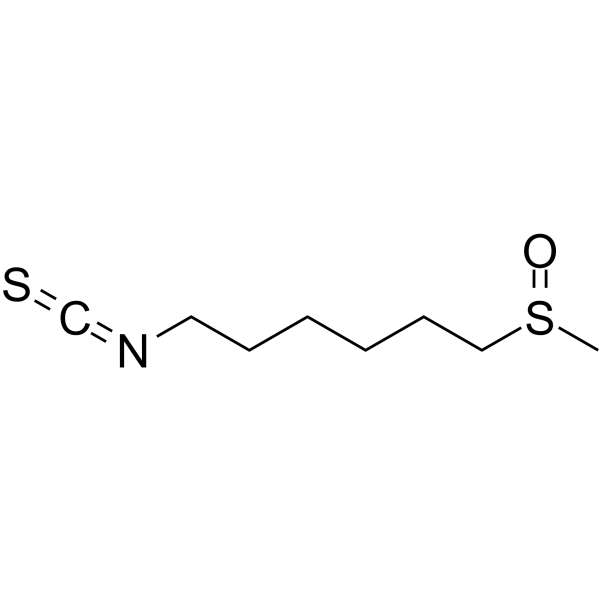
Hesperin is a bioactive ingredient present in Japanese horseradish (wasabi) and has been shown to be an Nrf2 activator.
For research use only. We do not sell to patients.
- Purity: 99.20%
- CAS No.: 4430-35-7
- Formula: C8H15NOS2
- Molecular Weight:205.34
-
Storage:
Solution, -20°C, 2 years


-
 Biological Activity
-
Chemical Information
- Protocol
- Purity & Documentation
- References
-
 Help & FAQs




Biological Activity
Nrf2[1]
|
Cell Line

|
Type | Value | Description | References |
|---|---|---|---|---|
| J774.1 | IC50 |
5.7 μM
Compound: 6-MITC
|
Antiinflammatory activity in mouse J774.1 cells assessed as inhibition of IFN-gamma and LPS-induced nitric oxide production after 20 to 24 hrs by Griess assay
Antiinflammatory activity in mouse J774.1 cells assessed as inhibition of IFN-gamma and LPS-induced nitric oxide production after 20 to 24 hrs by Griess assay
|
[PMID: 19716210] |
| J774.1 | IC50 |
8 μM
Compound: 6-MITC
|
Growth inhibition of mouse J774.1 cells assessed as cell viability after 24 hrs by MTT assay
Growth inhibition of mouse J774.1 cells assessed as cell viability after 24 hrs by MTT assay
|
[PMID: 19716210] |
Hesperin (6-Methylsulfinylhexyl isothiocyanate, 6-MSITC) is an active compound in wasabi (Wasabia japonica Matsum.). Whether Hesperin induces cytotoxicity of HUVECs is determined. More than 1 μg/mL of Hesperin markedly induces cytotoxicity and morphological alterations. In subsequent experiments we used Hesperin is used at concentrations of 0-1 μg/mL, to study the anti-coagulant and anti-inflammatory properties of Hesperin in HUVECs[2].
MedChemExpress (MCE) has not independently confirmed the accuracy of these methods. They are for reference only.
MedChemExpress (MCE) has not independently confirmed the accuracy of these methods. They are for reference only.


Chemical Information
-
CAS No. 4430-35-7
-
Appearance Liquid
-
Molecular Weight 205.34
-
Formula C8H15NOS2
-
Color Colorless to light yellow
-
SMILES
O=S(CCCCCCN=C=S)C
-
Shipping
Room temperature in continental US; may vary elsewhere.
-
Storage
Solution, -20°C, 2 years

Protocol
Primary human umbilical vein endothelial cells (HUVECs) are cultured in collagen-coated tissue-culture dishes in an atmosphere containing 95 % air and 5 % CO2. Human monoblast U937 cells are grown in RPMI-1640 medium with 10 % fetal bovine serum, 10 U/mL Penicillin, and 10μg/mL Streptomycin. HUVECs are cultured in collagen-coated 96-well plates as confluent monolayers. Hesperin is added into wells at the indicated final concentrations (0-30 μg/mL) and then incubated for 24 h. Cell viability is measured by cell counting kits[2].
MedChemExpress (MCE) has not independently confirmed the accuracy of these methods. They are for reference only.
Mice[1] A colony of wild-type and Nrf2-null mice are backcrossed with C57BL/6 mice for ten generations. All mice are housed in the same animal care facility controlled for temperature, humidity, and light. Seven-week-old male wild-typeand Nrf2-null mice (n=6-8/group) are divided into five groups fed the following diets: 1) a standard diet (AIN-93, containing 4% soybean oil) for 12 weeks and vehicle (1:10 solution of DMSO/PBS) injected intraperitoneally 4 times per week for the last four weeks (control group), 2) a high-fat diet (HFD) (containing 4% soybean oil and 31% lard) for 12 weeks and vehicle injected intraperitoneally 4 times per week for the last four weeks (HFD group),3) a HFD for 12 weeks and Hesperin (10mg/Kg/day; dissolved in 1:10 solution of DMSO/PBS) injected intraperitoneally 4 times per week for the last four weeks (HFD+ Hesperin), 4) a HFD for 6 weeks followed by a HFD containing 1% carbonyl iron for 6 weeks and vehicle injected intraperitoneally 4 times per week for the last four weeks(HFD+Iron), and 5) a HFD for 6 weeks followed by a HFD containing 1% carbonyl iron for 6 weeks and Hesperin (10mg/Kg/day) injected intraperitoneally 4 times per week for the last four weeks (HFD+Iron+Hesperin). After 12 weeks, blood samples are collected by cardiac puncture under anesthesia with sodium pentobarbital (50 mg/kg, ip) and livers are harvested and stored at -80°C until analysis[1].
MedChemExpress (MCE) has not independently confirmed the accuracy of these methods. They are for reference only.


Purity & Documentation
-
Data Sheet (269 KB)
-
SDS (393 KB)
- English - EN (393 KB)
- Français - FR (393 KB)
- Deutsch - DE (393 KB)
- Norwegian - NO (393 KB)
- Español - ES (393 KB)
- Swedish - SV (393 KB)
- Italian - IT (393 KB)
- Korean - KR (393 KB)
- Portuguese - PT (393 KB)
-
Handling Instructions (2659 KB)
References
[1]. Tanaka Y, et al. 6-Methylsulfinylhexyl isothiocyanate prevents high-fat diet-induced fatty liver but fails to attenuate hepatic iron accumulation in mice. Clin Exp Pharmacol Physiol. 2016 Nov;43(11):1153-1156. [Content Brief]
[2]. Okamoto T, et al. 6-Methylsulfinylhexyl isothiocyanate modulates endothelial cell function and suppresses leukocyte adhesion. J Nat Med. 2014 Jan;68(1):144-53. [Content Brief]

Calculators
Concentration (start) × Volume (start) = Concentration (final) × Volume (final)


 Powered by Bioz