



INHBE Protein, Human (HEK293, Fc)

Based on 1 Customer Validation
The INHBE protein is an important molecular switch that coordinates the inhibin and activin systems to regulate pituitary follicle-stimulating hormone secretion. Its critical role extends to multiple physiological functions, including hormone secretion, cell development, insulin release, and bone growth. INHBE Protein, Human (HEK293, Fc) is the recombinant human-derived INHBE protein, expressed by HEK293 , with N-hFc labeled tag.
- Species: Human
- Source: HEK293
-
보관:Stored at -20°C for 2 years from date of receipt. After reconstitution, it is stable at 4°C for 1 week or -20°C for longer (with carrier protein). It is recommended to freeze aliquots at -20°C or -80°C for extended storage.


-
 Biological Activity
-
Technical Parameters
-
Product Properties
- 각종 서류
- Help & FAQs



Biological Activity
The INHBE protein is an important molecular switch that coordinates the inhibin and activin systems to regulate pituitary follicle-stimulating hormone secretion. Its critical role extends to multiple physiological functions, including hormone secretion, cell development, insulin release, and bone growth. INHBE Protein, Human (HEK293, Fc) is the recombinant human-derived INHBE protein, expressed by HEK293 , with N-hFc labeled tag.
INHBE protein assumes a pivotal role in the intricate orchestration of the inhibin and activin systems, serving as a molecular switch to either inhibit or activate the secretion of follitropin by the pituitary gland. Within the broader context, inhibins and activins, and by extension, INHBE, contribute to the regulation of a myriad of physiological functions spanning hypothalamic and pituitary hormone secretion, gonadal hormone secretion, germ cell development and maturation, erythroid differentiation, insulin secretion, nerve cell survival, embryonic axial development, and bone growth. The dynamic interplay between inhibins and activins is underscored by their opposing functions, where inhibins, typified by heterodimeric structures like Inhibin A and Inhibin B, counteract the actions of activins. Structurally, INHBE exists in homodimeric or heterodimeric configurations through its association with alpha and beta subunits, intricately linked by one or more disulfide bonds. Notably, inhibins present as heterodimers comprising one alpha and one beta subunit, while activins, whether in homodimeric or heterodimeric form, exclusively consist of beta subunits, exemplifying the nuanced and versatile regulatory roles played by INHBE in shaping diverse physiological responses.

Technical Parameters
-
Species Human
-
Source HEK293
-
Tag N-hFc
-
Accession
P58166 (T237-S350)
-
Molecular Construction
-
N-term
-
hFc
-
INHBE (T237-S350)
Accession # P58166 -
C-term
-
-
Protein Length
Full Length of Mature Protein
-
Synonyms
Inhibin beta E chain; Activin beta-E chain; INHBE
-
AA Sequence
TPTCEPATPLCCRRDHYVDFQELGWRDWILQPEGYQLNYCSGQCPPHLAGSPGIAASFHSAVFSLLKANNPWPASTSCCVPTARRPLSLLYLDHNGNVVKTDVPDMVVEACGCS
-
Predicted Molecular Mass
40.9 kDa
-
분자량
Approximately 43 kDa, based on SDS-PAGE under reducing conditions.
-
Purity
≥ 90%, as determined by reducing SDS-PAGE.
-
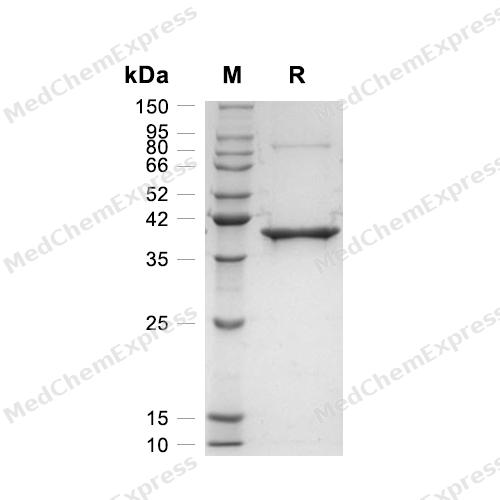 ≥ 90%, as determined by reducing SDS-PAGE.
-

Product Properties
Lyophilized powder
1.Lyophilized from a 0.22 μm filtered solution of 20 mM PB, 150 mM NaCl, pH 7.4.
2.Lyophilized from a 0.22 μm filtered solution of PBS.
3.Lyophilized from a 0.22 μm filtered solution of PBS, pH 7.4, 8% trehalose.
Please refer to the lot-specific COA for specific buffer information.
<1 EU/μg, determined by LAL method.
It is not recommended to reconstitute to a concentration less than 100 μg/mL in ddH2O.
Stored at -20°C for 2 years from date of receipt. After reconstitution, it is stable at 4°C for 1 week or -20°C for longer (with carrier protein). It is recommended to freeze aliquots at -20°C or -80°C for extended storage.
Room temperature in continental US; may vary elsewhere.


각종 서류
-
Data Sheet (236 KB)
-
SDS (252 KB)
- English - EN (252 KB)
- Français - FR (252 KB)
- Deutsch - DE (252 KB)
- Norwegian - NO (252 KB)
- Español - ES (252 KB)
- Swedish - SV (252 KB)
- Italian - IT (252 KB)
- Portuguese - PT (252 KB)
-
Handling Instructions (2659 KB)


Calculators
Concentration (start) × Volume (start) = Concentration (final) × Volume (final)


 Powered by Bioz

