65 Results for "

Silane

" in MedChemExpress (MCE) Product Catalog:
Products (65)

65 Results for "Silane" in MCE Product Catalog:

1
1 Cited Publications
Cat. No.: HY-W036410
CAS No.: 13822-56-5
Synonyms: 3-AminopropyltrimethoxySilane
Aminopropyltrimethoxysilane (APTMS) is a silane coupling agent. Aminopropyltrimethoxysilane couples with Tosylcellulose. Aminopropyltrimethoxysilane improves the thermal stability of the material. Aminopropyltrimethoxysilane can be used in the preparation of GNBP substrates .
Cat. No.: HY-W442186
CAS No.: 1631-82-9
Synonyms: Methyl-phenyl-chloroSilane
Chloro(methyl)(phenyl)silane (Methyl-phenyl-chlorosilane) is a silicon hydride. Chloro(methyl)(phenyl)silane undergoes an addition reaction with long-chain unsaturated fatty acid esters .
Cat. No.: HY-W105426
CAS No.: 2530-85-0
Synonyms: [3-(Methacryloyloxy)propyl]trimethoxySilane
3-(Trimethoxysilyl)propyl methacrylate ([3-(Methacryloyloxy)propyl]trimethoxysilane) is a reactive monomer and silane coupling agent with C=C and O-C=O functional groups, acting as a surface modifier and anti-agglomeration agent. 3-(Trimethoxysilyl)propyl methacrylate can be used to prepare nanoparticles .
Cat. No.: HY-Y0147
CAS No.: 81290-20-2
연구분야:  

Others

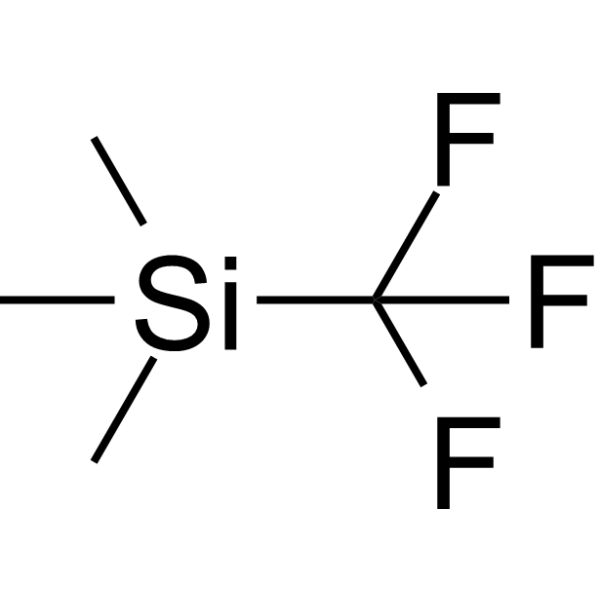
Trimethylsilyl(trifluoromethyl)silane is a biochemical reagent that can be used as a biological material or organic compound for life science related research.
Cat. No.: HY-W008525
CAS No.: 1109-15-5
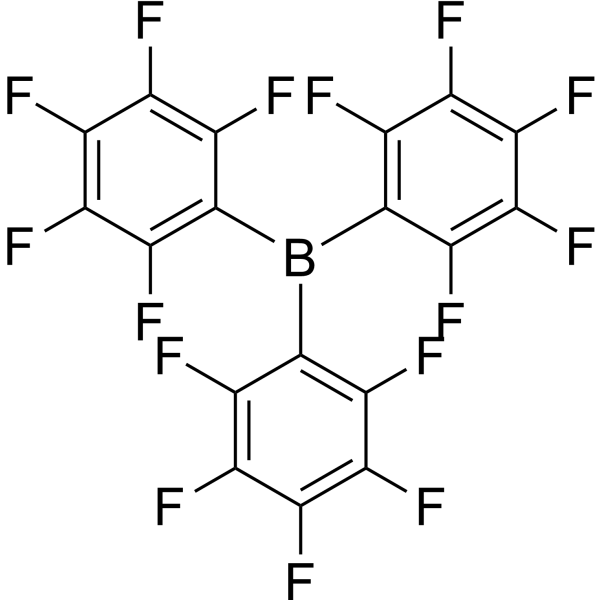
Tris (perfluorophenyl) borane is a biochemical reagent that can be used as a biomaterial or organic compound for life science-related research .
Cat. No.: HY-W102303
CAS No.: 114653-19-9
Target:  

PROTAC Linkers

연구분야:  

Cancer

(E)-tert-Butyldimethyl((3-(4,4,5,5-tetramethyl-1,3,2-dioxaborolan-2-yl)allyl)oxy)silane is a PROTAC linker that can be used in the synthesis of PROTACs.
Cat. No.: HY-W1123939C
Silane-PEG5000-COOH can be used to modify proteins, peptides and other materials with active groups. The carboxyl group (-COOH) can easily form a stable amide bond with the amino group, and can also form an ester bond with the hydroxyl group. Silane-functionalized PEG (Silane-PEG-X) can be used to modify glass, silicon, etc .
Cat. No.: HY-W102301
CAS No.: 480425-30-7
Target:  

PROTAC Linkers

연구분야:  

Cancer

(E)-tert-Butyldimethyl((4-(4,4,5,5-tetramethyl-1,3,2-dioxaborolan-2-yl)but-3-en-1-yl)oxy)silane is a PROTAC linker that can be used in the synthesis of PROTACs.
Cat. No.: HY-91018
CAS No.: 35141-36-7
Synonyms: N-[3-(Trimethoxysilyl)propyl]-N,N,N-trimethylammonium chloride, 50% in methanol
Trimethyl[3-(trimethoxysilyl)propyl]ammonium (N-[3-(Trimethoxysilyl)propyl]-N,N,N-trimethylammonium) chloride (50% in methanol) is a functional organic silane coupling agent and quaternary ammonium salt cationic functional monomer, which can be used for functionalizing mesoporous silica with electrochemical modified electrodes or surface chemical modification .
Cat. No.: HY-174955B
mPEG5000-Silane is a PEG derivative containing silane that can be used to modify glass, silicon or other surfaces by reacting the hydroxyl groups with ethoxy (methoxy) silane .
Cat. No.: HY-174955A
mPEG2000-Silane is a PEG derivative containing silane that can be used to modify glass, silicon or other surfaces by reacting the hydroxyl groups with ethoxy (methoxy) silane .
Cat. No.: HY-174970D
Synonyms: Silane-PEG3400-azide
Silane-PEG3400-N3 (Silane-PEG3400-azide) is a PEG derivative composed of silane, PEG units, and azide groups, which can be used to modify glass, silicon, or other surfaces by reacting hydroxyl groups with ethoxy (methoxy) silanes. Silane-PEG3400-N3 contains an azide group and can undergo copper-catalyzed azide-alkyne cycloaddition (CuAAc) with molecules containing alkyne groups. It can also undergo ring strain-driven alkyne-azide cycloaddition (SPAAC) with molecules containing DBCO or BCN groups .
Cat. No.: HY-W1052262B
Silane-PEG5000-Mal is a PEG derivative that can be used to modify proteins, peptides and other materials. Silane-PEG5000-Mal can be used for peptide modification and drug delivery .
Cat. No.: HY-27980
CAS No.: 152958-91-3
Target:  

Drug Intermediate

연구분야:  

Others

Trimethoxy(4-phenylbutyl)silane is a drug intermediate for synthesis of various active compounds.
Cat. No.: HY-75016
CAS No.: 111594-58-2
Target:  

Drug Intermediate

연구분야:  

Others

Silane,[[(1a,3b,5E,7E,22E)-9,10-secoergosta-5,7,10(19),22-tetraene-1,3-diyl]bis(oxy)]bis[(1,1-dimethylethyl)dimethyl- is a drug intermediate for synthesis of various active compounds.
Cat. No.: HY-W688571
CAS No.: 26115-72-0
연구분야:  

Others

T-02 is an isocyanate silane coupling agent .
Cat. No.: HY-174955
mPEG1000-Silane is a PEG derivative containing silane that can be used to modify glass, silicon or other surfaces by reacting the hydroxyl groups with ethoxy (methoxy) silane .
Cat. No.: HY-174969
Alkyne-PEG1000-Silane is a PEG derivative composed of silane, PEG, and alkynyl groups. Alkyne-PEG1000-Silane is a click chemistry reagent. It contains an Alkyne group, which can undergo copper-catalyzed azide-alkyne cycloaddition reaction (CuAAc) with molecules containing an Azide group. The Silane group enables Alkyne-PEG1000-Silane to modify surfaces such as glass and silicon .
Cat. No.: HY-174970B
Synonyms: Silane-PEG1000-azide
Silane-PEG1000-N3 (Silane-PEG1000-azide) is a PEG derivative composed of silane, PEG units, and azide groups, which can be used to modify glass, silicon, or other surfaces by reacting hydroxyl groups with ethoxy (methoxy) silanes. Silane-PEG1000-N3 contains an azide group and can undergo copper-catalyzed azide-alkyne cycloaddition (CuAAc) with molecules containing alkyne groups. It can also undergo ring strain-driven alkyne-azide cycloaddition (SPAAC) with molecules containing DBCO or BCN groups .
Cat. No.: HY-174970C
Synonyms: Silane-PEG2000-azide
Silane-PEG2000-N3 (Silane-PEG2000-azide) is a PEG derivative composed of silane, PEG units, and azide groups, which can be used to modify glass, silicon, or other surfaces by reacting hydroxyl groups with ethoxy (methoxy) silanes. Silane-PEG2000-N3 contains an azide group and can undergo copper-catalyzed azide-alkyne cycloaddition (CuAAc) with molecules containing alkyne groups. It can also undergo ring strain-driven alkyne-azide cycloaddition (SPAAC) with molecules containing DBCO or BCN groups .

