
15 Results for "

Escherichia coli K-12

" in MedChemExpress (MCE) Product Catalog:
Products (15)

15 Results for "Escherichia coli K-12" in MCE Product Catalog:

1
1 Cited Publications
Art. -Nr.: HY-148983
CAS. Nr.: 7803-49-8
Hydroxylamine (50% w/w in water) is an inorganic highly reactive compound and antibacterial agent. Hydroxylamine (50% w/w in water) acutely activates the transport activity of GLUT1, inhibits Monoamine oxidase activity. Hydroxylamine (50% w/w in water) inhibits nitrite oxidizing bacteria. Hydroxylamine (50% w/w in water) activates glucose uptake. Hydroxylamine (50% w/w in water) can be used in the research of inflammatory diseases and allergies[1][2][3][4] .
Art. -Nr.: HY-W009004
CAS. Nr.: 13184-14-0
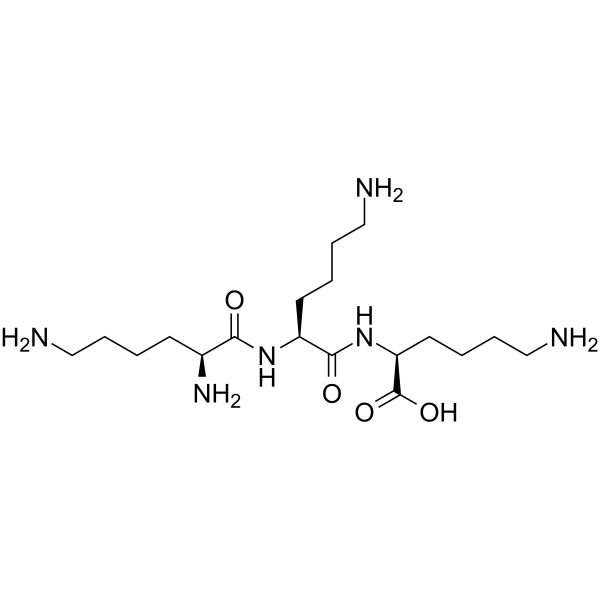
Synonyms: Lys-Lys-Lys; H-Lys-Lys-Lys-OH
Forschungsgebiete:  

Others

Trilysine is a tripeptide and also a substrate for specific peptidases. Trilysine serves as a hydrolytic substrate for the tripeptide-specific aminopeptidase TP and the oligopeptidase OP .
Art. -Nr.: HY-W250308A
Synonyms: Epsilon-polylysine hydrochloride (MV 2000-5000); ε-Polylysine hydrochloride (MV 2000-5000); ε-PL hydrochloride (MV 2000-5000)
ε-Poly-L-lysine (Epsilon-polylysine; ε-Polylysine) hydrochloride (MV 2000-5000) is a polycationic antibacterial agent with broad-spectrum activity against Gram-positive bacteria, Gram-negative bacteria, fungi, yeasts and specific bacteriophages. ε-Poly-L-lysine hydrochloride (MV 2000-5000) exerts bactericidal effects through mechanisms such as disrupting microbial membranes, inducing ROS production, inhibiting metabolism and spore germination. ε-Poly-L-lysine hydrochloride (MV 2000-5000) also regulates the expression of multiple key genes including sodA, oxyR and recA. ε-Poly-L-lysine hydrochloride (MV 2000-5000) exhibits properties such as low eukaryotic cytotoxicity, thermal stability and pH stability, and supports tissue regeneration and anti-tumor applications. ε-Poly-L-lysine hydrochloride (MV 2000-5000) can be applied in research fields including bacterial and fungal infections, diabetic ulcers, and methicillin-resistant Staphylococcus aureus infections .
Art. -Nr.: HY-P2891
CAS. Nr.: 9001-96-1
Synonyms: PoxB
Forschungsgebiete:  

Others

Pyruvate Oxidase, Microorganisms (PoxB) is a peripheral membrane enzyme, isolated from microorganisms. Pyruvate oxidase catalyzes the oxidative decarboxylation of pyruvate to acetyl phosphate, carbon dioxide and water. Pyruvate oxidase is an important enzyme in bacterial metabolism and is often used in biochemical research .
Art. -Nr.: HY-136648B
CAS. Nr.: 54680-12-5
Synonyms: dATP trisodium,100 mM Solution,PCR Grade
2'-Deoxyadenosine-5'-triphosphate (dATP) trisodium, 100 mM Solution, PCR Gradeis one of the raw materials used by DNA polymerase to synthesize long DNA strands during DNA replication. 2'-Deoxyadenosine-5'-triphosphate trisodium,100 mM Solution,PCR Grade is used in reverse transcription polymerase chain reaction (RT-PCR) for DNA amplification. This product is supplied in the form of an aqueous solution .
Art. -Nr.: HY-N10479
CAS. Nr.: 617-12-9
Chorismic acid is a precursor for the biosynthesis of aromatic amino acids and vitamins, as well as a key metabolite in tRNA modification. Chorismic acid is a critical metabolite for the synthesis of cmo 5U. Deficiency of Chorismic acid inhibits the formation of cmo 5U and mcmo 5U. Chorismic acid can be used in studies of S. typhimurium and E. coli infections .\n


Art. -Nr.: HY-P2876
CAS. Nr.: 9024-00-4
Target:  

Bacterial

Forschungsgebiete:  

Others

Tryptophanase is a zymogen-converting enzyme and inducible enzyme that can convert its inactive precursor form into an active enzyme without additional polypeptide synthesis. In Escherichia coli K12, tryptophanase functions as an inducible enzyme, and its induction kinetics are similar to those of β-galactosidase. Tryptophanase catalyzes the conversion of L-tryptophan to indole .
Art. -Nr.: HY-N12320
CAS. Nr.: 1596355-59-7
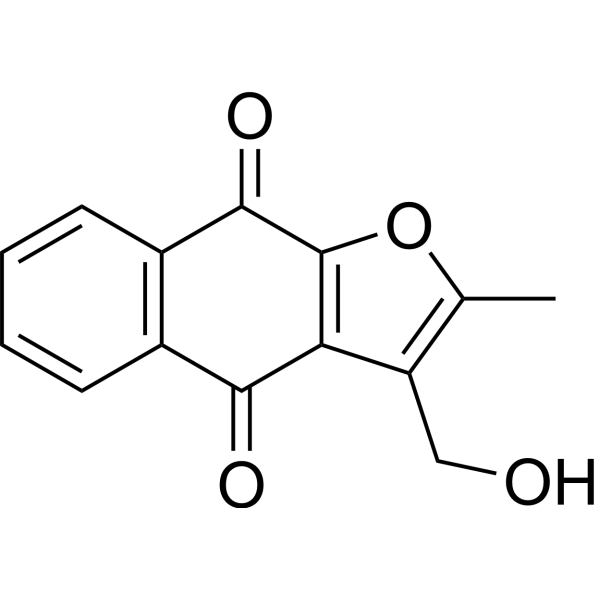
Majoranaquinone exhibits a high antibacterial effect against 4 Staphylococcus, 1 Moraxella, and 1 Enterococcus strains. Majoranaquinone shows substantial efflux pump inhibitory activity in Escherichia coliATCC 25922 strain. Majoranaquinone is found to be an effective biofilm formation inhibitor on E.coli, ATCC 25922 and E. coli K-12 AG100 bacteria .
Art. -Nr.: HY-135599
CAS. Nr.: 25125-92-2
Target:  

Bacterial

Forschungsgebiete:  

Infection

Lysine hydroxamate is an amino acid hydroxamate that inhibits the growth of Escherichia coli K-12. Of the other amino acid hydroxamates tested, only L-lysine hydroxamate reduced the growth rate. The inhibition of growth by L-serine hydroxamate could be rapidly reversed by adding L-serine to the bacterial culture or by removing the analog by filtration. This reversal was specific for L-serine. L-alanine, glycine, or adenine had no effect on the inhibited culture. There was no evidence for active transport of the analog.
Art. -Nr.: HY-144728
Target:  

Bacterial

Forschungsgebiete:  

Infection

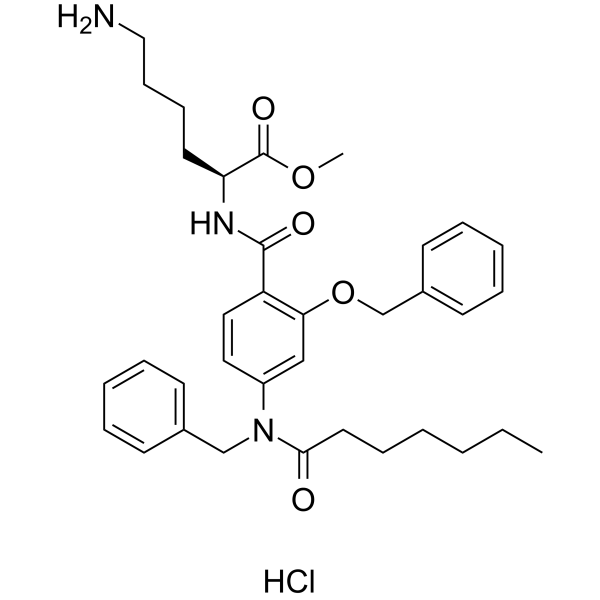
MraY-IN-1 (compound 12a) is a potent  MraY inhibitor with an IC50 value of 140 μM. MraY-IN-1 has antimicrobial activity against Escherichia coli K12, Bacillus subtilis W23 and Pseudomonas fluorescens Pf-5 with MIC50s of 7 µg/mL, 12 µg/mL and 46 µg/mL, respectively. MraY-IN-1 can be used for researching anti-bacteria .
Art. -Nr.: HY-P703455
Reinheit:  ≥ 80%, as determined by reducing SDS-PAGE.
Synonyms: Protein FimG; fimG; Escherichia coli (strain K12)
Species:  
Source:  
Art. -Nr.: HY-W150407
CAS. Nr.: 1653-31-2
Target:  

Endogenous Metabolite

Forschungsgebiete:  

Others

2-Tridecanol is a metabolite that can be found in extra virgin coconut oil, and serves as a growth substrate for Pseudomonas multivorans. 2-Tridecanol can be metabolized by Pseudomonas multivorans and Pseudomonas aeruginosa to produce 2-tridecanone, undecyl acetate, and 1-undecanol, and acts as a metabolic intermediate in their 2-tridecanone catabolic pathway .
Art. -Nr.: HY-P703429
Reinheit:  ≥ 80%, as determined by reducing SDS-PAGE.
Synonyms: Alkaline phosphatase; phoA; Escherichia coli (strain K12); APase; Hydrolase; 3.1.3.1
Species:  
Source:  
Art. -Nr.: HY-181939
Target:  

Bacterial

Forschungsgebiete:  

Infection

Antibacterial agent 329 (Compound 9c) is an antibacterial agent. Antibacterial agent 329 inhibits the activity of MraY. Antibacterial agent 329 exhibits antibacterial activity against Escherichia coli K12 and Bacillus subtilis W23 with a MIC of 16 μg/mL, but shows no activity against Pseudomonas fluorescens Pf-5. Antibacterial agent 329 exerts antibacterial activity against Acinetobacter baumannii 19606, Staphylococcus aureus MRSA USA300 JE2, Enterobacter cloacae 19434, Klebsiella pneumoniae 700603 and Enterococcus faecium 19434, with MIC values of 8, 8, 16-32, 16-32 and 16 μg/mL, respectively, while it shows no activity against Pseudomonas aeruginosa NCTC 13437 .
Art. -Nr.: HY-W083821
CAS. Nr.: 118158-53-5
Synonyms: 1-(4-Nitrobenzyl)-1,4-diazepane
Target:  

Bacterial

Forschungsgebiete:  

Infection

1-[(4-Nitrophenyl) methyl]-1,4-diazepane (1-(4-Nitrobenzyl)-1,4-diazepane) is an anti-biofilm agent. 1-[(4-Nitrophenyl) methyl]-1,4-diazepane reduces biofilm formation in Escherichia coli. 1-[(4-Nitrophenyl) methyl]-1,4-diazepane is used for the research of Escherichia coli biofilm-related infections .
  • 1

