



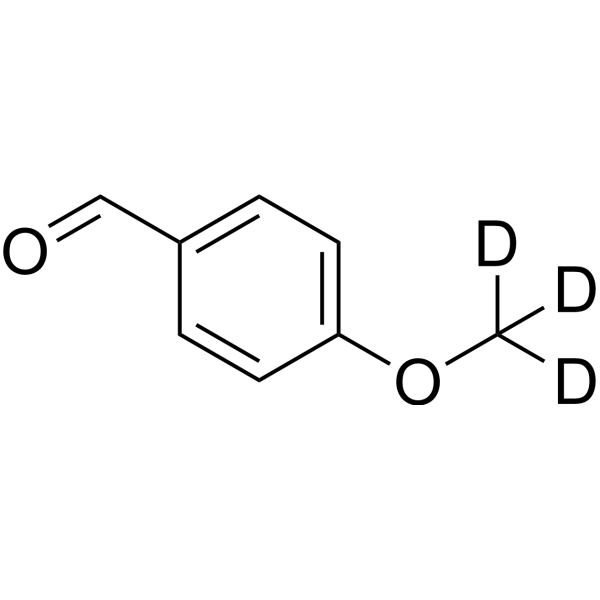
4-Methoxybenzaldehyde-d3
4-Methoxybenzaldehyde-d3 is the deuterium labeled 4-Methoxybenzaldehyde. 4-Methoxybenzaldehyde is a naturally occurring fragrant phenolic compound. 4-Methoxybenzaldehyde has been found in many plant species including horseradish, anise, star anise. 4-Methoxybenzaldehyde is a possible neurotoxicant and it has shown effects that include mortality, attractancy, and interference with host seeking.
Nos produits utilisent uniquement pour la recherche. Nous ne vendons pas aux patients.
- CAS No.: 342611-04-5
- Formule: C8H5D3O2
- Masse moléculaire:139.17
-
Stockage:
Please store the product under the recommended conditions in the Certificate of Analysis.

To place orders, for customer services and technical support, please contact: MedChemExpress USA
Tel: 609-228-6898 E-mail: [email protected] [email protected]


-
 Activité biologique
-
Chemical Information
- Pureté et documentation
- Références
-
 Help & FAQs


Voir tous les produits spécifiques à Isoform Endogenous Metabolite
More

Activité biologique
Stable heavy isotopes of hydrogen, carbon, and other elements have been incorporated into drug molecules, largely as tracers for quantitation during the drug development process. Deuteration has gained attention because of its potential to affect the pharmacokinetic and metabolic profiles of drugs[1].
MedChemExpress (MCE) has not independently confirmed the accuracy of these methods. They are for reference only.
1. This compound can be used as a tracer
2. This compound can be used as an internal standard for quantitative analysis by NMR, GC-MS, or LC-MS.


Chemical Information
-
CAS No. 342611-04-5
-
Masse moléculaire 139.17
-
Formule C8H5D3O2
-
SMILES
O=CC1=CC=C(C=C1)OC([2H])([2H])[2H]
-
Livraison
Room temperature in continental US; may vary elsewhere.
-
Stockage
Please store the product under the recommended conditions in the Certificate of Analysis.


Pureté et documentation
Références
[1]. Russak EM, et al. Impact of Deuterium Substitution on the Pharmacokinetics of Pharmaceuticals. Ann Pharmacother. 2019 Feb;53(2):211-216. [Content Brief]
[2]. Showler AT , et al. Effects of the Botanical Compound p-Anisaldehyde on Horn Fly (Diptera: Muscidae) Repellency, Mortality, and Reproduction. J Med Entomol. 2018 Jan 10;55(1):183-192. [Content Brief]

Calculators
Concentration (start) × Volume (start) = Concentration (final) × Volume (final)


4-Methoxybenzaldehyde-d3 Related Classifications
HY-Y0740S1 Related Classifications
 Powered by Bioz