
32 Results for "

Cellobiose

" in MedChemExpress (MCE) Product Catalog:
Products (32)

32 Results for "Cellobiose" in MCE Product Catalog:

Cat. No.: HY-N2325
CAS No.: 528-50-7
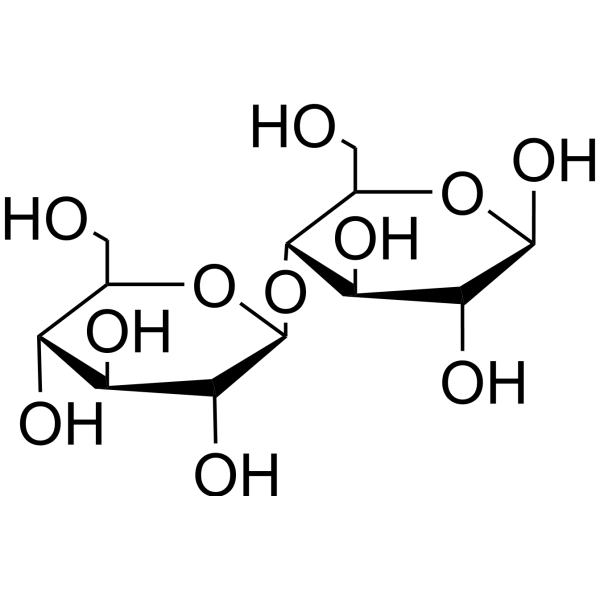
D-(+)-Cellobiose is a water-soluble disaccharide and an important intermediate product in the degradation process of cellulose and hemicellulose. D-(+)-cellobiose is used as a carbon source by microorganisms in fermentation processes, where it is converted into ethanol or other metabolic products. D-(+)-Cellobiose has significant application value in biofuel production, such as bioethanol .
Cat. No.: HY-N2325R
CAS No.: 528-50-7
D-(+)-Cellobiose (Standard) is the analytical standard of D-(+)-Cellobiose. This product is intended for research and analytical applications. D-(+)-Cellobiose is an endogenous metabolite.
Cat. No.: HY-W768206
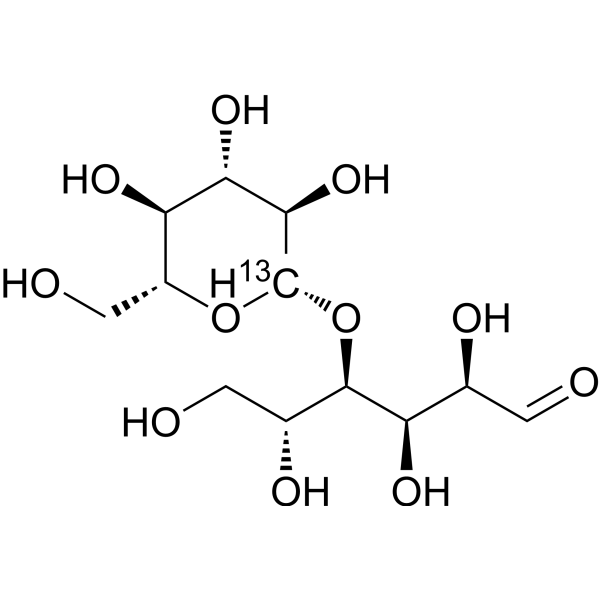
D-Cellobiose- 13C12 is the 13C-labeled
Cat. No.: HY-E70022
CAS No.: 9031-25-8
Target:  

Others

Research Areas:  

Others

D-Mannose isomerase (PsMaSeAF) is a carbohydrate isomerase catalyzing the reversible isomerization of d-mannose to d-fructose. D-Mannose isomerase (PsMaSeAF) belongs to the N-acylglucosamine 2-epimerase (AGE) superfamily along with AGE, cellobiose 2-epimerase (CE), and aldose-ketose isomerase (AKI) .
Cat. No.: HY-N2325S
CAS No.: 2460737-42-0
D-(+)-Cellobiose- 13C is the 13C labeled D-(+)-Cellobiose. D-(+)-Cellobiose is an endogenous metabolite .
Cat. No.: HY-W013696
CAS No.: 5346-90-7
Synonyms: alpha-D-Cellobiose octaacetate, 98%
α-D-Cellobiose octaacetate is used as a substrate for glycosidases and in glycobiology research.
Cat. No.: HY-W739883
CAS No.: 122147-95-9
4-Methylumbelliferyl-β-D-cellobiose heptaacetate is a kind of biochemical reagent.
Cat. No.: HY-W040094
CAS No.: 35405-71-1
Synonyms: 1,6-Anhydro-β-Cellobiose
Target:  

Endogenous Metabolite

Research Areas:  

Others

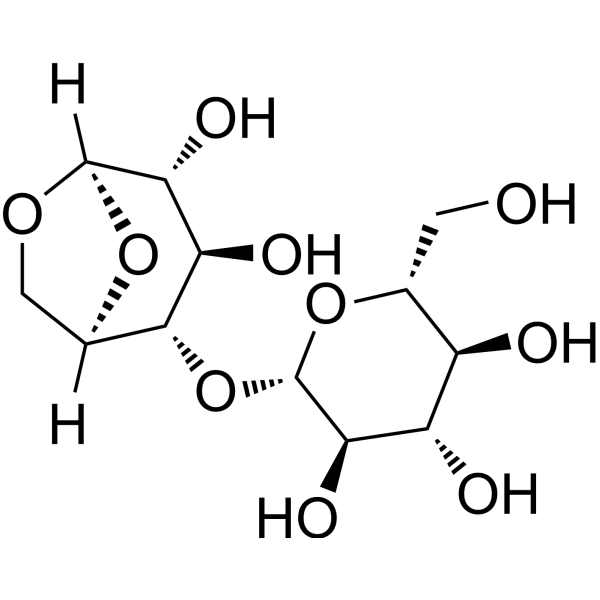
Cellobiosan is an anhydrosugar, which is produced from burning of biomass .
Cat. No.: HY-E70107
CAS No.: 37329-65-0
Synonyms: Cbh1
Target:  

Others

Research Areas:  

Others

Cellobiohydrolase I, Trichoderma longibrachiatum (Cbh1) belongs to glycoside hydrolase family 7 (GH7) that catalyzes the processive hydrolysis of cellulose into cellobiose .
Cat. No.: HY-164752
CAS No.: 52301-43-6
Target:  

Fungal

6-hydroxy-FAD is the dominant cofactor of H. insolens Cellobiose dehydrogenases. the activity of Cellobiose dehydrogenases containing 6-hydroxy-FAD is lower than that of the enzyme reconstituted with normal FAD .
Cat. No.: HY-E70889
Target:  

Glycosidase

Research Areas:  

Others

β-Xylosidase (thermostable) can release reducing sugars from birch xylan and catalyze the hydrolysis of 4-methylumbelliferone-β-D-cellobiose and 4-methylumbelliferone-β-D-glucopyranoside. β-Xylosidase does not possess endoxylanase, arabinoxylanase, or β-glucanase activity. β-Xylosidase undergoes post-translational glycosylation modification.
Cat. No.: HY-E70889A
Target:  

Glycosidase

Research Areas:  

Others

β-Xylosidase, Opitutus terrae (EC 3.2.1.37) can release reducing sugars from birch xylan and catalyze the hydrolysis of 4-methylumbelliferone-β-D-cellobiose and 4-methylumbelliferone-β-D-glucopyranoside. β-Xylosidase does not possess endoxylanase, arabinoxylanase, or β-glucanase activity. β-Xylosidase undergoes post-translational glycosylation modification.
Cat. No.: HY-E70889B
Target:  

Glycosidase

Research Areas:  

Others

β-Xylosidase, Lactobacillus brevis (EC 3.2.1.37) can release reducing sugars from birch xylan and catalyze the hydrolysis of 4-methylumbelliferone-β-D-cellobiose and 4-methylumbelliferone-β-D-glucopyranoside. β-Xylosidase does not possess endoxylanase, arabinoxylanase, or β-glucanase activity. β-Xylosidase undergoes post-translational glycosylation modification.
Cat. No.: HY-E70889C
Target:  

Glycosidase

Research Areas:  

Others

β-Xylosidase, Bacillus subtilis (EC 3.2.1.37) can release reducing sugars from birch xylan and catalyze the hydrolysis of 4-methylumbelliferone-β-D-cellobiose and 4-methylumbelliferone-β-D-glucopyranoside. β-Xylosidase does not possess endoxylanase, arabinoxylanase, or β-glucanase activity. β-Xylosidase undergoes post-translational glycosylation modification.
Cat. No.: HY-E71207
Research Areas:  

Others

α,α-Trehalose synthase (EC 2.4.1.245) requires Mg2+ for maximal activity. The enzyme-catalysed reaction is reversible. In the reverse direction to that shown above, α,α-Trehalose synthase (EC 2.4.1.245) is specific for α,α-Trehalose as substrate, as it cannot use α-or β-paranitrophenyl glucosides, maltose, sucrose, lactose or cellobiose.
Cat. No.: HY-P2775A
Target:  

Glycosidase

Research Areas:  

Metabolic Disease

β-Glucosidase(thermostable) is a glucosidase enzyme located in on the brush border of the small intestine that acts upon β1->4 bonds linking two glucose or glucose-substituted molecules (i.e., the disaccharide cellobiose). β-Glucosidase(thermostable) is an exocellulase with specificity for a variety of beta-D-glycoside substrates. It catalyzes the hydrolysis of terminal non-reducing residues in beta-D-glucosides with release of glucose.
Cat. No.: HY-P2763A
Target:  

Glycosidase

Research Areas:  

Metabolic Disease

β-Glucanase 2(thermostable) is a glucosidase enzyme located in on the brush border of the small intestine that acts upon β1->4 bonds linking two glucose or glucose-substituted molecules (i.e., the disaccharide cellobiose). β-Glucanase 2 (thermostable) is an exocellulase with specificity for a variety of beta-D-glycoside substrates. It catalyzes the hydrolysis of terminal non-reducing residues in beta-D-glucosides with release of glucose.
Cat. No.: HY-P2763B
Target:  

Glycosidase

Research Areas:  

Metabolic Disease

β-Glucanase 1(thermostable) is a glucosidase enzyme located in on the brush border of the small intestine that acts upon β1->4 bonds linking two glucose or glucose-substituted molecules (i.e., the disaccharide cellobiose). β-Glucanase 1 (thermostable) is an exocellulase with specificity for a variety of beta-D-glycoside substrates. It catalyzes the hydrolysis of terminal non-reducing residues in beta-D-glucosides with release of glucose.
Cat. No.: HY-P2775B
Target:  

Glycosidase

Research Areas:  

Metabolic Disease

β-Glucosidase, Rhizobium etli (EC 3.2.1.21), is a glucosidase that acts on the β1→4 glycosidic bond connecting two glucose molecules or glucose-substituted molecules (e.g., disaccharide cellobiose). β-Glucosidase is an exonuclease specific for a variety of β-D-glycosidic substrates. β-Glucosidase catalyzes the hydrolysis of the terminal non-reducing residues of β-D-glucosides, releasing glucose.
Cat. No.: HY-P2775C
Target:  

Glycosidase

Research Areas:  

Metabolic Disease

β-Glucosidase, Clostridium thermocellum (EC 3.2.1.21), is a glucosidase that acts on the β1→4 glycosidic bond connecting two glucose molecules or glucose-substituted molecules (e.g., disaccharide cellobiose). β-Glucosidase is an exonuclease specific for a variety of β-D-glycosidic substrates. β-Glucosidase catalyzes the hydrolysis of the terminal non-reducing residues of β-D-glucosides, releasing glucose.

