



Polyquaternium-1
Based on 1 publication(s) in Google Scholar
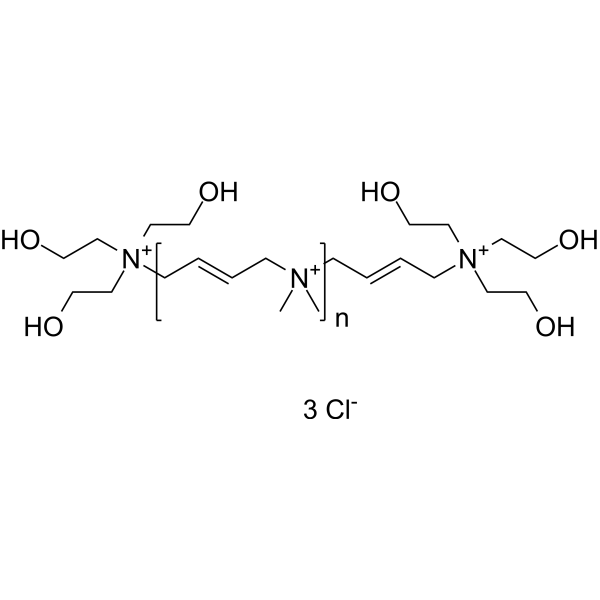
Polyquaternium-1 (Polidronium chloride; PQ-1) is an antimicrobial preservative and an activator of NF-κB. Polyquaternium-1 targets bacterial cell membranes, commonly used in ophthalmic surgery. Polyquaternium-1 adsorbs to the surface of microbial membranes through its polycationic properties, destroying membrane integrity and inducing potassium ion leakage, leading to bacterial death. Polyquaternium-1 exerts antimicrobial effects at a concentration of 0.001% and has low toxicity to mammalian cells. Polyquaternium-1 can be used to prepare products such as glaucoma eye drops (Travoprost preparations containing PQ-1), artificial tears, and contact lens solutions to reduce the ocular surface toxicity of traditional preservatives such as benzalkonium chloride (HY-B2232).
For research use only. We do not sell to patients.
- Purity: 98.6%
- CAS No.: 75345-27-6
- Formula: C22H48Cl3N3O6
-
Storage:
4°C, sealed storage, away from moisture
* In solvent : -80°C, 6 months; -20°C, 1 month (sealed storage, away from moisture)


-
 Biological Activity
-
Chemical Information
-
Solvent & Solubility
- Purity & Documentation
- References
-
 Help & FAQs


Publications Citing Use of MedChemExpress (MCE) Polyquaternium-1
More

Biological Activity
1. Cytotoxicity and inflammatory response:
Polyquaternium-1 (0.001%; 5-30 min + 24 h recovery) activates the NF-κB-related inflammatory pathway and reduces cell viability in HCE-2 human corneal epithelial cells (by about 50%), while 0.02% BAK (HY-B2232) induces all cell death. Polyquaternium-1 increases LDH release and activates the NF-κB pathway, enhances IL-6 and IL-8 secretion[1].
2. Comparison of preservative toxicity:
Compared with 0.015-0.02% BAK (HY-B2232), Polyquaternium-1 (0.001%; 25 min-2 h) has lower cytotoxicity in human corneal and conjunctival cells and does not cause significant cell damage or eye irritation[2].
MedChemExpress (MCE) has not independently confirmed the accuracy of these methods. They are for reference only.
-
Cell Line:HCE-2 human corneal epithelial cells
-
Concentration:0.001%
-
Incubation Time:5, 15, 30 min exposure + 24 h recovery for viability; 6 h for NF-κB assay
-
Result:Showed 50% viability reduction at 30 min exposure, with LDH release increased 6-fold compared to control.
Moderately elevated Caspase-3 activity (1.5-fold) after 15 min exposure, but without statistically significant.
Increased IL-6 and IL-8 levels by 3-8-fold and 1.5-3.5-fold, respectively, with NF-κB DNA binding significantly upregulated in nuclear extracts after 30 min exposure.
Compared with 0.02% BAK (HY-B2232), Polyquaternium-1 (0.001%; single topical application; maintained for 24 h) has no significant effect on corneal transepithelial electrical resistance (TER) in the New Zealand white rabbit corneal model, and the corneal epithelial cells has normal morphology and intact microvilli, without inducing obvious inflammation or cell damage[3].
2. Rabbit eye long-term toxicity test:
Compared with BAK (HY-B2232), Polyquaternium-1 (0.001%; single topical application; once a day; 30 days) has no significant effect on conjunctival goblet cell density in the Japanese white rabbit model, but reduces corneal fluorescein staining scores and prolongs tear film break-up time (TFBUT)[3].
MedChemExpress (MCE) has not independently confirmed the accuracy of these methods. They are for reference only.
-
Animal Model:New Zealand White rabbits (male, 2.5-3.0 kg, 6-8 weeks old) with ex vivo corneal TER measurement and SEM analysis[3]
-
Dosage:0.001%, in Travoprost/timolol solution (aqueous gel).
-
Administration:Topical application (1 mL), single 60-second exposure followed by 24 h recovery.
-
Result:Preserved corneal TER at 82.2% of baseline, comparable to HBSS control (101.3%), while 0.02% BAK in latanoprost/timolol reduced TER to 15.6%.
Reminded normal superficial corneal cells with intact microvilli in SEM results, whereas BAK group showed damaged cells with degenerated microvilli.
-
Animal Model:Japanese white rabbits (3.0-4.0 kg) with chronic topical dosing[3]
-
Dosage:0.001%, in artificial tears or glaucoma formulations (aqueous solution).
-
Administration:Daily instillation for 30 days, 1 drop/eye, once daily.
-
Result:Preserved goblet cell density (18.8 cells/0.01 mm2) similar to control (21.6 cells), while 0.1% BAK reduced density to 6.0 cells.
Decreased corneal fluorescein staining scores from 4.93 to 3.27, and increased TFBUT from 6.74 to 8.92 seconds, indicating improved tear film stability.
| NCT Number | Sponsor | Condition | Start Date |
Phase

|
|---|---|---|---|---|
| NCT01329991 | Plexxikon| | 2011-05 | PHASE1 |


Chemical Information
-
CAS No. 75345-27-6
-
Appearance Solid
-
Formula C22H48Cl3N3O6
-
Color Off-white to light yellow
-
SMILES
OCC[N+](CCO)(C/C=C/C[N+](C)(C/C=C/C[N+](CCO)(CCO)CCO)C)CCO.[3 Cl-].[n]
-
Synonyms
Polidronium chloride
-
Shipping
Room temperature in continental US; may vary elsewhere.
-
Storage
4°C, sealed storage, away from moisture
* In solvent : -80°C, 6 months; -20°C, 1 month (sealed storage, away from moisture)


Publications (1)
-
Journal Impact Factor
-
Most Recent
-
Am J Ophthalmol
In Vitro Study of Microbial Growth in Artificial Tears Using a Novel Kinetic and Culture-Based Model. [Abstract]2026 Jul:287:270-284. PMID: 41956347


Solvent & Solubility
H2O : 50 mg/mL (Need ultrasonic)


Purity & Documentation
-
Data Sheet (275 KB)
-
SDS (394 KB)
- English - EN (394 KB)
- Français - FR (394 KB)
- Deutsch - DE (394 KB)
- Norwegian - NO (394 KB)
- Español - ES (394 KB)
- Swedish - SV (394 KB)
- Italian - IT (394 KB)
- Portuguese - PT (394 KB)
-
Handling Instructions (2659 KB)
References
[1]. Paimela T, et al. The preservative polyquaternium-1 increases cytoxicity and NF-kappaB linked inflammation in human corneal epithelial cells. Mol Vis. 2012;18:1189-96. Epub 2012 May 6. [Content Brief]
[2]. Rolando M, et, al. Ophthalmic preservatives: focus on polyquaternium-1. Expert Opin Drug Deliv. 2011 Nov;8(11):1425-38. [Content Brief]
[3]. Mohamed YH, et al. Acute Corneal Toxicity of Combined Antiglaucoma Topical Eyedrops. Curr Eye Res. 2016 Oct;41(10):1326-1330. [Content Brief]

Calculators
Concentration (start) × Volume (start) = Concentration (final) × Volume (final)


 Powered by Bioz