



Glycol chitosan
Based on 3 publication(s) in Google Scholar
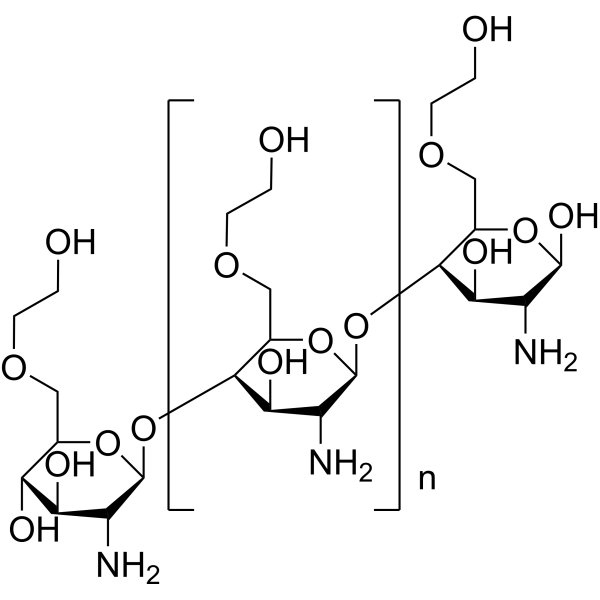
Glycol chitosan is a chitosan derivative with ethylene glycol branches. Glycol chitosan enhances membrane permeability and leadkage in Glycine max Harosoy 63W cells. Glycol chitosan is biocompatible and biodegradable. Glycol chitosan inhibits E. coli, S. aureus and S. enteritidis growths with MIC values of 4 μg/mL, 32 μg/mL and <0.5 μg/mL, respectively.
연구목적의 판매만을 진행합니다. 환자를 대상으로 한 판매는 하지 않습니다.
- Purity: 61.22%
- CAS No.: 123938-86-3
- 분자량:82685.58
-
보관:Powder -20°C, 3 years ; In solvent -80°C, 6 months , -20°C, 1 month


-
 Biological Activity
-
Chemical Information
-
용액&용해도
- 순도&문서
- References
-
 Help & FAQs



Publications Citing Use of MedChemExpress (MCE) Glycol chitosan
More Customer Validation & Images

-
Bio/Physico-chemical Assay


Biological Activity
MIC: 4 μg/mL (E. coli), 32 μg/mL (S. aureus) and <0.5 μg/mL (S. enteritidis)[4]
Glycol chitosan derivatives have been successfully applied to deliver antimicrobial agents and anticancer drugs such as chemodrugs, genes, and photosensitizers (PSs), either by physical encapsulation or chemical conjugation. Glycol chitosan can be directly linked with hydrophobic drugs to generate amphiphilic compounds that can also form nanoparticles (NPs) for cell imaging and drug delivery. The use of Glycol chitosan derivatives for cell imaging and drug delivery has several advantages, including superb tumor-homing ability in the case of Glycol chitosan NPs based on enhanced permeability and retention (EPR) effect, low cytotoxicity, ease of chemical modification, great biocompatibility, and biodegradability[1].
The hydrophobic modification of Glycol chitosan is already confirmed, such as Glycol chitosan bearing a 5β-cholanic acid moiety and deoxycholic acid-Glycol chitosan, could self-assemble into nanoparticles, acting as a promising vehicle for hydrophobic drugs and genes[2].
MedChemExpress (MCE) has not independently confirmed the accuracy of these methods. They are for reference only.


Chemical Information
-
CAS No. 123938-86-3
-
Appearance Solid
-
분자량 82685.58
-
Color Off-white to light yellow
-
SMILES
N[C@@H]1[C@@H](O)[C@H](O)[C@@H](COCCO)O[C@H]1O[C@@H]2[C@@H](COCCO)O[C@@H](O[C@@H]3[C@@H](COCCO)O[C@@H](O)[C@H](N)[C@H]3O)[C@H](N)[C@H]2O.[n]
-
선적
Room temperature in continental US; may vary elsewhere.
-
보관
Powder -20°C 3 years In solvent -80°C 6 months -20°C 1 month


Publications (3)
-
Journal Impact Factor
-
Most Recent
-
Biomater Res
Enhanced Postsurgical Cancer Treatment Using Methacrylated Glycol Chitosan Hydrogel for Sustained DNA/Doxorubicin Delivery and Immunotherapy. [Abstract]2024 Mar 23:28:0008. PMID: 38532906
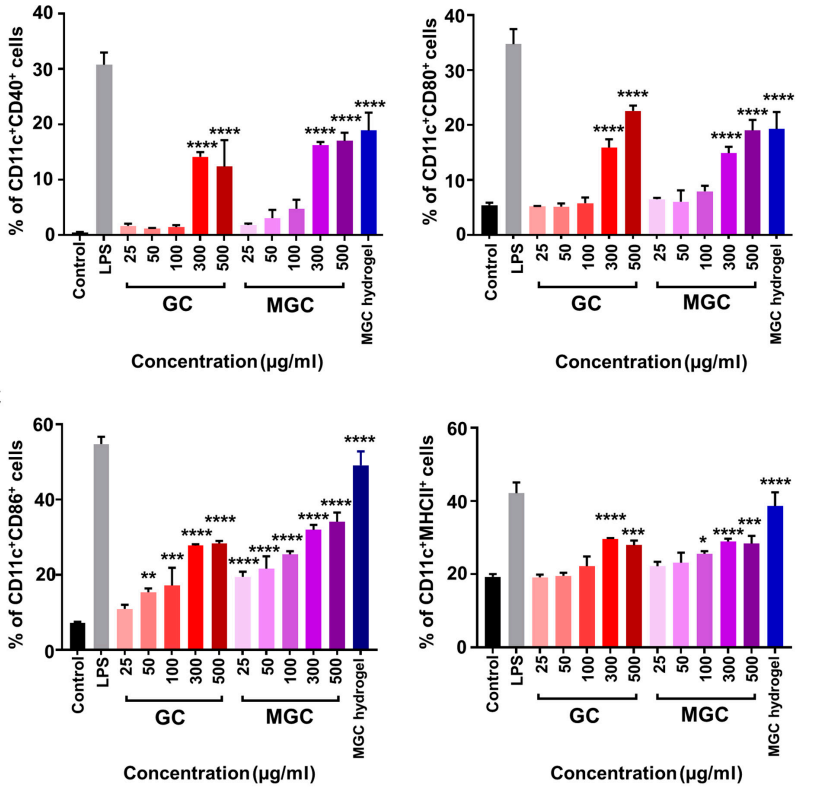
Glycol chitosan purchased from MedChemExpress. Usage Cited in: Biomater Res. 2024 Mar 23:28:0008. [Abstract]
Adjuvant potency of Glycol chitosan (GC), MGC and MGC hydrogel and biocompatibility of MGC and MGC hydrogel. The percentage of CD40+, CD80+, CD86+ and MHCII+ DCs.
-
Int J Biol Macromol
Mucoadhesive chitosan-poly (lactic-co-glycolic acid) nanoparticles for intranasal delivery of quetiapine - Development & characterization in physiologically relevant 3D tissue models. [Abstract]2024 May;267(Pt 2):131491. PMID: 38599435 -
Int J Pharm
A Nanoemulgel for Nose-to-Brain Delivery of Quetiapine - QbD-Enabled Formulation Development &In-vitro Characterization. [Abstract]2023 Dec 15:648:123566. PMID: 37918496


용액&용해도
DMSO : 50 mg/mL (0.60 mM; Need ultrasonic; Hygroscopic DMSO has a significant impact on the solubility of product, please use newly opened DMSO)
H2O : 7.5 mg/mL (0.09 mM; Need ultrasonic)
Select the appropriate dissolution method based on your experimental animal and administration route.
- For the following dissolution methods, please ensure to first prepare a clear stock solution using an In Vitro approach and then sequentially add co-solvents:
- To ensure reliable experimental results, the clarified stock solution can be appropriately stored based on storage conditions. As for the working solution for In Vivo experiments, it is recommended to prepare freshly and use it on the same day.
- The percentages shown for the solvents indicate their volumetric ratio in the final prepared solution. If precipitation or phase separation occurs during preparation, heat and/or sonication can be used to aid dissolution.
Add each solvent one by one: 10% DMSO 40% PEG300 5% Tween-80 45% Saline
Solubility: ≥ 2.5 mg/mL (0.03 mM); Clear solution
This protocol yields a clear solution of ≥ 2.5 mg/mL (saturation unknown).
Taking 1 mL working solution as an example, add 100 μL DMSO stock solution (25.0 mg/mL) to 400 μL PEG300, and mix evenly; then add 50 μL Tween-80 and mix evenly; then add 450 μL Saline to adjust the volume to 1 mL.
Preparation of Saline: Dissolve 0.9 g sodium chloride in ddH₂O and dilute to 100 mL to obtain a clear Saline solution.
Add each solvent one by one: 10% DMSO 90% (20% SBE-β-CD in Saline)
Solubility: ≥ 2.5 mg/mL (0.03 mM); Clear solution
This protocol yields a clear solution of ≥ 2.5 mg/mL (saturation unknown).
Taking 1 mL working solution as an example, add 100 μL DMSO stock solution (25.0 mg/mL) to 900 μL 20% SBE-β-CD in Saline, and mix evenly.
Preparation of 20% SBE-β-CD in Saline (4°C, storage for one week): 2 g SBE-β-CD powder is dissolved in 10 mL Saline, completely dissolve until clear.
For the following dissolution methods, please prepare the working solution directly:
It is recommended to prepare fresh solutions and use them promptly within a short period of time.
The percentages shown for the solvents indicate their volumetric ratio in the final prepared solution. If precipitation or phase separation occurs during preparation, heat and/or sonication can be used to aid dissolution.
Add each solvent one by one: PBS
Solubility: 50 mg/mL (0.60 mM); Clear solution; Need ultrasonic
Please enter the basic information of animal experiments:
-
-
-
-
Recommended: Prepare an additional quantity of animals to account for potential losses during experiments.
Please enter your animal formula composition:
-
%DMSO +
Recommended: Keep the proportion of DMSO in working solution below 2% if your animal is weak.
-
%+
-
+%Tween-80 + +
-
%Saline +
The co-solvents required include: DMSO, . All of co-solvents are available by MedChemExpress (MCE). , Tween 80. All of co-solvents are available by MedChemExpress (MCE).
Working solution concentration: 0.22 mg/mL
Method for preparing stock solution: mg drug dissolved in μL DMSO. Stock solution concentration: mg/mL.
1. Take μL DMSO stock solution;
2. Add μL .
μL , mix evenly;
3. Then add μL Tween 80, mix evenly;
4. Then add μL
Please ensure that the stock solution in the first step is dissolved to a clear state, and add co-solvents in sequence. You can use ultrasonic heating (ultrasonic cleaner, recommended frequency 20-40 kHz), vortexing, etc. to assist dissolution.


순도&문서
-
Data Sheet (281 KB)
-
SDS (251 KB)
- English - EN (251 KB)
- Français - FR (251 KB)
- Deutsch - DE (251 KB)
- Norwegian - NO (251 KB)
- Español - ES (251 KB)
- Swedish - SV (251 KB)
- Italian - IT (251 KB)
- Portuguese - PT (251 KB)
-
Handling Instructions (2659 KB)
References
[1]. Lin F, et al. Glycol Chitosan: A Water-Soluble Polymer for Cell Imaging and Drug Delivery. Molecules. 2019 Nov 29;24(23). pii: E4371. [Content Brief]
[2]. Yu A, et al. Mucoadhesive dexamethasone-glycol chitosan nanoparticles for ophthalmic drug delivery. Int J Pharm. 2020 Feb 15;575:118943. [Content Brief]
[3]. Young DH, et al. Effect of Chitosan on Membrane Permeability of Suspension-Cultured Glycine max and Phaseolus vulgaris Cells. Plant Physiol. 1982 Nov;70(5):1449-54. [Content Brief]
[4]. Stephen Inbaraj B, et al.Synthesis, characterization and antibacterial activity of superparamagnetic nanoparticles modified with glycol chitosan.Sci Technol Adv Mater. 2012 Feb 2;13(1):015002. [Content Brief]

Calculators
Concentration (start) × Volume (start) = Concentration (final) × Volume (final)


 Powered by Bioz