



Cy2

Based on 1 Customer Validation
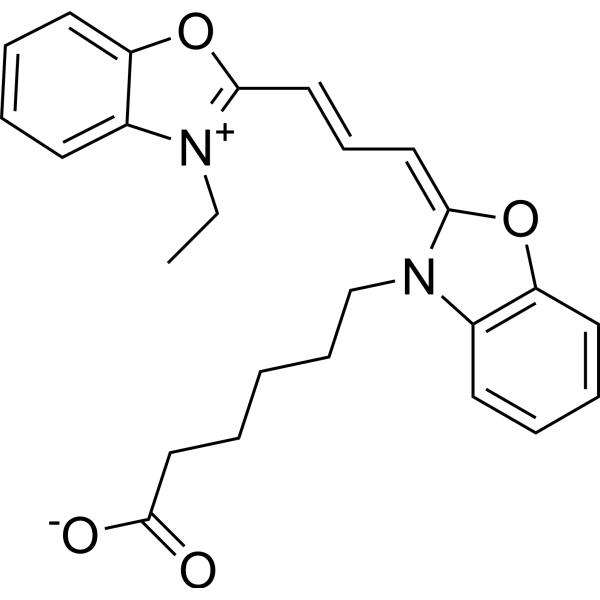
Cyanines are formally compounds with two nitrogen atoms linked by an odd number of methene units. 26 28 The nitrogen atoms are parts of the heterocyclic units (such as indole, benzoxazol, or benzothiazol) . The structures and optical properties of representative cyanine dyes used for in vivo imaging are presented. Cyanines are characterized by long wavelength, tunable absorption and emission, very high extinction coefficient (up to 300,000 M 1 cm 1), good water solubility, and relatively straightforward synthesis.
Nos produits utilisent uniquement pour la recherche. Nous ne vendons pas aux patients.
- Pureté : 98.0%
- CAS No.: 260430-02-2
- Formule: C25H26N2O4
- Masse moléculaire:418.49
-
Stockage:
-20°C, protect from light
* In solvent : -80°C, 6 months; -20°C, 1 month (protect from light)

To place orders, for customer services and technical support, please contact: MedChemExpress USA
Tel: 609-228-6898 E-mail: [email protected] [email protected]


-
 Activité biologique
-
Chemical Information
-
Solvant et solubilité
- Protocole
- Pureté et documentation
- Références
-
 Help & FAQs




Activité biologique
Description
In Vitro
Guide (The following is our recommended protocol. This protocol is only a guide and should be modified according to your specific needs).
1. Protein Preparation
To obtain the best labeling effect, please prepare the protein (antibody) concentration to 2 mg/mL.
1.1 The pH value of the protein solution should be 8.5 ± 0.5. If the pH is lower than 8.0, adjust it with 1 M sodium bicarbonate.
1.2 If the protein concentration is lower than 2 mg/mL, the labeling efficiency will be greatly reduced. To obtain the best labeling efficiency, it is recommended that the final protein concentration range be 2-10 mg/mL.
1.3 The protein must be in a buffer free of primary amines (such as Tris or glycine) and ammonium ions, otherwise the labeling efficiency will be affected.
2. Dye Preparation
Dilute the dye with anhydrous DMSO to prepare a clear stock solution of 10 mg/mL.
Note: Before use, it must be activated with condensation solution (500 μg/mL) (HY-D0178) before subsequent labeling experiments can be performed.
3. Calculation of Dye Amount
The amount of dye required for the reaction depends on the amount of protein to be labeled. The optimal molar ratio of dye to protein is approximately 10:1.
Example: Assuming the required labeled protein is 500 μL 2 mg/mL IgG (MW=150,000), and 1 mg of dye is dissolved in 100 μL DMSO, the required dye volume is 2.8 μL. The detailed calculation process is as follows:
1) mmol (IgG) = mg/mL (IgG) × mL (IgG)/MW (IgG) = 2 mg/mL × 0.5 mL/150,000 mg/mmol = 6.7 × 10⁻⁶ mmol
2) mmol (dye) = mmol (IgG) × 10 = 6.7 × 10⁻⁶ mmol × 10 = 6.7 × 10⁻⁵ mmol
3) μL (dye) = mmol (dye) × MW (dye)/mg/μL (dye) = 6.7 ×10⁻⁵ mmol ×418.49 mg/mmol/0.01 mg/μL = 2.8 μL (dye)
Note: We recommend using a dye:protein molar ratio of 10:1. If the concentration is too low or too high, the ratio can be adjusted to 5:1, 15:1, or 20:1.
4. Running the Coupling Reaction
1) Slowly add the calculated volume of freshly prepared 10 mg/mL dye to 0.5 mL of protein sample solution, gently shake to mix, and then briefly centrifuge to collect the sample at the bottom of the reaction tube. Avoid vigorous mixing to prevent denaturation and inactivation of the protein sample.
2) Place the reaction tube in a dark place and incubate gently with shaking for 60 minutes at room temperature. Every 10-15 minutes, gently invert the reaction tube several times to thoroughly mix the reactants and improve labeling efficiency.
5. Purification of Conjugates
The following protocol is an example of purifying dye-protein conjugates using a Labelling Kits Centrifugation-Based Rapid Desalting Column (5KD) (HY-D3014).
5.1 Prepare the desalting column according to the instructions.
5.2 Load the reaction mixture onto the top of the desalting column.
5.3 Once the sample has run below the resin surface, immediately add PBS (pH 7.2-7.4).
5.4 Add more PBS (pH 7.2-7.4) to the target sample to complete column purification. Collect the fraction containing the desired dye-protein conjugate.
MedChemExpress (MCE) has not independently confirmed the accuracy of these methods. They are for reference only.
Emission (Em)
515


Chemical Information
-
CAS No. 260430-02-2
-
Appearance Solid
-
Masse moléculaire 418.49
-
Formule C25H26N2O4
-
Color Pink to red
-
SMILES
CC[N+]1=C(/C=C/C=C(N2CCCCCC([O-])=O)/OC3=C2C=CC=C3)OC4=CC=CC=C41
-
Synonyms
Cyanine2
-
Livraison
Room temperature in continental US; may vary elsewhere.
-
Stockage
-20°C, protect from light
* In solvent : -80°C, 6 months; -20°C, 1 month (protect from light)


Solvant et solubilité
In Vitro:
DMSO : ≥ 30 mg/mL (71.69 mM; Hygroscopic DMSO has a significant impact on the solubility of product, please use newly opened DMSO)
* "≥" means soluble, but saturation unknown.
Please refer to the solubility information to select the appropriate solvent. Once prepared, please aliquot and store the solution to prevent product inactivation from repeated freeze-thaw cycles.
Storage method and period of stock solution: -80°C, 6 months; -20°C, 1 month (protect from light). When stored at -80°C, please use it within 6 months. When stored at -20°C, please use it within 1 month.
Please refer to the solubility information to select the appropriate solvent. Once prepared, please aliquot and store the solution to prevent product inactivation from repeated freeze-thaw cycles.
Storage method and period of stock solution: -80°C, 6 months; -20°C, 1 month (protect from light). When stored at -80°C, please use it within 6 months. When stored at -20°C, please use it within 1 month.
Concentration (start) × Volume (start) = Concentration (final) × Volume (final)


Pureté et documentation
-
Fiche technique (298 KB)
-
SDS (393 KB)
- English - EN (393 KB)
- Français - FR (393 KB)
- Deutsch - DE (393 KB)
- Norwegian - NO (393 KB)
- Español - ES (393 KB)
- Swedish - SV (393 KB)
- Italian - IT (393 KB)
- Korean - KR (393 KB)
- Portuguese - PT (393 KB)
-
Instruction de manipulation (2659 KB)
Références


Complete Stock Solution Preparation Table
Please refer to the solubility information to select the appropriate solvent. Once prepared, please aliquot and store the solution to prevent product inactivation from repeated freeze-thaw cycles.
Storage method and period of stock solution: -80°C, 6 months; -20°C, 1 month (protect from light). When stored at -80°C, please use it within 6 months. When stored at -20°C, please use it within 1 month.
| Optional Solvent | Concentration Solvent Mass | 1 mg | 5 mg | 10 mg | 25 mg |
|---|---|---|---|---|---|
| DMSO | 1 mM | 2.3895 mL | 11.9477 mL | 23.8954 mL | 59.7386 mL |
| 5 mM | 0.4779 mL | 2.3895 mL | 4.7791 mL | 11.9477 mL | |
| 10 mM | 0.2390 mL | 1.1948 mL | 2.3895 mL | 5.9739 mL | |
| 15 mM | 0.1593 mL | 0.7965 mL | 1.5930 mL | 3.9826 mL | |
| 20 mM | 0.1195 mL | 0.5974 mL | 1.1948 mL | 2.9869 mL | |
| 25 mM | 0.0956 mL | 0.4779 mL | 0.9558 mL | 2.3895 mL | |
| 30 mM | 0.0797 mL | 0.3983 mL | 0.7965 mL | 1.9913 mL | |
| 40 mM | 0.0597 mL | 0.2987 mL | 0.5974 mL | 1.4935 mL | |
| 50 mM | 0.0478 mL | 0.2390 mL | 0.4779 mL | 1.1948 mL | |
| 60 mM | 0.0398 mL | 0.1991 mL | 0.3983 mL | 0.9956 mL |


Cy2 Related Classifications
HY-D0827 Related Classifications
 Powered by Bioz