



Argonaute 2 Antibody
(Synonyms: Ago 2; Argonaute 2; dAgo2; eIF2C 2; hAgo2; PPD)Based on 1 Customer Validation
Argonaute 2 Antibody is a Rabbit-derived and non-conjugated IgG polyclonal antibody, targeting to Argonaute 2.
-
Host:
Rabbit
-
Isotype:
IgG
-
Application:
WB, IHC-P, ICC/IF, IP, FC
-
Reactivity :
Human, Mouse, Rat
-
Formulation:
Supplied in Rabbit IgG in 10mM phosphate buffered saline , pH 7.4, 150mM sodium chloride, 0.05% BSA, 0.02% sodium azide and 50% glycerol.
-
Conjugation:
Non-conjugated


To place orders, for customer services and technical support, please contact: MedChemExpress USA
Tel: 609-228-6898 E-mail: [email protected] [email protected]





Applications
| Application |
WB

WB: Western Blot
|
IHC-P
IHC-P: Immunohistochemistry-Paraffin
|
ICC/IF
ICC/IF: Immunocytochemistry/
Immunofluorescence |
IP
IP: Immunoprecipitation
|
FC
FC: Flow Cytometry
|
|---|---|---|---|---|---|
| Dilution Ratio | 1:500-1:1000 | 1:50-1:100 | 1:50-1:200 | 1:20 | 1:50-1:100 |


Product Details
Argonaute 2 Antibody is a Rabbit-derived and non-conjugated IgG polyclonal antibody, targeting to Argonaute 2.
-
Host Rabbit

-
Clonality Polyclonal

-
Species ReactivityHuman, Mouse, Rat
-
Observed Molecular WeightObserved band size: 97 kDa
Note: Due to possible protein modifications or aggregation, the molecular weight should be confirmed by actual measurement, and the predicted value is for reference only.

-
Calculated Molecular Weight Predicted band size: 97 kDa

Entrez Gene: 27161 Human ; 239528 Mouse ; 59117 Rat
SwissProt: Q9UKV8 Human ; Q8CJG0 Mouse ; Q9QZ81 Rat
OMIM: 619149 Human
Synthetic peptide corresponding to Human Argonaute 2 aa370-420/859.
Endogenous
affinity purified
Non-conjugated
Unmodified
IgG


Product Properties
-
Appearance
Solution
-
Formulation
Supplied in Rabbit IgG in 10mM phosphate buffered saline , pH 7.4, 150mM sodium chloride, 0.05% BSA, 0.02% sodium azide and 50% glycerol.
-
Concentration
Batch-dependent, Please check the COA for the concentration of each lot. Check Lot Concentration
-
Storage & Stability
Stored at -20°C for 1 year. Avoid repeated freeze / thaw cycles.
-
Shipping
Shipping with blue ice.


Verification Images
-
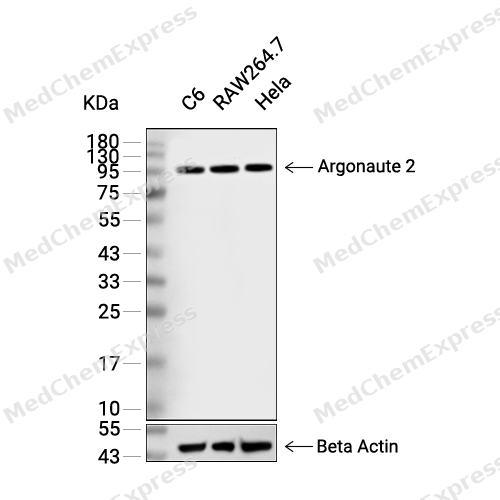 Western blot analysis of extracts from C6 (lane 2(20μg) , RAW264.7 (lane 3(20μg) , Hela (lane 4(20μg),using Argonaute 2 Antibody. Proteins were transferred to a PVDF membrane and blocked with 5% BSA in TBST for 2 hour at room temperature. The primary antibody and Loading control antibody (Beta Actin, HY-P80438, 1/3000) was used in 5% BSA in TBST at 4°C overnight. Goat Anti-Mouse/Rabbit IgG-HRP Secondary Antibody (HY-P8004/HY-P8001, 1/10,000) was used for 1 hour at room temperature.
 -
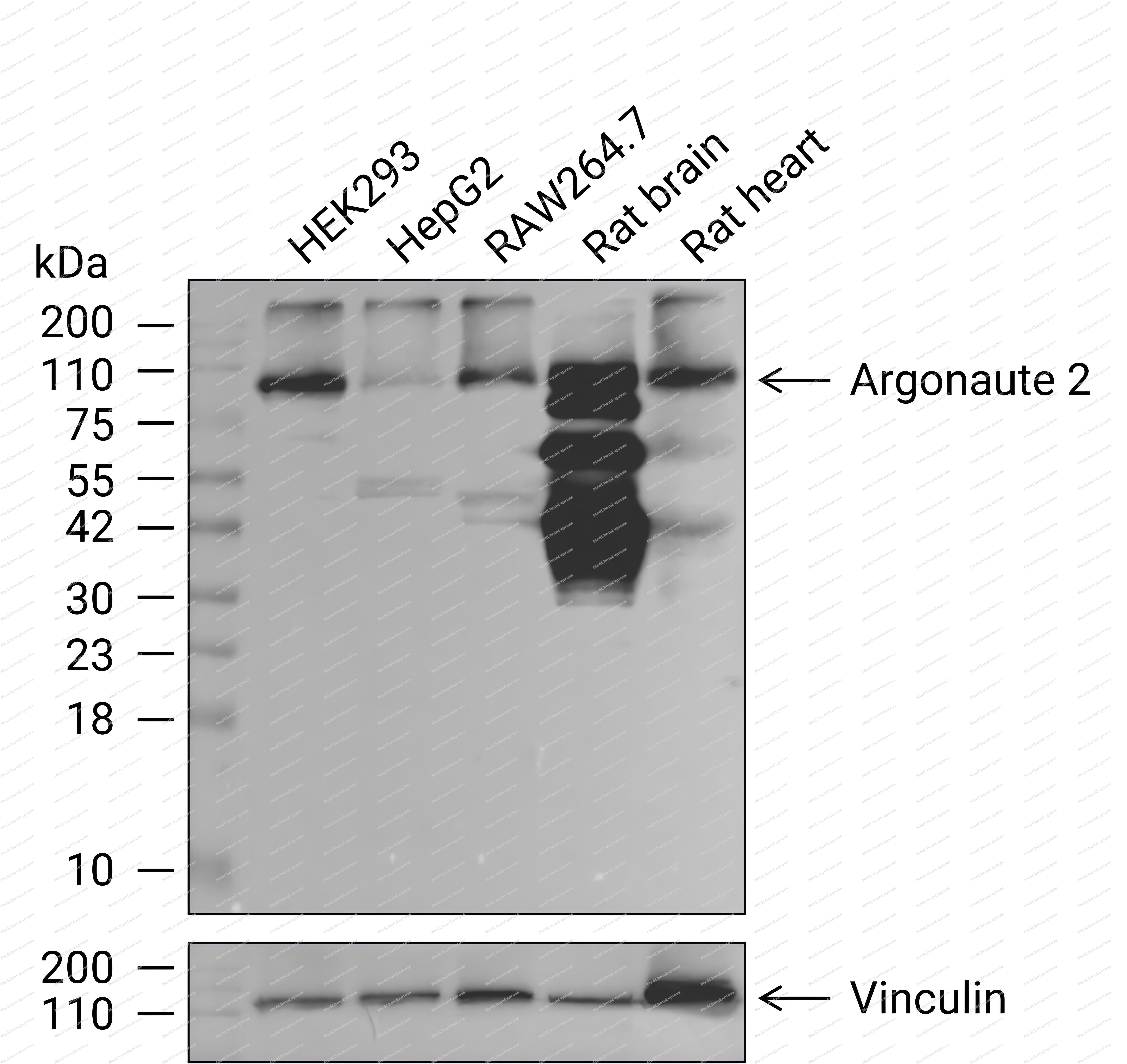 Western blot analysis of extracts from HEK293 (lane 1(20μg)) 、HepG2 (lane 2(20μg)) 、RAW264.7 (lane 3(20μg)) 、Rat brain (lane 4(40μg)) and Rat heart (lane 5(40μg)) using Argonaute 2 Antibody (HY-P80546) . Proteins were transferred to a PVDF membrane and blocked with 5% BSA in TBST for 1.5 hour at room temperature. The primary antibody (1/1000) and Loading control antibody (Vinculin, 1/5000) was used in 5% nonfat dry milk in TBST at 4℃ overnight. Goat Anti-Rabbit IgG-HRP Secondary Antibody (1/10,000) was used for 1 hour at room temperature.
 -
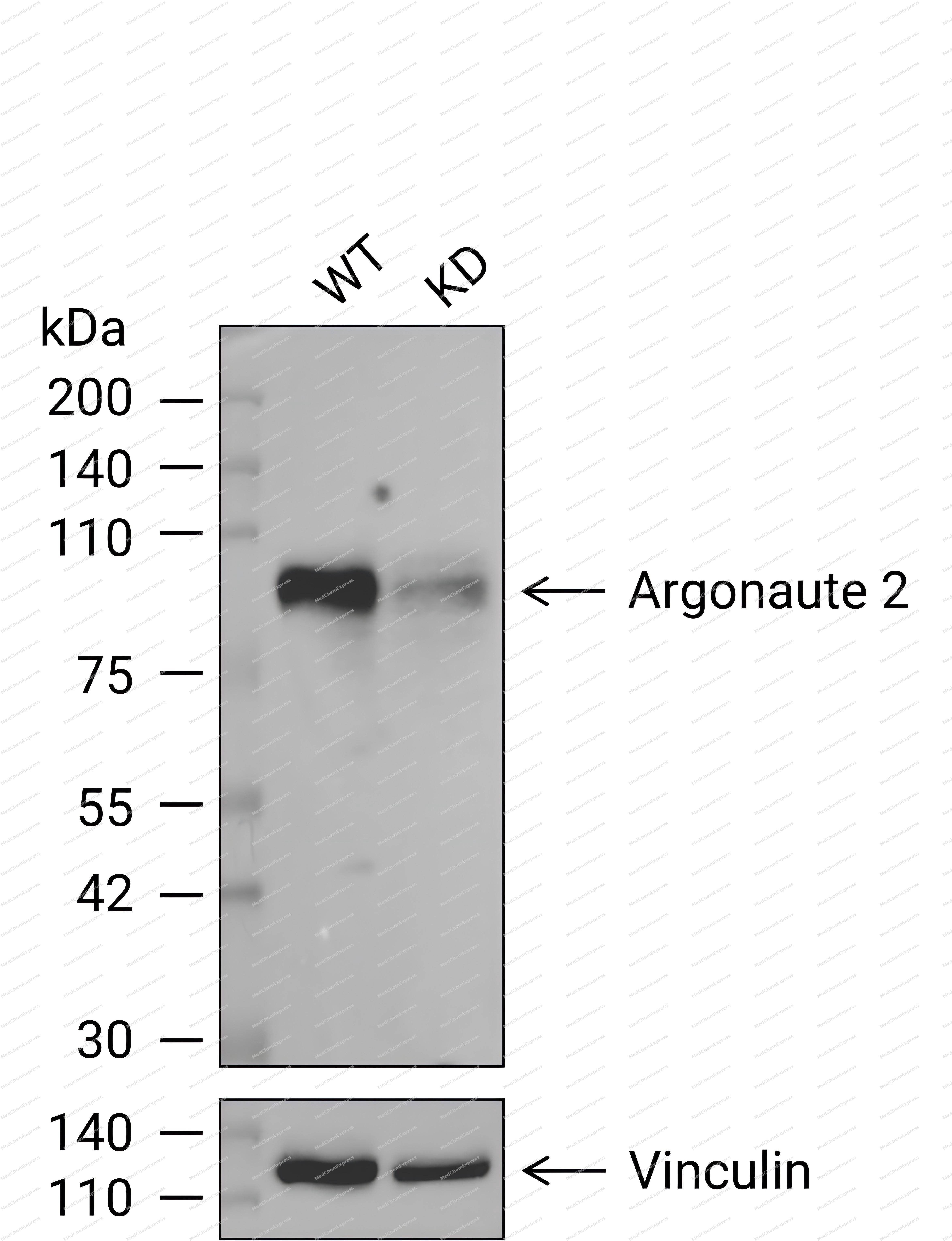 Western blot analysis of extracts from WT Hela cells (lane 1(20μg)) and KD Hela cells (lane 2(20μg)) using Argonaute 2 Antibody (HY-P80546) . Proteins were transferred to a PVDF membrane and blocked with 5% BSA in TBST for 1.5 hour at room temperature. The primary antibody (1/1000) and Loading control antibody (Vinculin, 1/5000) was used in 5% nonfat dry milk in TBST at 4℃ overnight. Goat Anti-Rabbit IgG-HRP Secondary Antibody (1/10,000) was used for 1 hour at room temperature.
 -
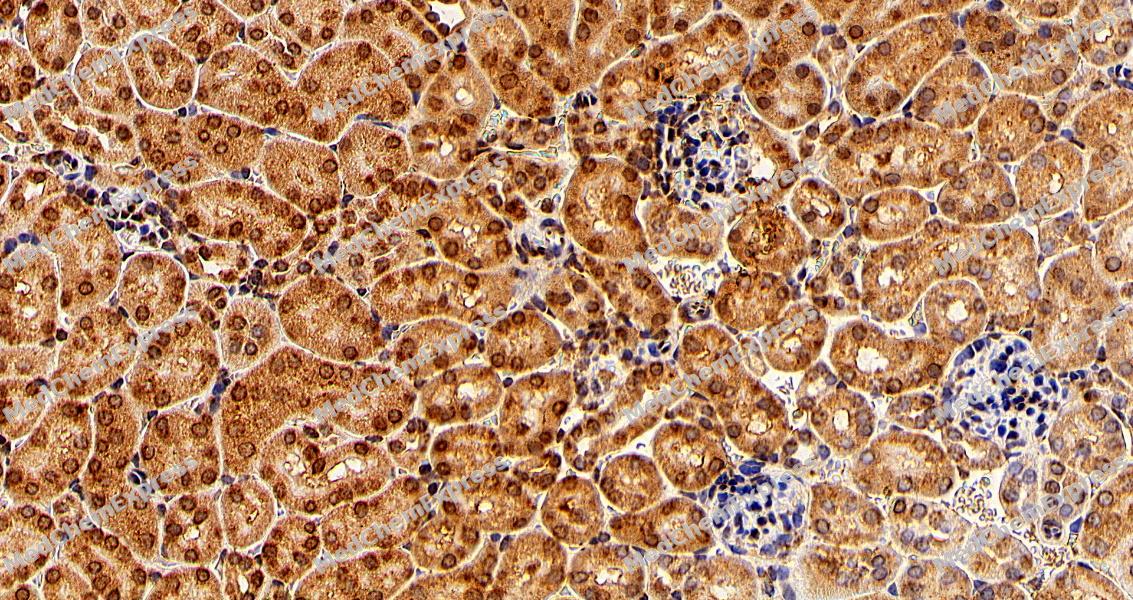 Immunohistochemical analysis of paraffin-embedded mouse kidney tissue using Argonaute 2 Antibody. The section was pre-treated using heat mediated antigen retrieval with sodium citrate buffer (pH 6.0) for 8 minutes. The tissues were blocked in QuickBlock for 20 minutes at room temperature, washed with ddH2O and PBS, and then probed with the primary antibody at 1/100 dilution in 4℃ overnight. The detection was performed using an HRP conjugated compact polymer system. DAB was used as the chromogen. Tissues were counterstained with hematoxylin and mounted with DPX.
 -
Immunohistochemical analysis of paraffin-embedded mouse kidney tissue using Argonaute 2 Antibody. The section was pre-treated using heat mediated antigen retrieval with sodium citrate buffer (pH 6.0) for 8 minutes. The tissues were blocked in QuickBlock for 20 minutes at room temperature, washed with ddH2O and PBS, and then probed with the primary antibody at 1/100 dilution in 4℃ overnight. The detection was performed using an HRP conjugated compact polymer system. DAB was used as the chromogen. Tissues were counterstained with hematoxylin and mounted with DPX.
-
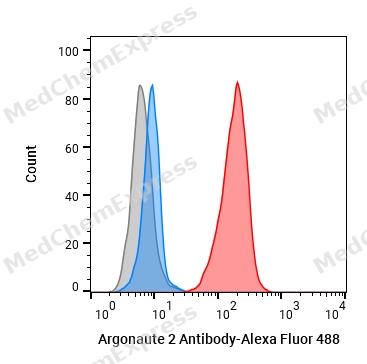 Flow cytometric analysis of 1X10^6 MCF-7 cells labeling Argonaute 2 Antibody (HY-P80546, red). Cells were fixed with 4% paraformaldehyde and permeabilised with 90% methanol. Then stained with the primary antibody at 1/50 dilution for an hour at 4℃. Alexa Fluor® 488-conjugated AffiniPure Goat Anti-Rabbit IgG H&L (HY-P8002) was used as the secondary antibody at 1/1,000 dilution for 30 minutes at 4℃. Rabbit IgG Isotype Control (HY-P80879, blue) was used as the isotype control, cells without incubation with primary antibody were used as the unlabeled control (black).
 -
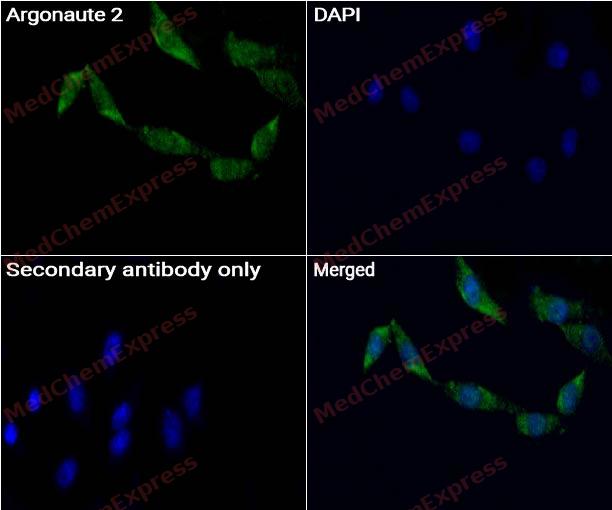 Immunocytochemistry analysis of C6 cells labeling Argonaute 2 with Argonaute 2 antibody (HY-P820546) at 1/50 dilution. Cells were fixed in 4% paraformaldehyde for 15 minutes at room temperature, permeabilized with 0.1% Triton X-100 for 10 minutes at room temperature, then blocked with QuickBlock™ Blocking Buffer for Immunol Staining for 10 min at room temperature. Cells were then incubated with Argonaute 2 antibody (HY-P80546) at 1/50 dilution in QuickBlock™ Blocking Buffer for Immunol Staining at 4 ℃. Alexa Fluor® 488-conjugated AffiniPure Goat Anti-Rabbit IgG H&L(HY-P8002, Green) was used as the secondary antibody at 1/1,000 dilution. PBS instead of the primary antibody was used as the secondary antibody only control. The Nuclear counterstain was DAPI (Blue).
 -
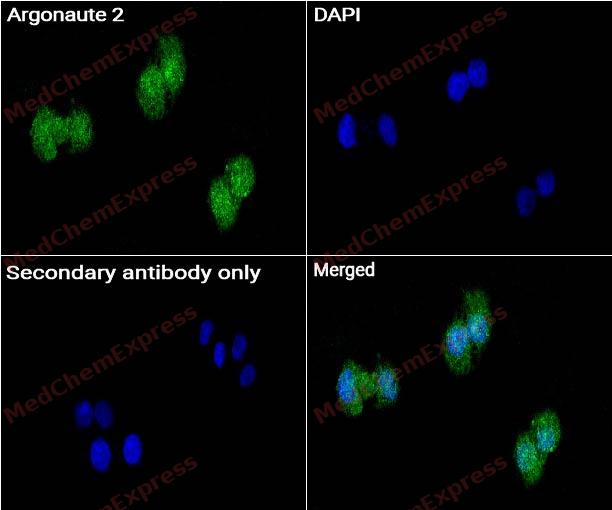 Immunocytochemistry analysis of HeLa cells labeling Argonaute 2 with Argonaute 2 antibody (HY-P80546) at 1/50 dilution. Cells were fixed in 4% paraformaldehyde for 15 minutes at room temperature, permeabilized with 0.1% Triton X-100 for 10 minutes at room temperature, then blocked with QuickBlock™ Blocking Buffer for Immunol Staining for 10 min at room temperature. Cells were then incubated with Argonaute 2 antibody (HY-P80546) at 1/50 dilution in QuickBlock™ Blocking Buffer for Immunol Staining at 4 ℃. Alexa Fluor® 488-conjugated AffiniPure Goat Anti-Rabbit IgG H&L(HY-P8002, Green) was used as the secondary antibody at 1/1,000 dilution. PBS instead of the primary antibody was used as the secondary antibody only control. The Nuclear counterstain was DAPI (Blue).


Background
-
Function
Argonaute 2 is required for RNA-mediated gene silencing (RNAi) by the RNA-induced silencing complex (RISC). The 'minimal RISC' appears to include AGO2 bound to a short guide RNA such as a microRNA (miRNA) or short interfering RNA (siRNA). These guide RNAs direct RISC to complementary mRNAs that are targets for RISC-mediated gene silencing. The precise mechanism of gene silencing depends on the degree of complementarity between the miRNA or siRNA and its target. Binding of RISC to a perfectly complementary mRNA generally results in silencing due to endonucleolytic cleavage of the mRNA specifically by AGO2. Binding of RISC to a partially complementary mRNA results in silencing through inhibition of translation, and this is independent of endonuclease activity. May inhibit translation initiation by binding to the 7-methylguanosine cap, thereby preventing the recruitment of the translation initiation factor eIF4-E. May also inhibit translation initiation via interaction with EIF6, which itself binds to the 60S ribosomal subunit and prevents its association with the 40S ribosomal subunit. The inhibition of translational initiation leads to the accumulation of the affected mRNA in cytoplasmic processing bodies (P-bodies), where mRNA degradation may subsequently occur. In some cases RISC-mediated translational repression is also observed for miRNAs that perfectly match the 3' untranslated region (3'-UTR). Can also up-regulate the translation of specific mRNAs under certain growth conditions. Binds to the AU element of the 3'-UTR of the TNF (TNF-alpha) mRNA and up-regulates translation under conditions of serum starvation. Also required for transcriptional gene silencing (TGS), in which short RNAs known as antigene RNAs or agRNAs direct the transcriptional repression of complementary promoter regions; (Microbial infection) Upon Sars-CoV-2 infection, associates with viral miRNA-like small RNA, CoV2-miR-O7a, and may repress mRNAs, such as BATF2, to evade the IFN response
-
Subcellular Localization
Cytoplasm, P-body; Nucleus
-
Isoforms & Post-Translational Modification
Q9UKV8 has 2 isomers: Q9UKV8-1: 97208 Da (predicted); Q9UKV8-2: 93620 Da (predicted).
Hydroxylated. 4-hydroxylation appears to enhance protein stability but is not required for miRNA-binding or endonuclease activity;Ubiquitinated on surface-exposed lysines by a SCF-like E3 ubiquitin-protein ligase complex containing ZSWIM8 during target-directed microRNA degradation (TDMD), a process that mediates degradation of microRNAs (miRNAs) (PubMed:33184234, PubMed:33184237). Ubiquitination by the SCF-like E3 ubiquitin-protein ligase complex containing ZSWIM8 leads to its subsequent degradation, thereby exposing miRNAs for degradation (PubMed:33184234, PubMed:33184237). ZSWIM8 recognizes and binds AGO2 when it is engaged with a TDMD target (PubMed:33184237);Phosphorylated. A phosphorylation cycle of C-terminal serine cluster (Ser-824-Ser-834) regulates the release of target mRNAs. Target-binding leads to phosphorylation of these residues by CSNK1A1, which reduces the affinity of AGO2 for mRNA and enables target release. The ANKRD52-PPP6C phosphatase complex dephosphorylates the residues, which primes AGO2 for binding a new target;Phosphorylation at Ser-387 by AKT3; leads to up-regulate translational repression of microRNA target and down-regulate endonucleolytic cleavage -
Subunit
Interacts with DICER1 through its Piwi domain and with TARBP2 during assembly of the RNA-induced silencing complex (RISC) (PubMed:14749716, PubMed:15973356, PubMed:16271387, PubMed:16289642, PubMed:16357216, PubMed:17507929, PubMed:18178619, PubMed:18690212, PubMed:33199684). Together, DICER1, AGO2 and TARBP2 constitute the trimeric RISC loading complex (RLC), or micro-RNA (miRNA) loading complex (miRLC). Within the RLC/miRLC, DICER1 and TARBP2 are required to process precursor miRNAs (pre-miRNAs) to mature miRNAs and then load them onto AGO2. AGO2 bound to the mature miRNA constitutes the minimal RISC and may subsequently dissociate from DICER1 and TARBP2. Note however that the term RISC has also been used to describe the trimeric RLC/miRLC. The formation of RISC complexes containing siRNAs rather than miRNAs appears to occur independently of DICER1. Interacts with AGO1. Also interacts with DDB1, DDX5, DDX6, DDX20, DHX30, DHX36, DDX47, DHX9, ELAVL, FXR1, GEMIN4, HNRNPF, IGF2BP1, ILF3, IMP8, MATR3, PABPC1, PRMT5, P4HA1, P4HB, RBM4, SART3, TNRC6A, TNRC6B, UPF1 and YBX1. Interacts with the P-body components DCP1A and XRN1. Associates with polysomes and messenger ribonucleoproteins (mNRPs). Interacts with RBM4; the interaction is modulated under stress-induced conditions, occurs under both cell proliferation and differentiation conditions and in an RNA- and phosphorylation-independent manner. Interacts with LIMD1, WTIP and AJUBA. Interacts with TRIM71; the interaction increases in presence of RNA (PubMed:23125361). Interacts with APOBEC3G in an RNA-dependent manner. Interacts with APOBEC3A, APOBEC3C, APOBEC3F and APOBEC3H. Interacts with DICER1, TARBP2, EIF6, MOV10 and RPL7A (60S ribosome subunit); they form a large RNA-induced silencing complex (RISC) (PubMed:17507929, PubMed:24726324). Interacts with FMR1 (PubMed:14703574). Interacts with ZFP36 (PubMed:15766526). Found in a complex, composed of AGO2, CHD7 and ARB2A (By similarity). Interacts with RC3H1; the interaction is RNA independent (PubMed:25697406). Interacts with SND1 (PubMed:14508492, PubMed:28546213). Interacts with SYT11 (By similarity). Interacts with CLNK (PubMed:26009488). Interacts with GARRE1 (PubMed:29395067). Interacts with GRB2; this interaction is important for the formation of a ternary complex containing GRB2, AGO2 and DICER1 (PubMed:37328606)
-
SwissProt ID
-
Synonyms
Ago 2; Argonaute 2; dAgo2; eIF2C 2; hAgo2; PPD
-
Research Field
Epigenetics and Nuclear Signaling


Documentation
-
Data Sheet (234 KB)
-
SDS (251 KB)
- English - EN (251 KB)
- Français - FR (251 KB)
- Deutsch - DE (251 KB)
- Norwegian - NO (251 KB)
- Español - ES (251 KB)
- Swedish - SV (251 KB)
- Italian - IT (251 KB)
- Korean - KR (251 KB)
- Portuguese - PT (251 KB)
-
User Guide for Antibodies (1077 KB)

 Powered by Bioz
