



NVX-207

Based on 1 Customer Validation
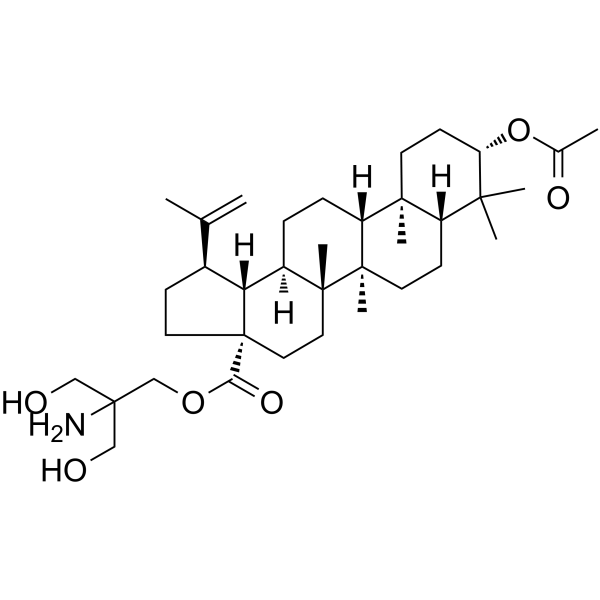
NVX-207, a Betulinic acid-derived anti-cancer compound, shows anti-tumor activity (mean IC50=3.5 μM) against various human and canine cell lines. NVX-207-induced apoptosis is associated with activation of the intrinsic apoptotic pathway via cleavage of caspases -9, -3, -7 and of PARP.
Nur für Forschungszwecke. Wir verkaufen nicht an Patienten.
- Reinheit: 98.0%
- CAS. Nr.: 745020-66-0
- Formel: C36H59NO6
- Molecular Weight:601.86
-
Speicherung:Powder -20°C, 3 years , 4°C, 2 years ; In solvent -80°C, 2 years , -20°C, 1 year


-
 Biologische Aktivität
-
Chemical Information
-
Lösungsmittel & Löslichkeit
- Protokoll
- Reinheit & Dokumentation
- Verweise
-
 Help & FAQs
-

Apoptosis Compound Library
HY-L003
-
Anti-Cancer Compound Library
HY-L025
-
Targeted Diversity Library
HY-L099
-
Cell Death Library
HY-L162
-
Bioactive Compound Library Max
HY-L181
-
MCE Bioactive Compound Library
HY-L001V
-
Bioactive Compound Library
HY-L001
-
Protein Kinase Compound Library
HY-L196
-
Non-Alcoholic Fatty Liver Disease (NAFLD) Compound Library
HY-L199
-
High-Throughput Bioactive Compound Library
HY-L205




Biologische Aktivität
|
Cell Line

|
Type | Value | Description | References |
|---|---|---|---|---|
| 518A2 | IC50 |
2.87 μM
Compound: 5
|
Cytotoxicity against human 518A2 cells after 96 hrs by SRB colorimetric assay
Cytotoxicity against human 518A2 cells after 96 hrs by SRB colorimetric assay
|
[PMID: 20472329] |
| A253 cell line | IC50 |
2.02 μM
Compound: 5
|
Cytotoxicity against human A253 cells after 96 hrs by SRB colorimetric assay
Cytotoxicity against human A253 cells after 96 hrs by SRB colorimetric assay
|
[PMID: 20472329] |
| A2780 | IC50 |
3.62 μM
Compound: 5
|
Cytotoxicity against human A2780 cells after 96 hrs by SRB colorimetric assay
Cytotoxicity against human A2780 cells after 96 hrs by SRB colorimetric assay
|
[PMID: 20472329] |
| A-431 | IC50 |
2.54 μM
Compound: 5
|
Cytotoxicity against human A431 cells after 96 hrs by SRB colorimetric assay
Cytotoxicity against human A431 cells after 96 hrs by SRB colorimetric assay
|
[PMID: 20472329] |
| A549 | IC50 |
2.5 μM
Compound: 14; NVX-207
|
Growth inhibition of human A549 cells after 18 hrs
Growth inhibition of human A549 cells after 18 hrs
|
[PMID: 28500966] |
| A549 | IC50 |
3.44 μM
Compound: 5
|
Cytotoxicity against human A549 cells after 96 hrs by SRB colorimetric assay
Cytotoxicity against human A549 cells after 96 hrs by SRB colorimetric assay
|
[PMID: 20472329] |
| HT-29 | IC50 |
2.45 μM
Compound: 5
|
Cytotoxicity against human HT-29 cells after 96 hrs by SRB colorimetric assay
Cytotoxicity against human HT-29 cells after 96 hrs by SRB colorimetric assay
|
[PMID: 20472329] |
| MCF7 | IC50 |
2.76 μM
Compound: 5
|
Cytotoxicity against human MCF7 cells after 96 hrs by SRB colorimetric assay
Cytotoxicity against human MCF7 cells after 96 hrs by SRB colorimetric assay
|
[PMID: 20472329] |
| SW-1736 | IC50 |
3.73 μM
Compound: 5
|
Cytotoxicity against human SW1736 cells after 96 hrs by SRB colorimetric assay
Cytotoxicity against human SW1736 cells after 96 hrs by SRB colorimetric assay
|
[PMID: 20472329] |
NVX-207 induces cell death via apoptosis[1]. NVX-207 has a high cytotoxicity with IC50 values ranging from 7.6-8.5 μM, in the three analyzed malignant glioma cell lines. NVX-207 leads to PARP cleavage and to a decrease in Survivin expression levels under normoxic and hypoxic conditions. NVX-207 (20 μM) causes a significantly high rate of necrosis of glioma cell lines[2].
MedChemExpress (MCE) has not independently confirmed the accuracy of these methods. They are for reference only.
MedChemExpress (MCE) has not independently confirmed the accuracy of these methods. They are for reference only.


Chemical Information
-
CAS. Nr. 745020-66-0
-
Appearance Solid
-
Molecular Weight 601.86
-
Formel C36H59NO6
-
Color White to off-white
-
SMILES
O=C([C@]1(CC[C@H]2C(C)=C)[C@@]2([H])[C@](CC[C@@]3([H])[C@]4(CC[C@]5([H])[C@@]3(CC[C@H](OC(C)=O)C5(C)C)C)C)([H])[C@@]4(C)CC1)OCC(CO)(N)CO
-
Versand
Room temperature in continental US; may vary elsewhere.
-
Speicherung
Powder -20°C 3 years 4°C 2 years In solvent -80°C 2 years -20°C 1 year


Lösungsmittel & Löslichkeit
DMSO : 125 mg/mL (207.69 mM; Need ultrasonic; Hygroscopic DMSO has a significant impact on the solubility of product, please use newly opened DMSO)
Please refer to the solubility information to select the appropriate solvent. Once prepared, please aliquot and store the solution to prevent product inactivation from repeated freeze-thaw cycles.
Storage method and period of stock solution: -80°C, 2 years; -20°C, 1 year. When stored at -80°C, please use it within 2 years. When stored at -20°C, please use it within 1 year.
Please refer to the solubility information to select the appropriate solvent. Once prepared, please aliquot and store the solution to prevent product inactivation from repeated freeze-thaw cycles.
Storage method and period of stock solution: -80°C, 2 years; -20°C, 1 year. When stored at -80°C, please use it within 2 years. When stored at -20°C, please use it within 1 year.
Konzentration (Stammlösung) × Volumen (Stammlösung) = Konzentration (Ziellösung) × Volumen (Ziellösung)
Select the appropriate dissolution method based on your experimental animal and administration route.
- For the following dissolution methods, please ensure to first prepare a clear stock solution using an In Vitro approach and then sequentially add co-solvents:
- To ensure reliable experimental results, the clarified stock solution can be appropriately stored based on storage conditions. As for the working solution for In Vivo experiments, it is recommended to prepare freshly and use it on the same day.
- The percentages shown for the solvents indicate their volumetric ratio in the final prepared solution. If precipitation or phase separation occurs during preparation, heat and/or sonication can be used to aid dissolution.
Add each solvent one by one: 10% DMSO 40% PEG300 5% Tween-80 45% Saline
Solubility: ≥ 2.08 mg/mL (3.46 mM); Clear solution
This protocol yields a clear solution of ≥ 2.08 mg/mL (saturation unknown).
Taking 1 mL working solution as an example, add 100 μL DMSO stock solution (20.8 mg/mL) to 400 μL PEG300, and mix evenly; then add 50 μL Tween-80 and mix evenly; then add 450 μL Saline to adjust the volume to 1 mL.
Preparation of Saline: Dissolve 0.9 g sodium chloride in ddH₂O and dilute to 100 mL to obtain a clear Saline solution.
Add each solvent one by one: 10% DMSO 90% (20% SBE-β-CD in Saline)
Solubility: ≥ 2.08 mg/mL (3.46 mM); Clear solution
This protocol yields a clear solution of ≥ 2.08 mg/mL (saturation unknown).
Taking 1 mL working solution as an example, add 100 μL DMSO stock solution (20.8 mg/mL) to 900 μL 20% SBE-β-CD in Saline, and mix evenly.
Preparation of 20% SBE-β-CD in Saline (4°C, storage for one week): 2 g SBE-β-CD powder is dissolved in 10 mL Saline, completely dissolve until clear.
Please enter the basic information of animal experiments:
-
-
-
-
Recommended: Prepare an additional quantity of animals to account for potential losses during experiments.
Please enter your animal formula composition:
-
%DMSO +
Recommended: Keep the proportion of DMSO in working solution below 2% if your animal is weak.
-
%+
-
+%Tween-80 + +
-
%Saline +
The co-solvents required include: DMSO, . All of co-solvents are available by MedChemExpress (MCE). , Tween 80. All of co-solvents are available by MedChemExpress (MCE).
Working solution concentration: 0.22 mg/mL
Method for preparing stock solution: mg drug dissolved in μL DMSO. Stock solution concentration: mg/mL.
1. Take μL DMSO stock solution;
2. Add μL .
μL , mix evenly;
3. Then add μL Tween 80, mix evenly;
4. Then add μL
Please ensure that the stock solution in the first step is dissolved to a clear state, and add co-solvents in sequence. You can use ultrasonic heating (ultrasonic cleaner, recommended frequency 20-40 kHz), vortexing, etc. to assist dissolution.

Protokoll
Cytotoxic activities are evaluated using the Sulforhodamine-B (SRB) assay. Exponentially growing cells are seeded into 96-well plates at cell densities to prevent confluence for 96 h. After 24 h, the cells are treated using a dilution series of the compounds for 72 h under normoxic or hypoxic conditions. After treatment, the adherent cells are fixed using 10% TCA at 4°C for 1 h; the cells are washed with ice-cold water and are dyed using 100 µL of 4.4% SRB solution for 10 min. After staining, the plates are washed with 1% acetic acid and air-dried overnight. Three hundred microliters of 20 mM Tris base solution is added, and the absorbance is measured at 540 nm using a 96-well plate reader. The IC50 values indicate the concentrations of the compound that cause 50% cell inhibition. The data are obtained in three independent experiments.
MedChemExpress (MCE) has not independently confirmed the accuracy of these methods. They are for reference only.


Reinheit & Dokumentation
-
Data Sheet (276 KB)
-
SDS (251 KB)
- English - EN (251 KB)
- Français - FR (251 KB)
- Deutsch - DE (251 KB)
- Norwegian - NO (251 KB)
- Español - ES (251 KB)
- Swedish - SV (251 KB)
- Italian - IT (251 KB)
- Portuguese - PT (251 KB)
-
Handling Instructions (2659 KB)
Verweise
[1]. Willmann M, et al. Characterization of NVX-207, a novel betulinic acid-derived anti-cancer compound. Eur J Clin Invest. 2009;39(5):384-394. [Content Brief]
[2]. Bache M, et al. Betulinic acid derivatives NVX-207 and B10 for treatment of glioblastoma--an in vitro study of cytotoxicity and radiosensitization. Int J Mol Sci. 2014 Oct 30;15(11):19777-90. [Content Brief]


Complete Stock Solution Preparation Table
Please refer to the solubility information to select the appropriate solvent. Once prepared, please aliquot and store the solution to prevent product inactivation from repeated freeze-thaw cycles.
Storage method and period of stock solution: -80°C, 2 years; -20°C, 1 year. When stored at -80°C, please use it within 2 years. When stored at -20°C, please use it within 1 year.
| Optional Solvent | Concentration Solvent Mass | 1 mg | 5 mg | 10 mg | 25 mg |
|---|---|---|---|---|---|
| DMSO | 1 mM | 1.6615 mL | 8.3076 mL | 16.6152 mL | 41.5379 mL |
| 5 mM | 0.3323 mL | 1.6615 mL | 3.3230 mL | 8.3076 mL | |
| 10 mM | 0.1662 mL | 0.8308 mL | 1.6615 mL | 4.1538 mL | |
| 15 mM | 0.1108 mL | 0.5538 mL | 1.1077 mL | 2.7692 mL | |
| 20 mM | 0.0831 mL | 0.4154 mL | 0.8308 mL | 2.0769 mL | |
| 25 mM | 0.0665 mL | 0.3323 mL | 0.6646 mL | 1.6615 mL | |
| 30 mM | 0.0554 mL | 0.2769 mL | 0.5538 mL | 1.3846 mL | |
| 40 mM | 0.0415 mL | 0.2077 mL | 0.4154 mL | 1.0384 mL | |
| 50 mM | 0.0332 mL | 0.1662 mL | 0.3323 mL | 0.8308 mL | |
| 60 mM | 0.0277 mL | 0.1385 mL | 0.2769 mL | 0.6923 mL | |
| 80 mM | 0.0208 mL | 0.1038 mL | 0.2077 mL | 0.5192 mL | |
| 100 mM | 0.0166 mL | 0.0831 mL | 0.1662 mL | 0.4154 mL |


 Powered by Bioz