



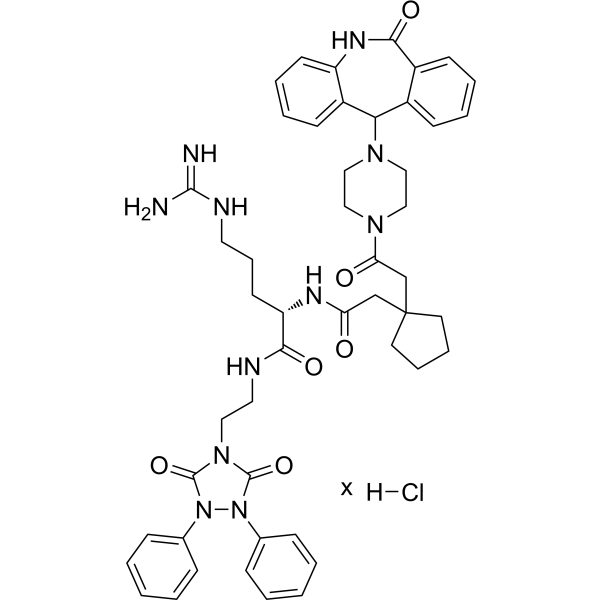
BIIE-0246 hydrochloride
Based on 2 publication(s) in Google Scholar
BIIE-0246 hydrochloride (AR-H 053591 hydrochloride) is a potent and selective NPY2R (neuropeptide Y receptor 2) antagonist with an IC50 value of 15 nM for rat [125I]PYY3-36. BIIE-0246 hydrochloride decreases the expression of p-AKT S473, P-p44/42 MAPK under the NPY-stimulated. BIIE-0246 hydrochloride reduces albuminuria in ADR nephropathy.
For research use only. We do not sell to patients.
- Purity : 99.33%
- Formula: C49H57N11O6.xHCl
-
Storage:
4°C, sealed storage, away from moisture
* In solvent : -80°C, 6 months; -20°C, 1 month (sealed storage, away from moisture)

To place orders, for customer services and technical support, please contact: MedChemExpress USA
Tel: 609-228-6898 E-mail: [email protected] [email protected]


-
 Biological Activity
-
Chemical Information
-
Solvent & Solubility
- Purity & Documentation
- References
-
 Help & FAQs


Publications Citing Use of MedChemExpress (MCE) BIIE-0246 hydrochloride
More Customer Validation & Images

-
In Vivo Efficacy Study

All Neuropeptide Y Receptor Isoforms
More

Biological Activity
Description
In Vitro
BIIE-0246 hydrochloride (1 µM; 24 h) decreases the expression of p-AKT S473, P-p44/42 MAPK under the NPY-stimulated (10, 100 ng/mL) in mouse podocytes[3].
MedChemExpress (MCE) has not independently confirmed the accuracy of these methods. They are for reference only.
-
Cell Line:Mouse podocytes
-
Concentration:1 µM
-
Incubation Time:24 h
-
Result:Blocked the NPY-stimulated phosphorylation of Akt and p44/42 MAPK.
In Vivo
BIIE-0246 hydrochloride (10 µg/day; i.p.; daily for 14 days) reduces albuminuria in ADR (adriamycin) nephropathy[3].
MedChemExpress (MCE) has not independently confirmed the accuracy of these methods. They are for reference only.
-
Animal Model:Homozygous transgenic male OE-NPYDβH and WT C57Bl/6N mice[1]
-
Dosage:1.3 mg/kg
-
Administration:I.p.; daily for 2 or 4.5 weeks
-
Result:Increased body weight gain in both genotypes on the chow diet caused metabolic disturbances, especially in WT mice. During energy surplus (i.e., on Western diet), blocking of Y2-receptors induced obesity in WT mice and OE-NPYDβH mice showed a reduced fat mass gain, hepatic glycogen and serum cholesterol levels relative to body adiposity.
-
Animal Model:Male BALB/c mice[3]
-
Dosage:10 µg/day
-
Administration:I.p.; daily for 14 days
-
Result:Reduces albuminuria in ADR nephropathy.


Chemical Information
-
Appearance Solid
-
Formula C49H57N11O6.xHCl
-
Color White to off-white
-
SMILES
O=C(N[C@H](C(NCCN1C(N(C2=CC=CC=C2)N(C3=CC=CC=C3)C1=O)=O)=O)CCCNC(N)=N)CC4(CC(N5CCN(C(C6=CC=CC=C67)C8=CC=CC=C8NC7=O)CC5)=O)CCCC4.[H]Cl.[x]
-
Synonyms
AR-H 053591 hydrochloride
-
Shipping
Room temperature in continental US; may vary elsewhere.
-
Storage
4°C, sealed storage, away from moisture
* In solvent : -80°C, 6 months; -20°C, 1 month (sealed storage, away from moisture)


Publications (2)
-
Journal Impact Factor
-
Most Recent
-
Sci Rep
Combined effects of red light and direct-current electric fields on neurite growth in 3D neural cell cultures. [Abstract]2025 Nov 29;16(1):408. PMID: 41318831 -
In Vivo
Ghrelin Induces the Production of Hypothalamic NPY Through the AMPK-mTOR Pathway to Alleviate Cancer-induced Bone Pain. [Abstract]2024 May-Jun;38(3):1133-1142. PMID: 38688635
BIIE-0246 hydrochloride purchased from MedChemExpress. Usage Cited in: In Vivo. 2024 May-Jun;38(3):1133-1142. [Abstract]
BIIE-0246 (3 μg; i.c.v.; 10 μL) reversed the antinociceptive effect of NPY. PWT was measured using von Frey filaments and PWL was measured using a hot plate experiment Sprague-Dawley rat with Cancer-induced bone pain (CIBP).


Solvent & Solubility
In Vitro:
DMSO : 40 mg/mL (Need ultrasonic and warming; Hygroscopic DMSO has a significant impact on the solubility of product, please use newly opened DMSO)


Purity & Documentation
-
Data Sheet (280 KB)
-
SDS (252 KB)
- English - EN (252 KB)
- Français - FR (252 KB)
- Deutsch - DE (252 KB)
- Norwegian - NO (252 KB)
- Español - ES (252 KB)
- Swedish - SV (252 KB)
- Italian - IT (252 KB)
- Korean - KR (252 KB)
- Portuguese - PT (252 KB)
-
Handling Instructions (2659 KB)
References
[1]. Ailanen L, et al. Peripherally Administered Y2-Receptor Antagonist BIIE0246 Prevents Diet-Induced Obesity in Mice With Excess Neuropeptide Y, but Enhances Obesity in Control Mice. Front Pharmacol. 2018 Apr 5;9:319. [Content Brief]
[2]. Dumont Y, et al. BIIE0246, a potent and highly selective non-peptide neuropeptide Y Y(2) receptor antagonist. Br J Pharmacol. 2000 Mar;129(6):1075-88. [Content Brief]
[3]. Lay AC, et al. A role for NPY-NPY2R signaling in albuminuric kidney disease. Proc Natl Acad Sci U S A. 2020 Jul 7;117(27):15862-15873. [Content Brief]

Calculators
Concentration (start) × Volume (start) = Concentration (final) × Volume (final)


BIIE-0246 hydrochloride Related Classifications
HY-101986A Related Classifications
 Powered by Bioz