



Aluminum Hydroxide
Based on 7 publication(s) in Google Scholar
Aluminum Hydroxide is an orally active main form of aluminum used as adjuvant. Aluminum hydroxide-based adjuvant researches include the repository effect, pro-phagocytic effect, and activation of the pro-inflammatory NLRP3 pathway. Aluminum Hydroxide also acts as adjuvant to compensate low inherent immunogenicity of subunit vaccines.
For research use only. We do not sell to patients.
- Purity: 97.0%
- CAS No.: 21645-51-2
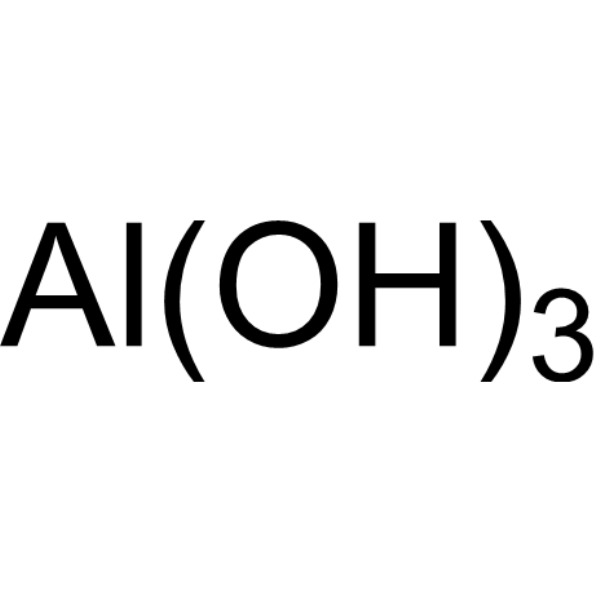
- Formula: Al(OH)3
- Molecular Weight:78.00
-
Storage:
Store at room temperature 3 years.
In solvent -80°C, 2 years , -20°C, 1 year


-
 Biological Activity
-
Chemical Information
-
Solvent & Solubility
- Purity & Documentation
- References
-
 Help & FAQs



Publications Citing Use of MedChemExpress (MCE) Aluminum Hydroxide
More- J Control Release. 2026 May 10:393:114809. [Abstract]
- Phytomedicine. 2025 Apr:139:156508. [Abstract]
- J Transl Int Med. 2021 Aug 24;11(3):282-293. [Abstract]
- Biochem Pharmacol. 2026 Apr:246:117701. [Abstract]
- Arch Biochem Biophys. 2025 Jun 9:110502. [Abstract]
- Immunobiology. 2025 Jul 16;230(4):153103. [Abstract]
- Biosci Biotechnol Biochem. 2020 Jul;84(7):1409-1417. [Abstract]


Biological Activity
Aluminum Hydroxide is not recommended to be freezed when used as the vaccine adjuvant to avoid reducing the immunogenicity of the vaccine.
MedChemExpress (MCE) has not independently confirmed the accuracy of these methods. They are for reference only.
MedChemExpress (MCE) has not independently confirmed the accuracy of these methods. They are for reference only.
| NCT Number | Sponsor | Condition | Start Date |
Phase

|
|---|---|---|---|---|
| NCT01329991 | Plexxikon| | 2011-05 | PHASE1 |


Chemical Information
-
CAS No. 21645-51-2
-
Appearance Solid
-
Molecular Weight 78.00
-
Formula Al(OH)3
-
Color White to off-white
-
SMILES
O[Al](O)O
-
Shipping
Room temperature in continental US; may vary elsewhere.
-
Storage
Store at room temperature 3 years
In solvent -80°C 2 years -20°C 1 year


Publications (7)
-
Journal Impact Factor
-
Most Recent
-
J Control Release
Dual-action nasal spray with mussel protein and xylitol restores epithelial barrier and attenuates type 2 inflammation in allergic rhinitis. [Abstract]2026 May 10:393:114809. PMID: 41819426 -
Phytomedicine
Jieyu Guben decoction alleviates combined allergic rhinitis and asthma syndrome by balancing Th17/Treg expression and restoring PPARD. [Abstract]2025 Apr:139:156508. PMID: 40031093 -
J Transl Int Med
MiR-182/Sestrin2 affects the function of asthmatic airway smooth muscle cells by the AMPK/mTOR pathway. [Abstract]2021 Aug 24;11(3):282-293. PMID: 37662894 -
Biochem Pharmacol
TTC3-mediated ubiquitination of APPL1 is suppression involved in the anti-asthmatic effects of the substance P receptor antagonist WIN62577. [Abstract]2026 Apr:246:117701. PMID: 41520735 -
Arch Biochem Biophys
Targeting IL-33 to suppress ferroptosis and alleviate inflammation in asthma exacerbations. [Abstract]2025 Jun 9:110502. PMID: 40499633 -
Immunobiology
Exosomes derived from baicalin-pretreated bone marrow mesenchymal stem cells inactivate the TLR4/MyD88/NF-kB pathway to improve asthma. [Abstract]2025 Jul 16;230(4):153103. PMID: 40695068 -
Biosci Biotechnol Biochem
Bulleyaconitine A inhibits the lung inflammation and airway remodeling through restoring Th1/Th2 balance in asthmatic model mice. [Abstract]2020 Jul;84(7):1409-1417. PMID: 32290781


Solvent & Solubility
H2O : < 0.1 mg/mL (insoluble)
DMSO : < 1 mg/mL (insoluble or slightly soluble)
For the following dissolution methods, please prepare the working solution directly:
It is recommended to prepare fresh solutions and use them promptly within a short period of time.
The percentages shown for the solvents indicate their volumetric ratio in the final prepared solution. If precipitation or phase separation occurs during preparation, heat and/or sonication can be used to aid dissolution.
Add each solvent one by one: 0.5% CMC-Na/saline water
Solubility: 10 mg/mL (128.21 mM); Suspended solution; Need ultrasonic


Purity & Documentation
-
Data Sheet (274 KB)
-
SDS (393 KB)
- English - EN (393 KB)
- Français - FR (393 KB)
- Deutsch - DE (393 KB)
- Norwegian - NO (393 KB)
- Español - ES (393 KB)
- Swedish - SV (393 KB)
- Italian - IT (393 KB)
- Korean - KR (393 KB)
- Portuguese - PT (393 KB)
-
Handling Instructions (2659 KB)
References
[1]. He P, et al. Advances in aluminum hydroxide-based adjuvant research and its mechanism. Hum Vaccin Immunother. 2015;11(2):477-88. [Content Brief]
[2]. Amini Y, et al. Aluminum hydroxide nanoparticles show strong activity to stimulate Th-1 immune response against tuberculosis. Artif Cells Nanomed Biotechnol. 2017 Nov;45(7):1331-1335. [Content Brief]
[3]. Ohtawa M, et al. Effect of aluminum ingestion on lipid peroxidation in rats. Chem Pharm Bull (Tokyo). 1983 Apr;31(4):1415-8. [Content Brief]

Calculators
Concentration (start) × Volume (start) = Concentration (final) × Volume (final)


 Powered by Bioz