



PND-1186
Based on 18 publication(s) in Google Scholar
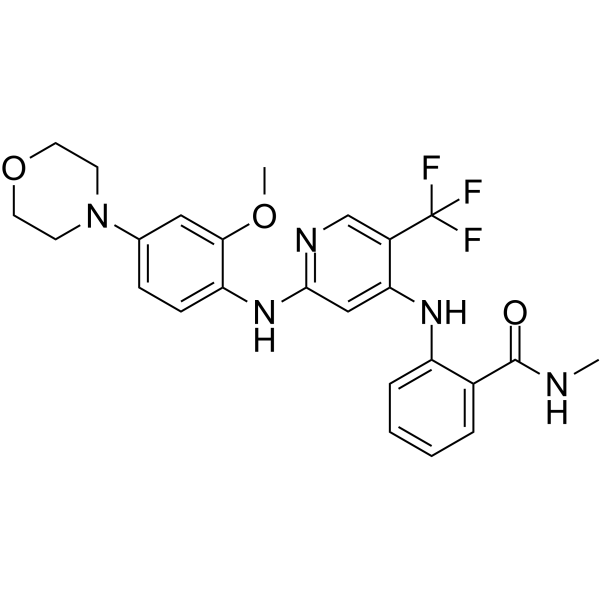
PND-1186 (VS-4718) is a potent, highly-specific and reversible inhibitor of FAK with an IC50 of 1.5 nM. PND-1186 selectively promotes tumor cell apoptosis.
For research use only. We do not sell to patients.
- Purity: 99.88%
- CAS No.: 1061353-68-1
- Formula: C25H26F3N5O3
- Molecular Weight:501.50
-
Storage:Powder -20°C, 3 years , 4°C, 2 years ; In solvent -80°C, 2 years , -20°C, 1 year

To place orders, for customer services and technical support, please contact: MedChemExpress USA
Tel: 609-228-6898 E-mail: [email protected] [email protected]


-
 Biological Activity
-
Chemical Information
-
Solvent & Solubility
- Purity & Documentation
- References
-
 Help & FAQs
-

Apoptosis Compound Library
HY-L003
-
Kinase Inhibitor Library
HY-L009
-
Protein Tyrosine Kinase Compound Library
HY-L016
-
Anti-Cancer Compound Library
HY-L025
-
Clinical Compound Library
HY-L026
-
Cytoskeleton Compound Library
HY-L060
-
Orally Active Compound Library
HY-L061
-
Anti-Pancreatic Cancer Compound Library
HY-L077
-
Anti-Pulmonary Fibrosis Compound Library
HY-L125
-
Heterocyclic Compound Library
HY-L138
-
Highly Selective Inhibitors Library
HY-L158
-
Highly Selective Activators Library
HY-L159
-
Cell Death Library
HY-L162
-
Bioactive Compound Library Max
HY-L181
-
Kinase Inhibitor Library Mini
HY-L009M
-
MCE Bioactive Compound Library
HY-L001V
-
Clinical Compound Library Plus
HY-L026P
-
Bioactive Compound Library
HY-L001
-
Protein Kinase Compound Library
HY-L196
-
Non-Alcoholic Fatty Liver Disease (NAFLD) Compound Library
HY-L199
-
High-Throughput Bioactive Compound Library
HY-L205
-
Posttranslational Modification Library
HY-L226


Publications Citing Use of MedChemExpress (MCE) PND-1186
More- Cancer Cell. 2019 Mar 18;35(3):457-472.e5. [Abstract]
- Cancer Commun (Lond). 2023 Jun;43(6):685-705. [Abstract]
- Nat Commun. 2024 Nov 30;15(1):10422. [Abstract]
- Cell Death Differ. 2026 Mar 6. [Abstract]
- Autophagy. 2026 May 29:1-15.
- J Exp Clin Cancer Res. 2022 Jun 3;41(1):193. [Abstract]
- Sci Adv. 2026 Jan 30;12(5):eady8382. [Abstract]
- Clin Cancer Res. 2019 Jul 15;25(14):4552-4566. [Abstract]
- EMBO Mol Med. 2024 Oct;16(10):2402-2426. [Abstract]
- Apoptosis. 2024 May 25. [Abstract]
- Biochem Pharmacol. 2026 Aug;250(Pt 2):118087.
- Commun Biol. 2024 Dec 30;7(1):1713. [Abstract]
- Cancers (Basel). 2023 Apr 13;15(8):2280. [Abstract]
- Am J Physiol Renal Physiol. 2025 Oct 1;329(4):F465-F481. [Abstract]
- Chembiochem. 2023 Oct 4;24(19):e202300141. [Abstract]
- Mol Biol Cell. 2025 Jun 1;36(6):ar64. [Abstract]
- bioRxiv. 2024 November 06.
- bioRxiv. 2020 Apr.
 Customer Validation & Images

-
WB
-
WB
-
Cell Proliferation/Viability Assay
-
WB
-
RT-PCR


Biological Activity
IC50: 1.5 nM (FAK)[1]
|
Cell Line

|
Type | Value | Description | References |
|---|---|---|---|---|
| 786-0 | IC50 |
>50 μM
Compound: VS-4718; PND1186
|
Antiproliferative activity against human 786-O cells assessed as reduction in cell viability
Antiproliferative activity against human 786-O cells assessed as reduction in cell viability
|
[PMID: 32784087] |
| BXPC-3 | IC50 |
0.93 μM
Compound: VS-4718; PND1186
|
Antiproliferative activity against human BXPC-3 cells assessed as reduction in cell viability
Antiproliferative activity against human BXPC-3 cells assessed as reduction in cell viability
|
[PMID: 32784087] |
| DU-145 | IC50 |
0.62 μM
Compound: VS-4718; PND1186
|
Antiproliferative activity against human DU-145 cells assessed as reduction in cell viability
Antiproliferative activity against human DU-145 cells assessed as reduction in cell viability
|
[PMID: 32784087] |
| MDA-MB-231 | IC50 |
0.029 μM
Compound: VS-4718; PND1186
|
Antiproliferative activity against human MDA-MB-231 cells assessed as reduction in cell viability
Antiproliferative activity against human MDA-MB-231 cells assessed as reduction in cell viability
|
[PMID: 32784087] |
| NCI-H1975 | IC50 |
0.34 μM
Compound: VS-4718; PND1186
|
Antiproliferative activity against human NCI-H1975 cells assessed as reduction in cell viability
Antiproliferative activity against human NCI-H1975 cells assessed as reduction in cell viability
|
[PMID: 32784087] |
| RD | IC50 |
1.22 μM
Compound: 3; VS-4718, PND-1186
|
Cytotoxicity against human RD cells incubated for 96 hrs by DIMSCAN method
Cytotoxicity against human RD cells incubated for 96 hrs by DIMSCAN method
|
[PMID: 33058670] |
PND-1186 has an IC50 of ~100 nM in breast carcinoma cells as determined by anti-phospho-specific immunoblotting to FAK Tyr-397[1].
In murine 4T1 breast carcinoma cells, FAK is important in promoting an invasive and metastatic cell phenotype. Increasing concentrations of PND-1186 (0.1 to 1.0 μM) added to 4T1 cells inhibits FAK Tyr-397 phosphorylation (pY397) and results in elevated levels of total FAK protein within 1 h[1].
MedChemExpress (MCE) has not independently confirmed the accuracy of these methods. They are for reference only.
-
Cell Line:4T1 breast carcinoma cells
-
Concentration:0.1, 0.2, 0.4, 0.6 and 1.0 µM
-
Incubation Time:1 hour
-
Result:Inhibited FAK Tyr-397 phosphorylation (pY397) and resulted in elevated levels of total FAK protein.
MedChemExpress (MCE) has not independently confirmed the accuracy of these methods. They are for reference only.
-
Animal Model:BALB/c mice[1]
-
Dosage:30 mg/kg or 100 mg/kg
-
Administration:Injected (100 µL) subcutaneously in the neck region; every 12 h (twice-daily, b.i.d.) for 5 days.
-
Result:100 mg/kg treatment significantly reduced final 4T1 tumor weight 2-fold whereas 30 mg/kg treatment slightly reduced final tumor weight but was not significantly different compared to control.
| NCT Number | Sponsor | Condition | Start Date |
Phase
|
|---|---|---|---|---|
| NCT01329991 | Plexxikon| | 2011-05 | PHASE1 |


Chemical Information
-
CAS No. 1061353-68-1
-
Appearance Solid
-
Molecular Weight 501.50
-
Formula C25H26F3N5O3
-
Color White to gray
-
SMILES
O=C(NC)C1=CC=CC=C1NC2=CC(NC3=CC=C(N4CCOCC4)C=C3OC)=NC=C2C(F)(F)F
-
Synonyms
VS-4718; SR-2516
-
Shipping
Room temperature in continental US; may vary elsewhere.
-
Storage
Powder -20°C 3 years 4°C 2 years In solvent -80°C 2 years -20°C 1 year


Publications (18)
-
Journal Impact Factor
-
Most Recent
-
Cancer Cell
A Platform of Synthetic Lethal Gene Interaction Networks Reveals that the GNAQ Uveal Melanoma Oncogene Controls the Hippo Pathway through FAK. [Abstract]2019 Mar 18;35(3):457-472.e5. PMID: 30773340
PND-1186 purchased from MedChemExpress. Usage Cited in: Cancer Cell. 2019 Mar 18;35(3):457-472.e5. [Abstract]
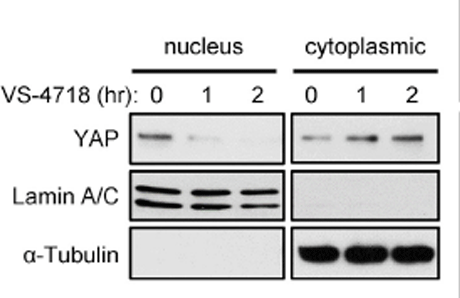
Immunoblot showing YAP nuclear and cytoplasmic localization after 2 h VS-4718 (PND-1186) (1 μM) treatment in OMM1.3 cells, using lamin A/C and a-tubulin as nuclear and cytoplasmic markers, respectively.
PND-1186 purchased from MedChemExpress. Usage Cited in: Cancer Cell. 2019 Mar 18;35(3):457-472.e5. [Abstract]
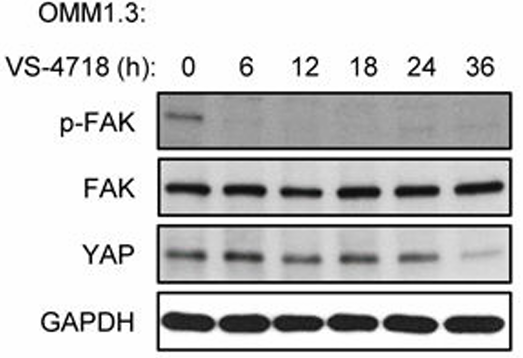
Immunoblot showing levels of total YAP over a time course of VS-4718 (PND-1186) treatment (1 μM; 6-36 h) in OMM1.3 cells.
PND-1186 purchased from MedChemExpress. Usage Cited in: Cancer Cell. 2019 Mar 18;35(3):457-472.e5. [Abstract]
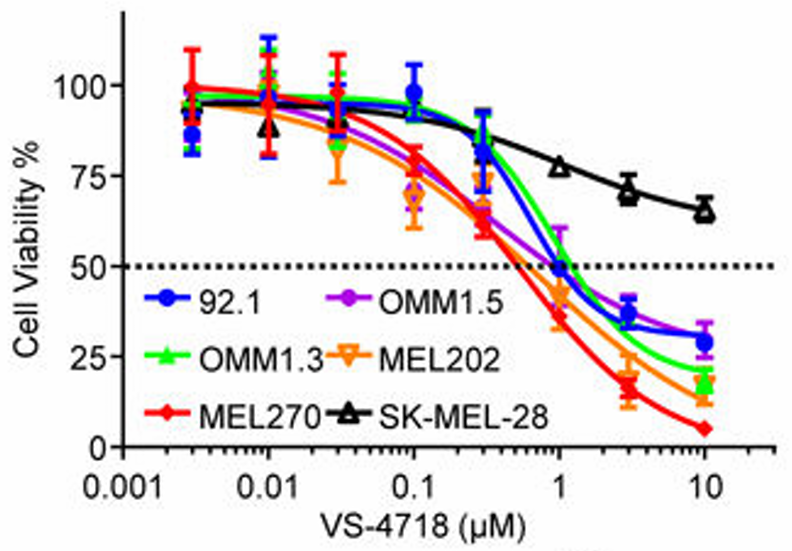
UM cell lines (MEL270, 92.1, OMM1.3, OMM1.5 and MEL202 with GNAQ active mutation) are sensitive to FAK inhibition in a dose-dependent manner after treatment with VS-4718 (PND-1186) (0.001-10 μM; 72 h), SKCM cells (SK-MEL-28 with BRAF mutation) served as control.
PND-1186 purchased from MedChemExpress. Usage Cited in: Cancer Cell. 2019 Mar 18;35(3):457-472.e5. [Abstract]
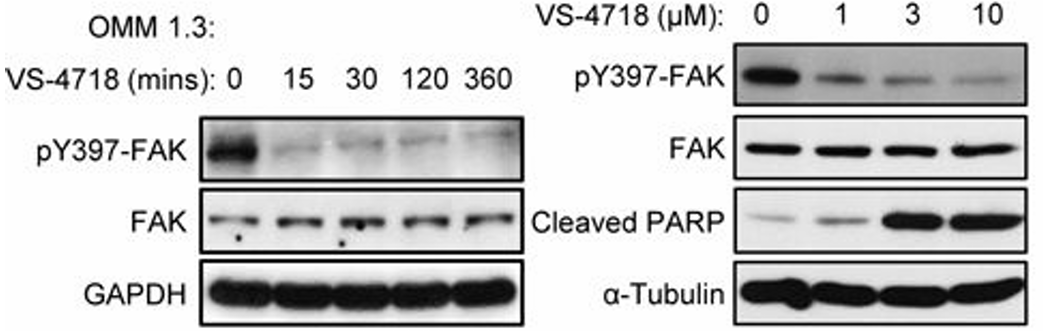
VS-4718 (PND-1186) (1-10 μM; 15-360 min) inhibits FAK activation in OMM1.3 (decrease in pY397- FAK, left panel) and induces apoptosis (increased cleaved PARP, right panel).
PND-1186 purchased from MedChemExpress. Usage Cited in: Cancer Cell. 2019 Mar 18;35(3):457-472.e5. [Abstract]
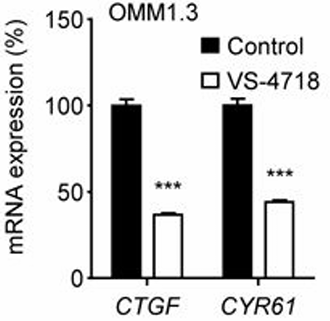
mRNA expression of CTGF and CYR61 measured by qPCR in UM cells OMM1.3 with VS-4718 (PND-1186) treatment (1μM, vehicle treatment as control, mean ± SEM, n=3).
PND-1186 purchased from MedChemExpress. Usage Cited in: Cancer Cell. 2019 Mar 18;35(3):457-472.e5. [Abstract]
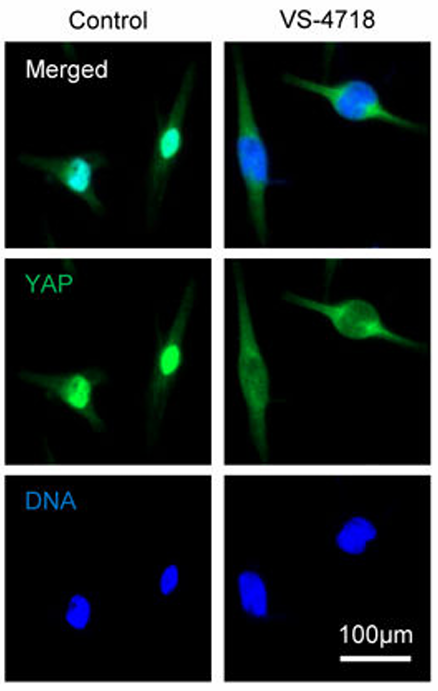
Immunofluorescent staining of endogenous YAP (green) and Hoeschst staining for nuclear DNA (blue) in OMM1.3 cells after VS-4718 (PND-1186) treatment (1μM, vehicle treatment as control).
PND-1186 purchased from MedChemExpress. Usage Cited in: Cancer Cell. 2019 Mar 18;35(3):457-472.e5. [Abstract]
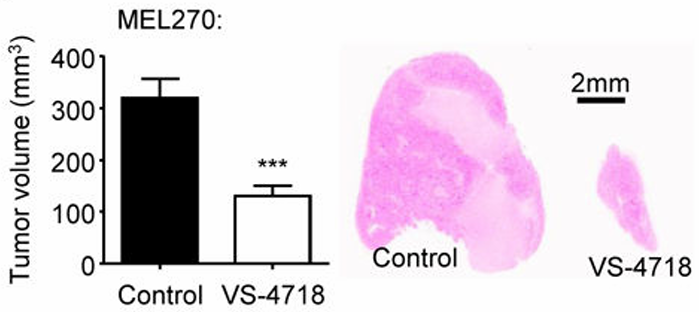
Tumor volume of MEL270 cells in vivo with or without VS-4718 (PND-1186) (100mg/kg; oral gavage; twice daily) treatment, tumor size at the end of the study were measured (mean ± SEM, n=8) (left panel), and hematoxylin and eosin (H&E)-stained sections of representative tumors from each group are shown (right panel).
-
Cancer Commun (Lond)
N6-methyladenosine modification of CENPF mRNA facilitates gastric cancer metastasis via regulating FAK nuclear export. [Abstract]2023 Jun;43(6):685-705. PMID: 37256823 -
Nat Commun
The dysadherin/MMP9 axis modifies the extracellular matrix to accelerate colorectal cancer progression. [Abstract]2024 Nov 30;15(1):10422. PMID: 39613801 -
Cell Death Differ
Functional genomic screens uncover FERMT2 as a critical regulator of YAP/TAZ-driven tumorigenicity. [Abstract]2026 Mar 6. PMID: 41792242 -
-
J Exp Clin Cancer Res
Focal Adhesion Kinase (FAK)-Hippo/YAP transduction signaling mediates the stimulatory effects exerted by S100A8/A9-RAGE system in triple-negative breast cancer (TNBC). [Abstract]2022 Jun 3;41(1):193. PMID: 35655319 -
Sci Adv
Inhibition of focal adhesion kinase impairs tumor formation and preserves hearing in a murine model of NF2-related schwannomatosis. [Abstract]2026 Jan 30;12(5):eady8382. PMID: 41616055 -
Clin Cancer Res
High-throughput Chemical Screening Identifies Focal Adhesion Kinase and Aurora Kinase B Inhibition as a Synergistic Treatment Combination in Ewing Sarcoma. [Abstract]2019 Jul 15;25(14):4552-4566. PMID: 30979745 -
EMBO Mol Med
ERK5 suppression overcomes FAK inhibitor resistance in mutant KRAS-driven non-small cell lung cancer. [Abstract]2024 Oct;16(10):2402-2426. PMID: 39271958 -
Apoptosis
IGFBP2 induces podocyte apoptosis promoted by mitochondrial damage via integrin α5/FAK in diabetic kidney disease. [Abstract]2024 May 25. PMID: 38796567 -
-
Commun Biol
Abnormal cytoskeletal remodeling but normal neuronal excitability in a mouse model of the recurrent developmental and epileptic encephalopathy-susceptibility KCNB1-p.R312H variant. [Abstract]2024 Dec 30;7(1):1713. PMID: 39738805 -
Cancers (Basel)
FAK Inhibitor-Based Combinations with MEK or PKC Inhibitors Trigger Synergistic Antitumor Effects in Uveal Melanoma. [Abstract]2023 Apr 13;15(8):2280. PMID: 37190207 -
Am J Physiol Renal Physiol
Focal adhesion kinase inhibition induces membrane accumulation of aquaporin-2 in renal epithelial cells by actin depolymerization and endocytosis inhibition. [Abstract]2025 Oct 1;329(4):F465-F481. PMID: 40857140 -
Chembiochem
Development and characterization of selective FAK inhibitors and PROTACs with in vivo activity. [Abstract]2023 Oct 4;24(19):e202300141. PMID: 37088717 -
Mol Biol Cell
Inducible FAK loss but not FAK inhibition in endothelial cells of PYK2-null mice activates p53 tumor suppressor to prevent tumor growth. [Abstract]2025 Jun 1;36(6):ar64. PMID: 40202821 -
-


Solvent & Solubility
DMSO : 31.25 mg/mL (62.31 mM; Need ultrasonic; Hygroscopic DMSO has a significant impact on the solubility of product, please use newly opened DMSO)
Please refer to the solubility information to select the appropriate solvent. Once prepared, please aliquot and store the solution to prevent product inactivation from repeated freeze-thaw cycles.
Storage method and period of stock solution: -80°C, 2 years; -20°C, 1 year. When stored at -80°C, please use it within 2 years. When stored at -20°C, please use it within 1 year.
Please refer to the solubility information to select the appropriate solvent. Once prepared, please aliquot and store the solution to prevent product inactivation from repeated freeze-thaw cycles.
Storage method and period of stock solution: -80°C, 2 years; -20°C, 1 year. When stored at -80°C, please use it within 2 years. When stored at -20°C, please use it within 1 year.
Concentration (start) × Volume (start) = Concentration (final) × Volume (final)
Select the appropriate dissolution method based on your experimental animal and administration route.
- For the following dissolution methods, please ensure to first prepare a clear stock solution using an In Vitro approach and then sequentially add co-solvents:
- To ensure reliable experimental results, the clarified stock solution can be appropriately stored based on storage conditions. As for the working solution for In Vivo experiments, it is recommended to prepare freshly and use it on the same day.
- The percentages shown for the solvents indicate their volumetric ratio in the final prepared solution. If precipitation or phase separation occurs during preparation, heat and/or sonication can be used to aid dissolution.
Add each solvent one by one: 10% DMSO 40% PEG300 5% Tween-80 45% Saline
Solubility: ≥ 2.5 mg/mL (4.99 mM); Clear solution
This protocol yields a clear solution of ≥ 2.5 mg/mL (saturation unknown).
Taking 1 mL working solution as an example, add 100 μL DMSO stock solution (25.0 mg/mL) to 400 μL PEG300, and mix evenly; then add 50 μL Tween-80 and mix evenly; then add 450 μL Saline to adjust the volume to 1 mL.
Preparation of Saline: Dissolve 0.9 g sodium chloride in ddH₂O and dilute to 100 mL to obtain a clear Saline solution.
Please enter the basic information of animal experiments:
-
-
-
-
Recommended: Prepare an additional quantity of animals to account for potential losses during experiments.
Please enter your animal formula composition:
-
%DMSO +
Recommended: Keep the proportion of DMSO in working solution below 2% if your animal is weak.
-
%+
-
+%Tween-80 + +
-
%Saline +
The co-solvents required include: DMSO, . All of co-solvents are available by MedChemExpress (MCE). , Tween 80. All of co-solvents are available by MedChemExpress (MCE).
Working solution concentration: 0.22 mg/mL
Method for preparing stock solution: mg drug dissolved in μL DMSO. Stock solution concentration: mg/mL.
1. Take μL DMSO stock solution;
2. Add μL .
μL , mix evenly;
3. Then add μL Tween 80, mix evenly;
4. Then add μL
Please ensure that the stock solution in the first step is dissolved to a clear state, and add co-solvents in sequence. You can use ultrasonic heating (ultrasonic cleaner, recommended frequency 20-40 kHz), vortexing, etc. to assist dissolution.


Purity & Documentation
-
Data Sheet (275 KB)
-
SDS (393 KB)
- English - EN (393 KB)
- Français - FR (393 KB)
- Deutsch - DE (393 KB)
- Norwegian - NO (393 KB)
- Español - ES (393 KB)
- Swedish - SV (393 KB)
- Italian - IT (393 KB)
- Korean - KR (393 KB)
- Portuguese - PT (393 KB)
-
Handling Instructions (2659 KB)
References


Complete Stock Solution Preparation Table
Please refer to the solubility information to select the appropriate solvent. Once prepared, please aliquot and store the solution to prevent product inactivation from repeated freeze-thaw cycles.
Storage method and period of stock solution: -80°C, 2 years; -20°C, 1 year. When stored at -80°C, please use it within 2 years. When stored at -20°C, please use it within 1 year.
| Optional Solvent | Concentration Solvent Mass | 1 mg | 5 mg | 10 mg | 25 mg |
|---|---|---|---|---|---|
| DMSO | 1 mM | 1.9940 mL | 9.9701 mL | 19.9402 mL | 49.8504 mL |
| 5 mM | 0.3988 mL | 1.9940 mL | 3.9880 mL | 9.9701 mL | |
| 10 mM | 0.1994 mL | 0.9970 mL | 1.9940 mL | 4.9850 mL | |
| 15 mM | 0.1329 mL | 0.6647 mL | 1.3293 mL | 3.3234 mL | |
| 20 mM | 0.0997 mL | 0.4985 mL | 0.9970 mL | 2.4925 mL | |
| 25 mM | 0.0798 mL | 0.3988 mL | 0.7976 mL | 1.9940 mL | |
| 30 mM | 0.0665 mL | 0.3323 mL | 0.6647 mL | 1.6617 mL | |
| 40 mM | 0.0499 mL | 0.2493 mL | 0.4985 mL | 1.2463 mL | |
| 50 mM | 0.0399 mL | 0.1994 mL | 0.3988 mL | 0.9970 mL | |
| 60 mM | 0.0332 mL | 0.1662 mL | 0.3323 mL | 0.8308 mL |


PND-1186 Related Classifications
HY-13917 Related Classifications
 Powered by Bioz