





14 Results for "

HIV-1+Tat

" in MedChemExpress (MCE) Product Catalog:
Products (14)

14 Results for "HIV-1+Tat" in MCE Product Catalog:

2
2 Cited Publications
Cat. No.: HY-P2259
CAS No.: 1404188-93-7
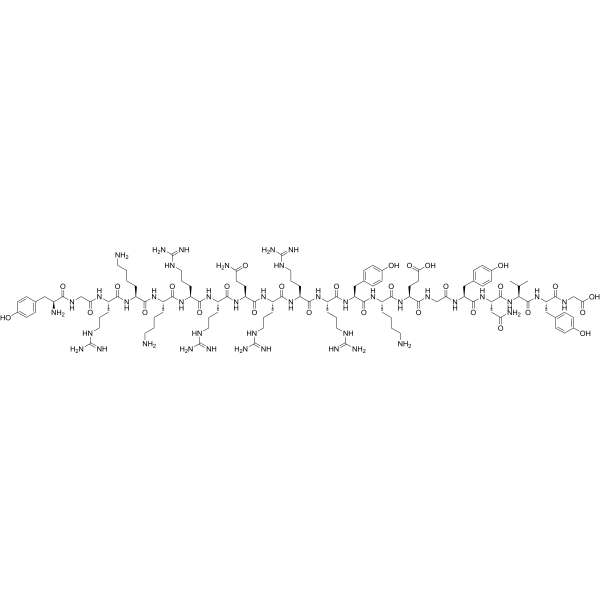
TAT-GluA2 3Y is a blood-brain barrier-permeable AMPA receptor inhibitory peptide that crosses cell membranes via the HIV-1 TAT protein domain. TAT-GluA2 3Y blocks the endocytosis of AMPA receptors, including the internalization of GluA1/GluA2 subunits, by disrupting interactions with the AP2, Brag2 and Syt3-GluA2 complexes, while also inhibiting long-term depression. TAT-GluA2 3Y blocks hypoxia-mediated AMPAR internalization, alleviates A1R-induced persistent synaptic inhibition, and reduces cerebral ischemic volume, neurological deficits and spatial memory deficits. TAT-GluA2 3Y blocks the effect of NLRP3 deficiency on fear generalization, inhibits amphetamine-induced behavioral/neurochemical sensitization, weakens the unconditioned stimulus-conditioned stimulus association of morphine, and promotes the extinction of morphine CPP. TAT-GluA2 3Y can be used in studies related to fear generalization, ischemic stroke, hypoxia, drug addiction and opioid addiction [1] .
Cat. No.: HY-P0281
CAS No.: 191936-91-1
Synonyms: TAT(47-57); HIV-1 TAT protein (47-57)
TAT (YGRKKRRQRRR) is derived from the transactivator of transcription (TAT) of human immunodeficiency virus-1 (HIV-1) and is a cell-penetrating peptide. TAT can increase the yields and the solubility of heterologous proteins [1].
Cat. No.: HY-P1491
CAS No.: 220408-24-2
Target:  

HIV

Research Areas:  

Infection

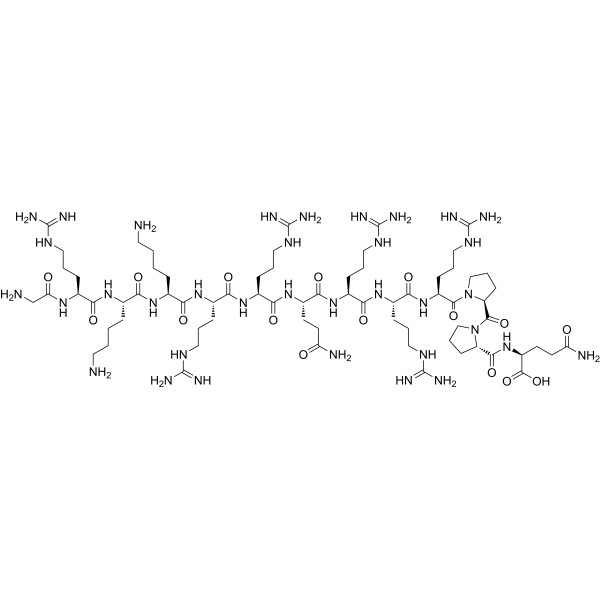
HIV-1 TAT (48-60) is a cell-penetrating peptide derived from the human immunodeficient virus (HIV)-1 Tat protein residue 48-60. It has been used to deliver exogenous macromolecules into cells in a non-disruptive way.
Cat. No.: HY-P0281A
Synonyms: TAT(47-57) TFA; HIV-1 TAT protein (47-57) TFA
Target:  

HIV

Research Areas:  

Infection

TAT TFA (YGRKKRRQRRR) is derived from the transactivator of transcription (TAT) of human immunodeficiency virus (HIV-1) and is a cell-penetrating peptide. TAT can increase the yields and the solubility of heterologous proteins [1].
Cat. No.: HY-P4125A
Target:  

HIV Fluorescent Dye

Research Areas:  

Others

FITC-LC-TAT (47-57) acetate is a FITC-labeled TAT peptide (HY-P0281) (λex: 493 nm, λem: 522 nm). Derived from the trans-activator of transcription (TAT) of immunodeficiency virus (HIV-1), TAT enhances the yield of heterologous proteins [1].
Cat. No.: HY-P2260B
Target:  

HIV

Research Areas:  

Infection

Tat-beclin 1 scrambled is the scrambled part and a scrambled control of Tat-beclin 1 (HY-P2260), which is derived from a region of the autophagy protein, beclin 1. beclin 1 induces autophagy via binding human immunodeficiency virus, HIV-1 Nef and interacting with negative regulator GAPR-1 (GLIPR2). Tat-beclin 1 decreases the accumulation of polyglutamine expansion protein aggregates and the replication of several pathogens, such as HIV-1. Tat-beclin 1 also reduces mortality in mice infected with chikungunya or West Nile virus [1].
Cat. No.: HY-P4125
Target:  

HIV Fluorescent Dye

Research Areas:  

Infection

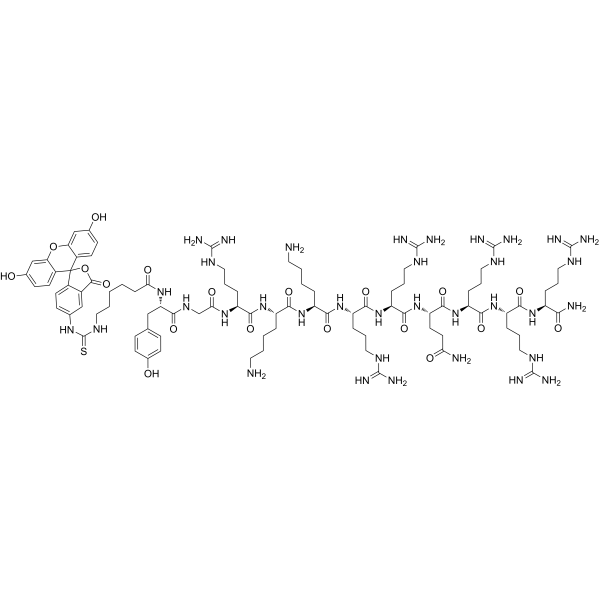
FITC-LC-TAT (47-57) is a FITC-labeled TAT peptide (HY-P0281) (λex: 493 nm, λem: 522 nm). Derived from the trans-activator of transcription (TAT) of human immunodeficiency virus (HIV-1), TAT enhances the yield of heterologous proteins [1].
Cat. No.: HY-P2260C
Target:  

HIV

Research Areas:  

Infection

Tat-beclin 1 scrambled TFA is the scrambled part and a scrambled control of Tat-beclin 1 (HY-P2260), which is derived from a region of the autophagy protein, beclin 1. beclin 1 induces autophagy via binding human immunodeficiency virus, HIV-1 Nef and interacting with negative regulator GAPR-1 (GLIPR2). Tat-beclin 1 decreases the accumulation of polyglutamine expansion protein aggregates and the replication of several pathogens, such as HIV-1. Tat-beclin 1 also reduces mortality in mice infected with chikungunya or West Nile virus [1].
Cat. No.: HY-P11152
CAS No.: 200203-20-9
Target:  

HIV

Research Areas:  

Infection Inflammation/Immunology

HIV-1 tat Protein (1-9) occurs extracellularly and has a role in the immunosuppression of non-HIV-1-infected T cells in acquired AIDS. HIV-1 tat Protein (1-9) is an inhibitor of DP IV. HIV-1 tat Protein (1-9) can be synthesized by phase peptide synthesis with Fmoc (N-(9-fluorenyl)methoxycarbonyl) technique using the peptide synthesizer 431A. HIV-1 tat Protein (1-9) can be studied in research on HIV-1 [1].
Cat. No.: HY-P0281B
Synonyms: TAT(47-57) acetate; HIV-1 TAT protein (47-57) acetate
Target:  

HIV

Research Areas:  

Infection

TAT (TAT(47-57)) acetate is derived from the transactivator of transcription (TAT) of human immunodeficiency virus-1 (HIV-1) and is a cell-penetrating peptide. TAT acetate can increase the yields and the solubility of heterologous proteins [1].
Cat. No.: HY-P2493
CAS No.: 627079-23-6
Target:  

HIV

Research Areas:  

Others

(Cys47)-HIV-1 tat Protein (47-57) has membrane translocation function and can be used to derivatize the surface of magnetic pharmaceuticals and substantially facilitated their uptake into target cells [1] .
Cat. No.: HY-P5947
Target:  

HIV

Research Areas:  

Neurological Disease

Tat-HA-NR2B9 contains a fragment of the cellmembrane transduction domain of HIV-1 Tat, a influenza virus hemagglutinin (HA) epitope-tag, and the C-terminal 9 amino acids of NR2B (NR2B9c). Tat-HA-NR2B9 reduces infarct size and improves neurological functions in ischemia-induced cerebral injury in the rats [1]
Cat. No.: HY-P0281F
Synonyms: Cy5-TAT(47-57) acetate; Cy5-HIV-1 TAT protein (47-57) acetate
Target:  

Fluorescent Dye

Research Areas:  

Others

Cy5-TAT acetate is a TAT peptide labeled with CY5 (HY-D0821) (Ex= 600-620 nm, Em= 670 nm). Cy5-TAT acetate can be used for fluorescence microscopy especially single-molecule fluorescence imaging [1].
Cat. No.: HY-P85390
Synonyms: KAT5; HTATIP; TIP60; Histone acetyltransferase KAT5; 60 kDa Tat-interactive protein; Tip60; Histone acetyltransferase HTATIP; HIV-1 Tat interactive protein; Lysine acetyltransferase 5; cPLA; 2; -interacting protein

Host:  

Mouse

Application:  

WB, FC

Reactivity:  

Human

  • 1

