



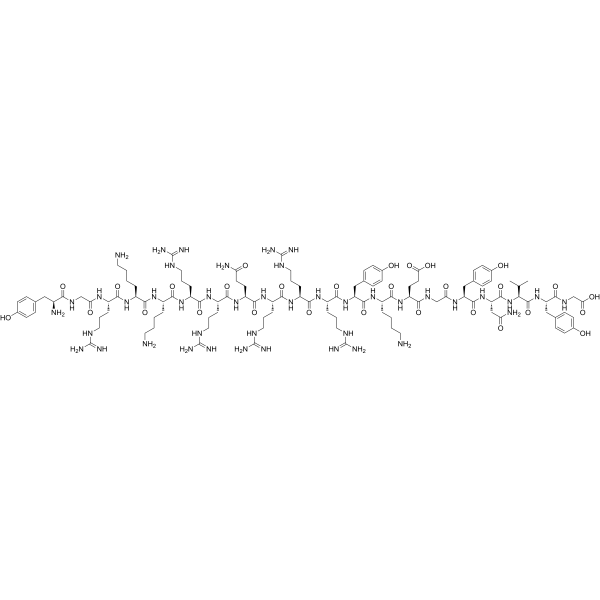
TAT-GluA2 3Y
Based on 2 publication(s) in Google Scholar
TAT-GluA2 3Y is a blood-brain barrier-permeable AMPA receptor inhibitory peptide that crosses cell membranes via the HIV-1 TAT protein domain. TAT-GluA2 3Y blocks the endocytosis of AMPA receptors, including the internalization of GluA1/GluA2 subunits, by disrupting interactions with the AP2, Brag2 and Syt3-GluA2 complexes, while also inhibiting long-term depression. TAT-GluA2 3Y blocks hypoxia-mediated AMPAR internalization, alleviates A1R-induced persistent synaptic inhibition, and reduces cerebral ischemic volume, neurological deficits and spatial memory deficits. TAT-GluA2 3Y blocks the effect of NLRP3 deficiency on fear generalization, inhibits amphetamine-induced behavioral/neurochemical sensitization, weakens the unconditioned stimulus-conditioned stimulus association of morphine, and promotes the extinction of morphine CPP. TAT-GluA2 3Y can be used in studies related to fear generalization, ischemic stroke, hypoxia, drug addiction and opioid addiction.
For research use only. We do not sell to patients.
- Purity : 99.93%
- CAS No.: 1404188-93-7
- Formula: C115H185N43O29
- Molecular Weight:2633.97
-
Storage:
Sealed storage, away from moisture and light, under nitrogen.
Powder -80°C, 2 years , -20°C, 1 year* In solvent : -80°C, 6 months; -20°C, 1 month (sealed storage, away from moisture and light, under nitrogen)

To place orders, for customer services and technical support, please contact: MedChemExpress USA
Tel: 609-228-6898 E-mail: [email protected] [email protected]


-
 Biological Activity
-
Chemical Information
-
Solvent & Solubility
- Protocols
- Purity & Documentation
- References
-
 Help & FAQs


Publications Citing Use of MedChemExpress (MCE) TAT-GluA2 3Y
MoreAll iGluR Isoforms
MoreAll Adenosine Receptor Isoforms
More

Biological Activity
Description
|
AMPA Receptor |
A1R |
In Vitro
Tat-GluA2-3Y (2 μM; 1 h pre-incubation) blocks clathrin-mediated endocytosis, thereby inhibiting A1R agonist- and hypoxia-induced internalization of GluA2 and GluA1 AMPARs, as well as A1R agonist-induced reduction in surface GluA2 and GluA1 AMPAR levels, in primary cultured rat hippocampal neurons[3].
Tat-GluA2-3Y (2 μM; 1 h pre-incubation) prevents A1R agonist-induced GluA2 AMPAR internalization in rat hippocampal slices[3].
The Tat-GluA2-3Y peptide (2 μM) can partially block clathrin-mediated GluA2 internalization, thereby attenuating the persistent synaptic inhibition induced by A1R agonists in the CA3-CA1 synapses of rat hippocampus[3].
MedChemExpress (MCE) has not independently confirmed the accuracy of these methods. They are for reference only. Further protocols information, click here.
In Vivo
TAT-GluA2 3Y (5 mg/kg; i.p.; multiple administrations) disrupts the interaction between Syt3 and GluA2, increases the surface expression level of GluA2, inhibits the formation of CP-AMPAR, reduces the cerebral ischemic volume by approximately 40%-50% in male SD rats with ischemic stroke induced by middle cerebral artery occlusion/reperfusion (MCAO/R), improves neurological function, and enhances the recovery of long-term sensorimotor and cognitive functions[2].
TAT-GluA2 3Y (1.5 nM/g; intravenous injection; 5 times (once before each dexamphetamine injection, once every 2 days)) blocks the induction, maintenance and expression of amphetamine-induced behavioral and neurochemical sensitization in male SD rats[4].
TAT-GluA2 3Y (15 pM; bilateral microinjection into the ventral tegmental area (VTA); 5 total injections, one before each d-amphetamine injection, once every 2 days) inhibits the maintenance and expression of amphetamine-induced behavioral sensitization in male SD rats, but does not inhibit its induction[4].
Co-administration of TAT-GluA2 3Y (intravenously injected at a dose of 1.5-2.25 nM/g; administered 1 h prior to each morphine conditioning session) with morphine during the acquisition phase of morphine-conditioned place preference (CPP) promotes rapid extinction of preference, but does not affect the induction, expression, maintenance or reinstatement of CPP[5].
TAT-GluA2 3Y (2.25 nM/g; intravenous injection; 1 hour prior to each food conditioning session) has no effect on the induction, extinction, or reinstatement of food-induced conditioned place preference in rats[5].
MedChemExpress (MCE) has not independently confirmed the accuracy of these methods. They are for reference only.
-
Animal Model:C57BL/6J background NLRP3 knockout (male, 8-10 weeks old)[1]
-
Dosage:4.32 μM/kg
-
Administration:i.p.; single dose
-
Result:Blocked the NLRP3 deprivation effect on fear generalization, as evidenced by a significant reduction in CS- freezing levels compared to untreated NLRP3 KO mice.
Left basal and CS+ freezing levels comparable between treated and untreated groups.
Recovered the hippocampal expression of phosphorylated AMPA receptor 1 at ser831.
Decreased phosphorylated CaMKII levels.
Left phosphorylated PKA levels unchanged.
-
Animal Model:Sprague-Dawley (male, 250-300 g, middle cerebral artery occlusion/reperfusion model)[2]
-
Dosage:5 mg/kg
-
Administration:i.p.; multiple doses (1 h before MCAO/R, 1 h after MCAO/R, 1 h before each behavioral test on days 3, 5, 7, 14, 21, 22, 23, 24, 25, 26, 27 post-MCAO/R)
-
Result:Reduced Syt3-GluA2 co-immunoprecipitation levels in penumbral tissue by ~90% compared with saline controls at 6 h post-MCAO/R.
Reduced ischemic volume to ~17% of total brain volume when administered 1 h before MCAO/R, compared with ~27% in scrambled peptide controls; reduced ischemic volume to ~20% when administered 1 h after MCAO/R.
Reduced mNSS scores to ~5 when administered 1 h before MCAO/R, and ~7 when administered 1 h after MCAO/R, compared with ~12 in scrambled peptide controls at 24 h post-reperfusion.
Increased surface GluA2 protein levels by ~40% in penumbral tissue at 6 h post-MCAO/R, compared with scrambled peptide controls, while intracellular GluA2 levels were reduced by ~40%.
Reduced AMPAR-mediated excitatory postsynaptic current amplitude reduction by Naspm to ~20%, compared with ~50% reduction in scrambled peptide controls.
Increased rotarod test latency to fall to ~220 s by day 21 post-MCAO/R, compared with ~150 s in scrambled peptide controls.
Reduced adhesive removal test contact time to ~10 s, and removal time to ~15 s by day 21 post-MCAO/R, compared with ~30 s and ~40 s, respectively, in scrambled peptide controls.
Reduced Morris water maze escape latency to ~20 s by day 26 post-MCAO/R, compared with ~30 s in scrambled peptide controls; increased platform crossings to ~3 times, compared with ~1 time in scrambled peptide controls.
-
Animal Model:Sprague-Dawley (male, 250-275 g, amphetamine-induced behavioural sensitization model)[4]
-
Dosage:1.5 nM/g
-
Administration:i.v.; 5 times (once before each d-amphetamine injection every second day)
-
Result:Blocked the induction of locomotor sensitization.
Attenuated d-amphetamine-induced dopamine efflux in the NAcc on day 9 to 278% of baseline, compared to 633% on day 1.
Reduced the locomotor response to the d-amphetamine challenge significantly compared to vehicle or scrambled peptide control groups, with no significant difference from drug-naive rats.
Blocked neurochemical sensitization, with d-amphetamine-induced dopamine efflux in the NAcc significantly lower than scrambled peptide control.
-
Animal Model:Sprague-Dawley (male, 250-275 g, amphetamine-induced behavioural sensitization model)[4]
-
Dosage:15 pM
-
Administration:bilateral microinjection into VTA; 5 times (once before each d-amphetamine injection every second day)
-
Result:Did not affect the induction of locomotor sensitization, with significant increases in cumulative 30-min distance travelled from day 1 to day .
Reduced the locomotor response to the d-amphetamine challenge significantly compared to vehicle or scrambled peptide control groups, blocking the maintenance and expression of behavioural sensitization.
-
Animal Model:Sprague-Dawley (male, 220-240 g at arrival, morphine-induced conditioned place preference model)[5]
-
Dosage:1.5 nM/g; 2.25 nM/g
-
Administration:i.v.; 1 h before each morphine conditioning session
-
Result:Had no effect on induction, initial expression, or maintenance of morphine-induced CPP, with rats maintaining a significant preference for the morphine-associated compartment in bi-weekly tests over 8 weeks.
Greatly facilitated extinction: rats treated with 1.5 nmol/g or 2.25 nmol/g failed to display a consistent preference for the morphine-paired compartment across 11 extinction days, whereas saline or scrambled peptide controls maintained preference until days 9 and 11 respectively.
Had no effect on morphine-induced reinstatement of CPP, with all groups showing a significant preference for the morphine-associated compartment during retesting.
-
Animal Model:Sprague-Dawley (male, weight maintained at 90% of standard growth curve, food-induced conditioned place preference model)[5]
-
Dosage:2.25 nM/g
-
Administration:i.v.; 1 h before each food conditioning session
-
Result:Had no effect on induction, extinction, or reinstatement of food-induced CPP.
All groups displayed a significant preference for the food-associated compartment during initial testing, extinguished their preference within 15 days, and showed significant reinstatement after exposure to a Froot Loop, with no group differences detected via two-way ANOVA for any phase.


Chemical Information
-
CAS No. 1404188-93-7
-
Appearance Solid
-
Molecular Weight 2633.97
-
Formula C115H185N43O29
-
Color White to off-white
-
Sequence Shortening
YGRKKRRQRRRYKEGYNVYG
-
Shipping
Room temperature in continental US; may vary elsewhere.
-
Storage
Sealed storage, away from moisture and light, under nitrogen
Powder -80°C 2 years -20°C 1 year * In solvent : -80°C, 6 months; -20°C, 1 month (sealed storage, away from moisture and light, under nitrogen)


Publications (2)
-
Journal Impact Factor
-
Most Recent
-
Nature
2025 May;641(8062):427-437. PMID: 40205038 -
Biochem Biophys Res Commun
AMPA receptor potentiation alleviates NLRP3 knockout-induced fear generalization in mice. [Abstract]2024 Aug 30:722:150074. PMID: 38805785


Solvent & Solubility
In Vitro:
H2O : 100 mg/mL (37.97 mM; Need ultrasonic)
Please refer to the solubility information to select the appropriate solvent. Once prepared, please aliquot and store the solution to prevent product inactivation from repeated freeze-thaw cycles.
Storage method and period of stock solution: -80°C, 6 months; -20°C, 1 month (sealed storage, away from moisture and light, under nitrogen). When stored at -80°C, please use it within 6 months. When stored at -20°C, please use it within 1 month.
* Note: If you choose water as the stock solution, please dilute it to the working solution, then filter and sterilize it with a 0.22 μm filter before use.
Please refer to the solubility information to select the appropriate solvent. Once prepared, please aliquot and store the solution to prevent product inactivation from repeated freeze-thaw cycles.
Storage method and period of stock solution: -80°C, 6 months; -20°C, 1 month (sealed storage, away from moisture and light, under nitrogen). When stored at -80°C, please use it within 6 months. When stored at -20°C, please use it within 1 month.
* Note: If you choose water as the stock solution, please dilute it to the working solution, then filter and sterilize it with a 0.22 μm filter before use.
Concentration (start) × Volume (start) = Concentration (final) × Volume (final)
In Vivo:
For the following dissolution methods, please prepare the working solution directly:
It is recommended to prepare fresh solutions and use them promptly within a short period of time.
The percentages shown for the solvents indicate their volumetric ratio in the final prepared solution. If precipitation or phase separation occurs during preparation, heat and/or sonication can be used to aid dissolution.
Add each solvent one by one: PBS
Solubility: 100 mg/mL (37.97 mM); Clear solution; Need ultrasonic

Protocols
-
Protocol for Water Maze
The Morris Water Maze is a rodent spatial learning and memory assay in which a mouse or rat swims in opaque water to find an escape platform; in the hidden-platform version, the animal cannot see the platform and must use distal extra-maze cues to learn its fixed spatial location. The assay primarily measures hippocampus-dependent spatial learning during acquisition trials and spatial reference memory during probe trials after platform removal; readouts include escape latency, swim path length, swim speed, quadrant occupancy, platform-site crossings, and proximity to the former platform location.


Purity & Documentation
-
Data Sheet (288 KB)
-
SDS (254 KB)
- English - EN (254 KB)
- Français - FR (254 KB)
- Deutsch - DE (254 KB)
- Norwegian - NO (254 KB)
- Español - ES (254 KB)
- Swedish - SV (254 KB)
- Italian - IT (254 KB)
- Korean - KR (254 KB)
- Portuguese - PT (254 KB)
-
Handling Instructions (2659 KB)
References
[1]. Li W, et al. AMPA receptor potentiation alleviates NLRP3 knockout-induced fear generalization in mice. Biochem Biophys Res Commun. 2024;722:150074. [Content Brief]
[2]. Lu H, et al. Synaptotagmin-3 interactions with GluA2 mediate brain damage and impair functional recovery in stroke. Cell Rep. 2023;42(3):112233. [Content Brief]
[3]. Chen Z, et al. Prolonged adenosine A1 receptor activation in hypoxia and pial vessel disruption focal cortical ischemia facilitates clathrin-mediated AMPA receptor endocytosis and long-lasting synaptic inhibition in rat hippocampal CA3-CA1 synapses: differential regulation of GluA2 and GluA1 subunits by p38 MAPK and JNK. J Neurosci. 2014;34(29):9621-9643. [Content Brief]
[4]. Choi FY, et al.Interference with AMPA receptor endocytosis: effects on behavioural and neurochemical correlates of amphetamine sensitization in male rats. J Psychiatry Neurosci. 2014 May;39(3):189-99. [Content Brief]
[5]. Dias C, et al. Facilitated extinction of morphine conditioned place preference with Tat-GluA2(3Y) interference peptide. Behav Brain Res. 2012 Aug 1;233(2):389-97. [Content Brief]


Complete Stock Solution Preparation Table
Please refer to the solubility information to select the appropriate solvent. Once prepared, please aliquot and store the solution to prevent product inactivation from repeated freeze-thaw cycles.
Storage method and period of stock solution: -80°C, 6 months; -20°C, 1 month (sealed storage, away from moisture and light, under nitrogen). When stored at -80°C, please use it within 6 months. When stored at -20°C, please use it within 1 month.
| Optional Solvent | Concentration Solvent Mass | 1 mg | 5 mg | 10 mg | 25 mg |
|---|---|---|---|---|---|
| H2O | 1 mM | 0.3797 mL | 1.8983 mL | 3.7966 mL | 9.4914 mL |
| 5 mM | 0.0759 mL | 0.3797 mL | 0.7593 mL | 1.8983 mL | |
| 10 mM | 0.0380 mL | 0.1898 mL | 0.3797 mL | 0.9491 mL | |
| 15 mM | 0.0253 mL | 0.1266 mL | 0.2531 mL | 0.6328 mL | |
| 20 mM | 0.0190 mL | 0.0949 mL | 0.1898 mL | 0.4746 mL | |
| 25 mM | 0.0152 mL | 0.0759 mL | 0.1519 mL | 0.3797 mL | |
| 30 mM | 0.0127 mL | 0.0633 mL | 0.1266 mL | 0.3164 mL |
* Note: If you choose water as the stock solution, please dilute it to the working solution, then filter and sterilize it with a 0.22 μm filter before use.


TAT-GluA2 3Y Related Classifications
HY-P2259 Related Classifications
 Powered by Bioz