



SIRT4
SIRT4 is a mitochondrial member of the sirtuin family that functions as an NAD+-dependent metabolic regulator and is distinguished by its prominent ADP-ribosyltransferase activity toward glutamate dehydrogenase (GDH)[1][2]. Mechanistically, SIRT4 represses mitochondrial glutamine and glutamate metabolism through ADP-ribosylation-mediated inhibition of GDH, thereby reducing amino acid-stimulated insulin secretion and modulating cellular energy homeostasis[1][2][3]. Beyond GDH regulation, SIRT4 participates in broader metabolic control, including the regulation of fatty acid oxidation, branched-chain amino acid catabolism, and mitochondrial metabolic adaptation during nutrient stress[4][5][6]. These functions position SIRT4 as an important regulator of mitochondrial metabolism and endocrine signaling in pancreatic β cells and other metabolically active tissues[1][4]. In disease contexts, reduced SIRT4 activity or expression has been associated with enhanced glutamine utilization and tumor progression, whereas restoration of SIRT4 suppresses proliferation and promotes tumor-suppressive metabolic programs in multiple experimental cancer models[7][8][9]. Compared with related mitochondrial isoforms such as SIRT3 and SIRT5, which primarily function through deacylation-dependent activation or remodeling of metabolic enzymes, SIRT4 is notable for suppressing metabolic flux through ADP-ribosylation-mediated inhibition of key mitochondrial targets[1][10]. For experimental applications, selective SIRT4 inhibitors have recently been reported, providing emerging tools for mechanistic studies of mitochondrial metabolism, insulin secretion, and cancer-associated metabolic reprogramming[11].
Verweise:
- [1]. Haigis MC, et al. SIRT4 inhibits glutamate dehydrogenase and opposes the effects of calorie restriction in pancreatic beta cells. Cell. 2006 Sep 8;126(5):941-54. [Content Brief]
- [2]. Caride AJ, et al. The plasma membrane Ca2+ pump isoform 4a differs from isoform 4b in the mechanism of calmodulin binding and activation kinetics: implications for Ca2+ signaling. J Biol Chem. 2007 Aug 31;282(35):25640-8. [Content Brief]
- [3]. Zaganjor E, et al. SIRT4 Is a Regulator of Insulin Secretion. Cell Chem Biol. 2017;24(6):656-658.
- [4]. Min Z, et al. The Roles of Mitochondrial SIRT4 in Cellular Metabolism. Front Endocrinol (Lausanne). 2019;9:783.
- [5]. Zaganjor E, et al. SIRT4 is an early regulator of branched-chain amino acid catabolism that promotes adipogenesis. Cell Rep. 2021 Jul 13;36(2):109345. [Content Brief]
- [6]. Wood JG, et al. Sirt4 is a mitochondrial regulator of metabolism and lifespan in Drosophila melanogaster. Proc Natl Acad Sci U S A. 2018 Feb 13;115(7):1564-1569. [Content Brief]
- [7]. Li J, et al. Sirtuin 4 activates autophagy and inhibits tumorigenesis by upregulating the p53 signaling pathway. Cell Death Differ. 2023;30:313-326.
- [8]. Cai G, et al. SIRT4 functions as a tumor suppressor during prostate cancer by inducing apoptosis and inhibiting glutamine metabolism. Sci Rep. 2022 Jul 16;12(1):12208. [Content Brief]
- [9]. Wang C, et al. Mammalian SIRT4 is a tumor suppressor of clear cell renal cell carcinoma by inhibiting cancer proliferation, migration and invasion. Cancer Biomark. 2020;29(4):453-462. [Content Brief]
- [10]. Kim E A, et al. Inhibition of glutamate dehydrogenase and insulin secretion by KHG26377 does not involve ADP-ribosylation by SIRT4 or deacetylation by SIRT3[J]. Bmb Reports, 2012, 45(8): 458-463.
- [11]. Pannek M, et al. Specific Inhibitors of Mitochondrial Deacylase Sirtuin 4 Endowed with Cellular Activity. J Med Chem. 2024 Feb 8;67(3):1843-1860. [Content Brief]
All Product Categories
-
SIRT4 Verwandte Produkte (1)
Verwandte Produkte (1)

-
SIRT4-IN-1
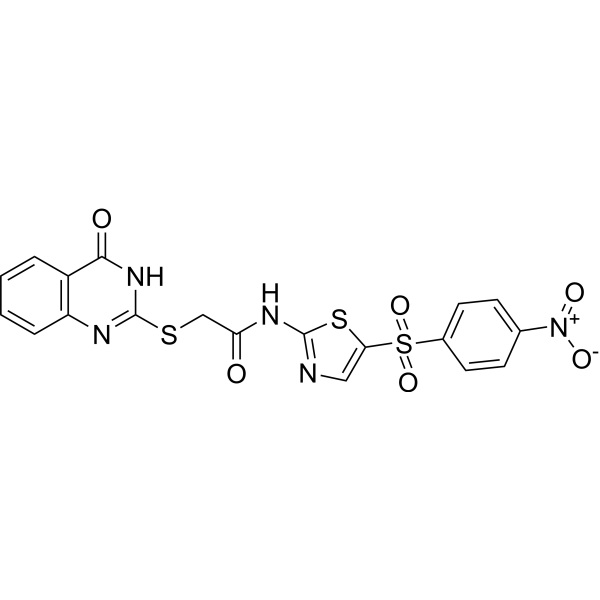 0 ImagesSIRT4-IN-1 is a selective and potent Sirtuin 4 (Sirt4) inhibitor with an IC50 of 16 μM for hSirt4. SIRT4-IN-1 also inhibits hSirt1, hSirt2, hSirt3, hSirt4 and hSirt6. SIRT4-IN-1 competes with acyl peptide substrate for Sirt4's acyl binding site, and is noncompetitive with NAD+. SIRT4-IN-1 increases glutamate dehydrogenase (GDH) activity and rescues pyruvate dehydrogenase (PDH) activity. SIRT4-IN-1 inhibits adipocyte differentiation and suppresses Sirt4 overexpression-induced increased differentiation. SIRT4-IN-1 can be used for the researches of cancer and metabolic disease.



