



TSSK
Testis-Specific Serine/Threonine Kinase
TSSK, or testis-specific serine/threonine kinase, belongs to the calcium/calmodulin kinase (CAMK) superfamily. It is a family of protein kinases specifically expressed in the testes and primarily regulate spermatogenesis and fertilization. This family contains six subtypes (TSSK1-TSSK6). In humans, TSSK5 is a pseudogene, and there is also a primate-specific pseudogene, TSSK1B. The core functional subtypes are TSSK1, TSSK2, TSSK3, TSSK4, and TSSK6. TSSK1/2 have the highest homology and similar structure, while TSSK3/4/6 contain only kinase domains. Key interactions/upstream and downstream targets include the substrate TSKS, the molecular chaperone HSP90, the upstream kinase PDK1, and the downstream substrates Odf2, CREB, and histones. TSSK1/2 specifically phosphorylates TSKS, TSSK4 phosphorylates Odf2 and CREB, TSSK6 participates in histone phosphorylation, and HSP90 is responsible for stabilization and activation. TSSK family kinases, PDK1 activates TSSK3; TSSK family is specifically expressed in the testes and mainly functions in sperm cells after meiosis. TSSK1/2/6 regulate sperm morphology, chromatin remodeling, and sperm-egg fusion. TSSK4 maintains sperm flagella structure and motility. TSSK3 is specifically expressed in testicular Ledich cells. Related disease areas focus on male infertility (oligospermia/asthenospermia/azoospermia, sperm abnormalities, fertilization disorders). At the same time, abnormal expression of TSSK2/3/6 is related to tumor proliferation and survival, and is a potential target for cancer research[1][2][3].
References:
- [1]. Zuercher G, et al. A novel member of the testis specific serine kinase family, tssk-3, expressed in the Leydig cells of sexually mature mice. Mech Dev. 2000 May;93(1-2):175-7. [Content Brief]
- [2]. Hao Z, et al. Expression analysis of the human testis-specific serine/threonine kinase (TSSK) homologues. A TSSK member is present in the equatorial segment of human sperm. Mol Hum Reprod. 2004 Jun;10(6):433-44. [Content Brief]
- [3]. Salicioni AM, et al. Testis-specific serine kinase protein family in male fertility and as targets for non-hormonal male contraception?. Biol Reprod. 2020 Aug 4;103(2):264-274. [Content Brief]
All Product Categories
-
TSSK Related Products (2)
Related Products (2)

-
ALK inhibitor 2
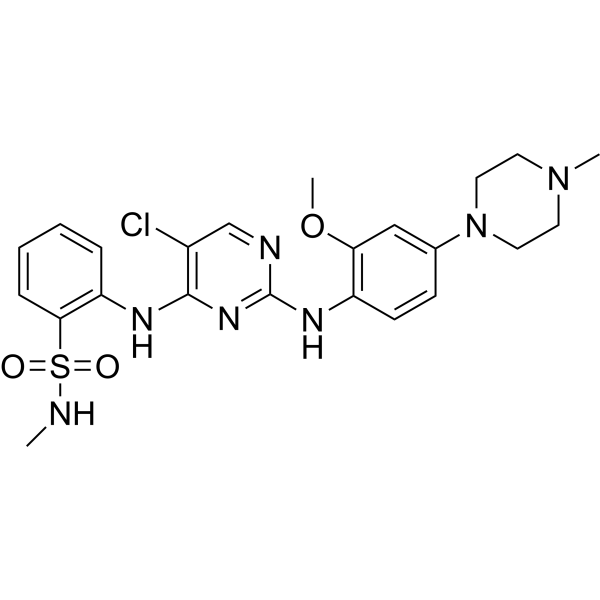 0 ImagesALK inhibitor 2 (compound 18) is a potent pyrimidin ALK inhibitor. ALK inhibitor 2 is a potent inhibitor of testis-specific serine/threonine kinase 2 (TSSK2; IC50=37 nM) and focal adhesion kinase (FAK; IC50=5 nM).
-
ALK inhibitor 1
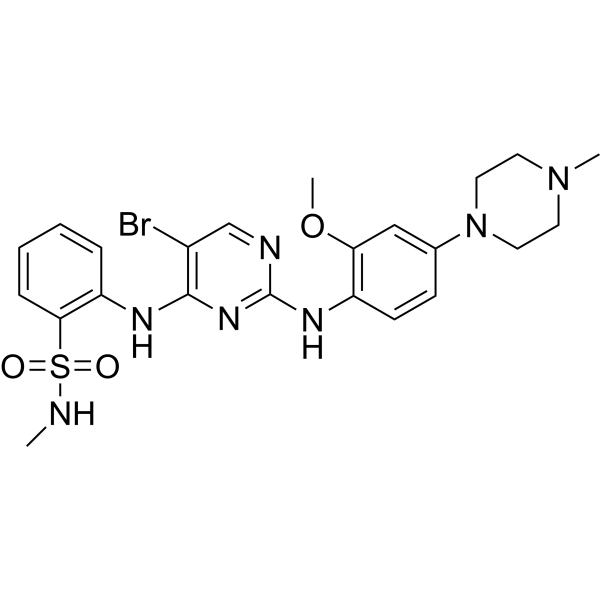 0 ImagesALK inhibitor 1 (compound 17) is a potent pyrimidin ALK inhibitor. ALK inhibitor 1 is a potent inhibitor of testis-specific serine/threonine kinase 2 (TSSK2; IC50=31 nM) and focal adhesion kinase (FAK; IC50=2 nM).



