



CRY2
CRY2 (Cryptochrome Circadian Regulator 2) is a flavin adenine dinucleotide (FAD)-binding core component of the mammalian circadian oscillator that participates in the transcription-translation negative feedback loop controlling circadian rhythmicity[1][2]. CRY2 is transcriptionally activated by the CLOCK:BMAL1 complex and subsequently represses CLOCK:BMAL1-dependent gene expression through PER/CRY-mediated feedback regulation, thereby maintaining circadian clock function and physiological timing programs[1][3]. Mechanistically, CRY2 functions as a transcriptional repressor within large PER-CRY complexes, regulating rhythmic processes linked to metabolism, sleep-wake cycles, and tissue-specific clock outputs[2][3]. In disease-relevant and experimental models, disruption of CRY2 activity has been associated with altered sleep patterns, metabolic regulation, cognitive decline following sleep deprivation, and circadian dysfunction, supporting its importance in physiological and pathological clock regulation[1][4]. Compared with the closely related isoform CRY1, CRY2 exhibits weaker repression of CLOCK:BMAL1 and displays distinct structural and biochemical properties that contribute to differential circadian period regulation[2][5]. Structural studies demonstrated that differences within the FAD-binding pocket, lid loop, secondary pocket, and serine loop influence protein interactions and underlie isoform-selective regulatory mechanisms between CRY1 and CRY2[2][5]. Therefore, CRY2 has become an important target for chemical biology and circadian research, where structural insights are guiding the development of small-molecule modulators and isoform-selective compounds for mechanistic studies of clock-associated biological processes and diseases[2][6].
References:
- [1]. CRY2 gene information from NCBI.
- [2]. Miller S, et al. Structural and Chemical Biology Approaches Reveal Isoform-Selective Mechanisms of Ligand Interactions in Mammalian Cryptochromes. Front Physiol. 2022 Jan 28;13:837280. [Content Brief]
- [3]. Uniprotkb.
- [4]. Luo S, et al. CRY2 mediates the cognitive decline induced by sleep deprivation in 5xFAD mice. PLoS One. 2024 Jul 16;19(7):e0306930. [Content Brief]
- [5]. Fribourgh JL, et al. Dynamics at the serine loop underlie differential affinity of cryptochromes for CLOCK:BMAL1 to control circadian timing. Elife. 2020 Feb 26;9:e55275. [Content Brief]
- [6]. Kowada T, et al. Quantitative Imaging of Labile Zn2+ in the Golgi Apparatus Using a Localizable Small-Molecule Fluorescent Probe. Cell Chem Biol. 2020 Dec 17;27(12):1521-1531.e8. [Content Brief]
-
CRY2 Related Products (3)
Related Products (3)

-
KL001
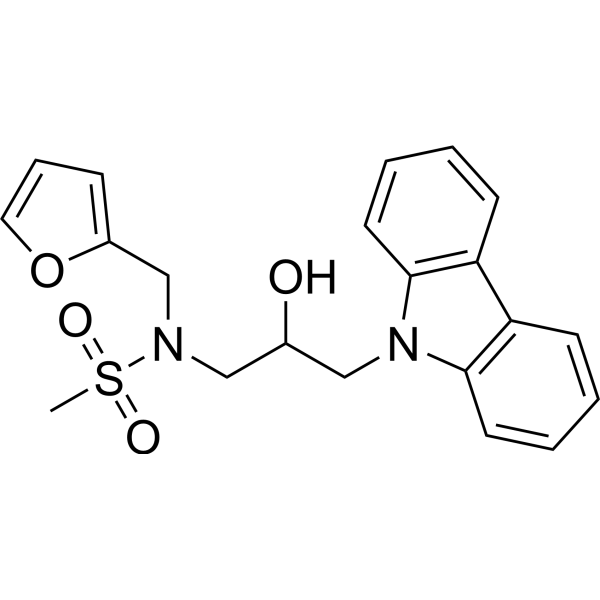 0 ImagesKL001 is a first-in-class cryptochrome (CRY, a flavoproteins that are sensitive to blue light, and is involved in the circadian rhythms of plants and animals) stabilizer which specifically interacts with CRY1 and CRY2. KL001 prevents ubiquitin-dependent degradation of CRY, resulting in lengthening of the circadian period. KL001 has the potential to control fasting hormone-induced gluconeogenesis.
-
KL201
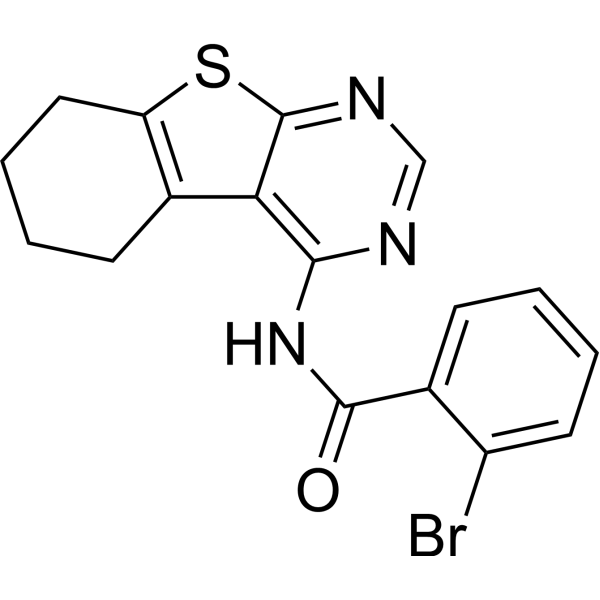 0 ImagesKL201 a circadian clock modulator, is a isoform-selective cryptochrome 1 (CRY1) stabilizer. KL201 has no stabilizing effect on CRY2. KL201 lengthens the period of circadian rhythms in cells and tissues.
-
TH301
 0 ImagesCat. No.: HY-134192CAS No.: 450338-32-6TH301 is a Phenylpyrazole derivative. TH301 selectively stabilize CRY2. TH301 dose-dependently prolongs circadian period.



