



Pep4c
Pep4c is an inactive control peptide for Pep2m (HY-P1058). Pep4c lacks functional activity to disrupt Protein Interacting with C Kinase 1 (PICK1)-AMPA receptor (GluA2) or N-ethylmaleimide-sensitive factor (NSF)-GluA2 interactions. Pep4c is used as a negative control in experiments to validate the specificity of Pep2m's effects on AMPA receptor trafficking and synaptic plasticity[1][2][3][4][5][6].
Nur für Forschungszwecke. Wir verkaufen nicht an Patienten.
- CAS. Nr.: 243843-43-8
- Formel: C48H91N17O13S
- Molecular Weight:1146.41
-
Speicherung:
Please store the product under the recommended conditions in the Certificate of Analysis.


To place orders, for customer services and technical support, please contact: MedChemExpress USA
Tel: 609-228-6898 E-mail: [email protected] [email protected]


-
 Biologische Aktivität
-
Chemical Information
- Reinheit & Dokumentation
- Verweise
-
 Help & FAQs


-
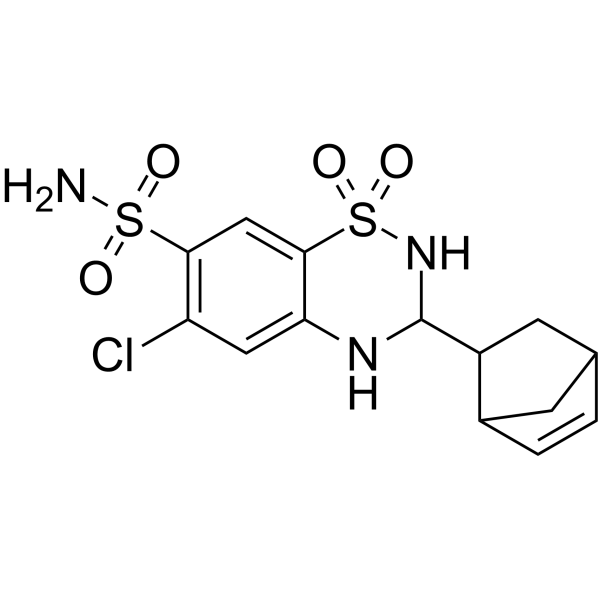
HY-101165
CyclothiazideAMPA Receptors PAM -
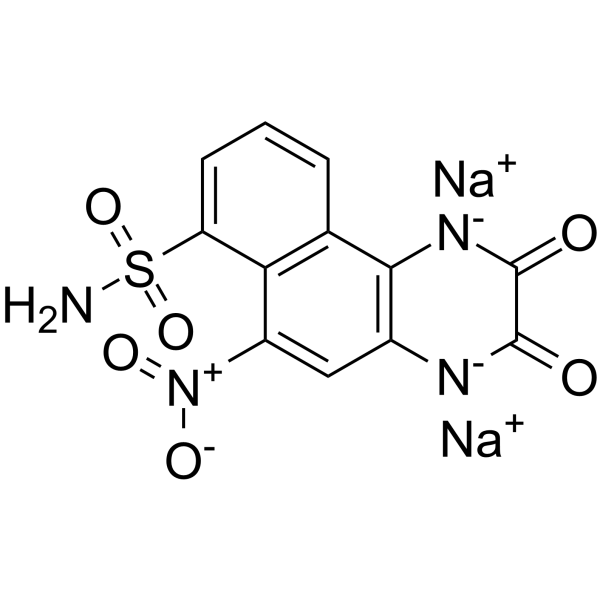
HY-15068A
NBQX disodiumAMPA Receptor Antagonist -
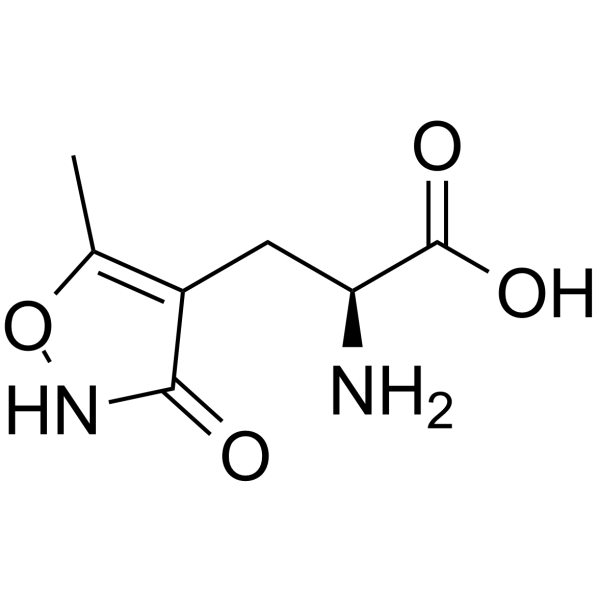
HY-100815A
(S)-AMPAAMPA Receptor Agonist -
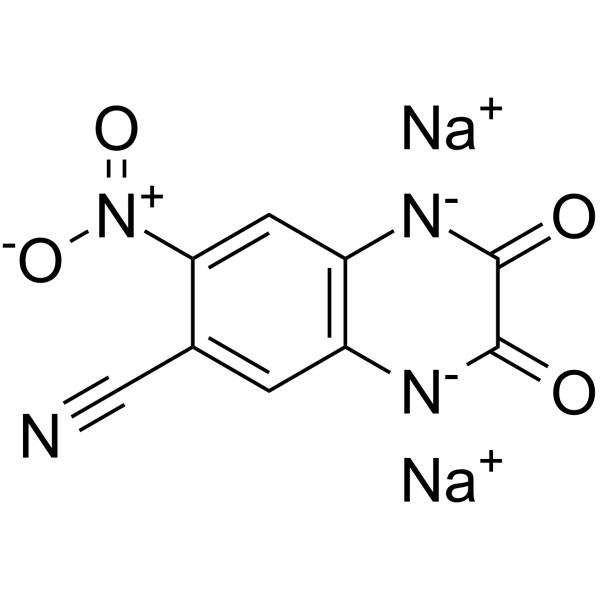
HY-15066A
CNQX disodiumiGluR Antagonist -
HY-12597
Quisqualic acidmGluR Activator -
HY-103230
IEM-1460 -
HY-18663
CP-465022AMPA Receptor Antagonist -
HY-101528
IDRA 21AMPA Modulator -
HY-15071
YM90KAMPA Receptor Antagonist -
HY-100815C
(RS)-AMPA hydrobromideL-glutamic Acid Agonist -
HY-103229
Cl-HIBOGluR1/2/AMPA Receptor Agonist -
HY-103232
IEM-1925 bromideGlutamate Receptor Antagonist
Alle iGluR Isoform-spezifische Produkte anzeigen
More

Biologische Aktivität
Beschreibung
IC50 & Target
[1][2][3][4][5][6]|
AMPA Receptor |
NMDA Receptor |
In Vitro
Pep4c does not reduce the current response to topically applied AMPA, nor does it affect the frequency and amplitude of AMPA-mEPSCs in cultured hippocampal neurons[1].
Pep4c does not alter the surface expression of AMPA receptors in cultured hippocampal neurons but improves the colocalization of GluR2 and synaptophysin in cultured hippocampal neurons[1].
Pep4c does not affect long-term depression (LTD) and basal parallel fiber excitatory postsynaptic current (PF-EPSC) in hippocampal slices, but can induce long-term potentiation (LTP) by 1 Hz parallel fiber (PF) stimulation[2][3].
Pep4c does not bind to NSF and does not alter autistic EPSCs evoked in Pep2m-loaded neurons[4].
Pep4c does not alter the release of radiolabeled D-aspartate ([3H]D-ASP) in rat hippocampal synaptosomes, either in the absence (not shown) or in the presence of 50 μM (S)AMPA[5].
Pep4c does not affect tritium release induced by 10 μM NMDA/1 μM Glycine (HY-Y0966), but caused changes in [3H]D-ASP release induced by 10 μM NMDA/1 μM Glycine and 10 μM NMDA/1 μM Glycine/50 μM (S)AMPA[5].
Pep4c does not attenuate synaptic transmission[6].
MedChemExpress (MCE) has not independently confirmed the accuracy of these methods. They are for reference only.


Chemical Information
-
CAS. Nr. 243843-43-8
-
Molecular Weight 1146.41
-
Formel C48H91N17O13S
-
Sequence
Lys-Arg-Met-Lys-Val-Ala-Lys-Ser-Ala-Gln
-
Sequence Shortening
KRMKVAKSAQ
-
Versand
Room temperature in continental US; may vary elsewhere.
-
Speicherung
Please store the product under the recommended conditions in the Certificate of Analysis.


Reinheit & Dokumentation
Verweise
[1]. Noel J, et al. Surface expression of AMPA receptors in hippocampal neurons is regulated by an NSF-dependent mechanism. Neuron. 1999 Jun;23(2):365-76. [Content Brief]
[2]. Lüthi A, et al. Hippocampal LTD expression involves a pool of AMPARs regulated by the NSF-GluR2 interaction. Neuron. 1999 Oct;24(2):389-99. [Content Brief]
[3]. Gallimore AR, et al. Switching On Depression and Potentiation in the Cerebellum. Cell Rep. 2018 Jan 16;22(3):722-733. [Content Brief]
[4]. Cingolani LA, et al. Activity-dependent regulation of synaptic AMPA receptor composition and abundance by beta3 integrins. Neuron. 2008 Jun 12;58(5):749-62. [Content Brief]
[5]. Summa M, et al. Hippocampal AMPA autoreceptors positively coupled to NMDA autoreceptors traffic in a constitutive manner and undergo adaptative changes following enriched environment training. Neuropharmacology. 2011 Dec;61(8):1282-90. [Content Brief]
[6]. Correia SS, et al. Motor protein-dependent transport of AMPA receptors into spines during long-term potentiation. Nat Neurosci. 2008 Apr;11(4):457-66. [Content Brief]

Calculators
Konzentration (Stammlösung) × Volumen (Stammlösung) = Konzentration (Ziellösung) × Volumen (Ziellösung)


Pep4c Related Classifications
HY-P1057 Related Classifications
 Powered by Bioz