



Bovinic acid
Based on 1 publication(s) in Google Scholar
Bovinic acid is an orally active anti-inflammatory agent. Bovinic acid inhibits oxidative stress and ferroptosis by regulating the Keap1-Nrf2 signaling pathway. Bovinic acid exerts hepatoprotective effects against alcohol-associated liver disease. Bovinic acid can be used for the research of alcohol-associated liver disease.
Nur für Forschungszwecke. Wir verkaufen nicht an Patienten.
- Reinheit: 96.21%
- CAS. Nr.: 2540-56-9
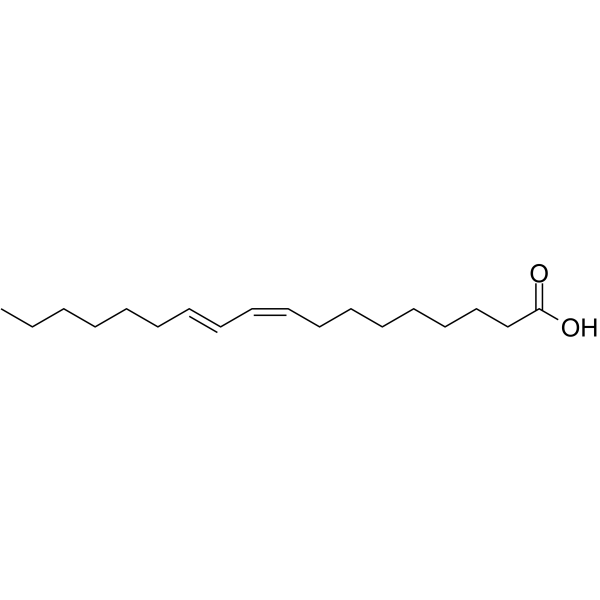
- Formel: C18H32O2
- Molecular Weight:280.45
-
Speicherung:Pure form -20°C, 3 years ; In solvent -80°C, 6 months , -20°C, 1 month

To place orders, for customer services and technical support, please contact: MedChemExpress USA
Tel: 609-228-6898 E-mail: [email protected] [email protected]


-
 Biologische Aktivität
-
Chemical Information
-
Lösungsmittel & Löslichkeit
- Reinheit & Dokumentation
- Verweise
-
 Help & FAQs
-

Immunology/Inflammation Compound Library
HY-L007
-
Metabolism/Protease Compound Library
HY-L012
-
NF-κB Signaling Compound Library
HY-L014
-
Stem Cell Signaling Compound Library
HY-L017
-
Natural Product Library
HY-L021
-
Anti-Cancer Compound Library
HY-L025
-
Anti-Aging Compound Library
HY-L034
-
Antioxidant Compound Library
HY-L037
-
Lipid Compound Library
HY-L043
-
Oxygen Sensing Compound Library
HY-L045
-
Ferroptosis Compound Library
HY-L051
-
Anti-Cancer Metabolism Compound Library
HY-L083
-
Anti-Parkinson's Disease Compound Library
HY-L085
-
Neurodegenerative Disease-related Compound Library
HY-L086
-
Transcription Factor-Targeted Library
HY-L090
-
Food-Sourced Compound Library
HY-L094
-
Anti-Cancer Natural Product Library
HY-L107
-
Human Metabolite Library
HY-L123
-
Animal-Sourced Natural Product Library
HY-L157
-
Cell Death Library
HY-L162
-
Multi-Target Compound Library
HY-L176
-
Radioprotector Library
HY-L178
-
Bioactive Compound Library Max
HY-L181
-
MCE Bioactive Compound Library
HY-L001V
-
Natural Product Library Plus
HY-L021P
-
Natural Product and Natural Product-Like Compound Library
HY-L021M
-
Bioactive Compound Library
HY-L001
-
Fatty Acids Compound Library
HY-L182
-
High-Throughput Bioactive Compound Library
HY-L205
-
High-Throughput Natural Product Library
HY-L206
-
Mass Spectrometry Human Metabolite Library
HY-L215
-
Lipid Metabolite Compound Library
HY-L228
-
Natural Product Diversity Scaffold Library
HY-L245
-
Lactylation Compound Library
HY-L249
-
Mass Spectrometry Natural Product Library
HY-L262


Publications Citing Use of MedChemExpress (MCE) Bovinic acid
More

Biologische Aktivität
|
Human Endogenous Metabolite |
Bovinic acid (0.5-50 μM) inhibits oxidative stress and ferroptosis in HepG2 cells treated with ethanol/tBHP (reducing the levels of ROS, MDA, and Fe2+, and enhancing the activities of SOD and GSH)[1].
Bovinic acid activates the Keap1-Nrf2 antioxidant signaling pathway in ethanol/tBHP-treated HepG2 cells by downregulating Keap1 and upregulating Nrf2 and HMOX1[1].
Bovinic acid inhibits TFRC-mediated iron uptake in ethanol/tBHP-treated HepG2 cells by downregulating TFRC mRNA expression[1].
MedChemExpress (MCE) has not independently confirmed the accuracy of these methods. They are for reference only.
MedChemExpress (MCE) has not independently confirmed the accuracy of these methods. They are for reference only.
-
Animal Model:C57BL/6J (male, 8 weeks old, alcohol-associated liver disease model)[1]
-
Dosage:0.1 g/kg
-
Administration:i.g.; daily; 10 days
-
Result:Significantly reduced elevated serum alanine aminotransferase (ALT) and aspartate aminotransferase (AST) levels.
Increased hepatic superoxide dismutase (SOD) activity.
Decreased hepatic malondialdehyde (MDA) levels.
Reduced hepatic Fe2+ levels.
Improved liver parenchymal morphology and reduced hepatic inflammation (H&E staining).


Chemical Information
-
CAS. Nr. 2540-56-9
-
Appearance Liquid (Density: 0.911±0.06 g/cm3)
-
Molecular Weight 280.45
-
Formel C18H32O2
-
Color Colorless to light yellow
-
SMILES
CCCCCC/C=C/C=C\CCCCCCCC(O)=O
-
Structure Classification
-
Initial Source
-
Versand
Room temperature in continental US; may vary elsewhere.
-
Speicherung
Pure form -20°C 3 years In solvent -80°C 6 months -20°C 1 month


Publications (1)
-
Journal Impact Factor
-
Most Recent


Lösungsmittel & Löslichkeit
DMSO : 100 mg/mL (356.57 mM; ultrasonic and warming and heat to 60°C; Hygroscopic DMSO has a significant impact on the solubility of product, please use newly opened DMSO)
Please refer to the solubility information to select the appropriate solvent. Once prepared, please aliquot and store the solution to prevent product inactivation from repeated freeze-thaw cycles.
Storage method and period of stock solution: -80°C, 6 months; -20°C, 1 month. When stored at -80°C, please use it within 6 months. When stored at -20°C, please use it within 1 month.
Please refer to the solubility information to select the appropriate solvent. Once prepared, please aliquot and store the solution to prevent product inactivation from repeated freeze-thaw cycles.
Storage method and period of stock solution: -80°C, 6 months; -20°C, 1 month. When stored at -80°C, please use it within 6 months. When stored at -20°C, please use it within 1 month.
Konzentration (Stammlösung) × Volumen (Stammlösung) = Konzentration (Ziellösung) × Volumen (Ziellösung)
Select the appropriate dissolution method based on your experimental animal and administration route.
- For the following dissolution methods, please ensure to first prepare a clear stock solution using an In Vitro approach and then sequentially add co-solvents:
- To ensure reliable experimental results, the clarified stock solution can be appropriately stored based on storage conditions. As for the working solution for In Vivo experiments, it is recommended to prepare freshly and use it on the same day.
- The percentages shown for the solvents indicate their volumetric ratio in the final prepared solution. If precipitation or phase separation occurs during preparation, heat and/or sonication can be used to aid dissolution.
Add each solvent one by one: 10% DMSO 90% (20% SBE-β-CD in Saline)
Solubility: 2.5 mg/mL (8.91 mM); Suspended solution; Need ultrasonic
This protocol yields a suspended solution of 2.5 mg/mL. Suspended solution can be used for oral and intraperitoneal injection.
Taking 1 mL working solution as an example, add 100 μL DMSO stock solution (25.0 mg/mL) to 900 μL 20% SBE-β-CD in Saline, and mix evenly.
Preparation of 20% SBE-β-CD in Saline (4°C, storage for one week): 2 g SBE-β-CD powder is dissolved in 10 mL Saline, completely dissolve until clear.
For the following dissolution methods, please prepare the working solution directly:
It is recommended to prepare fresh solutions and use them promptly within a short period of time.
The percentages shown for the solvents indicate their volumetric ratio in the final prepared solution. If precipitation or phase separation occurs during preparation, heat and/or sonication can be used to aid dissolution.
Add each solvent one by one: 50% PEG300 50% Saline
Solubility: 20 mg/mL (71.31 mM); Suspended solution; Need ultrasonic
Please enter the basic information of animal experiments:
-
-
-
-
Recommended: Prepare an additional quantity of animals to account for potential losses during experiments.
Please enter your animal formula composition:
-
%DMSO +
Recommended: Keep the proportion of DMSO in working solution below 2% if your animal is weak.
-
%+
-
+%Tween-80 + +
-
%Saline +
The co-solvents required include: DMSO, . All of co-solvents are available by MedChemExpress (MCE). , Tween 80. All of co-solvents are available by MedChemExpress (MCE).
Working solution concentration: 0.22 mg/mL
Method for preparing stock solution: mg drug dissolved in μL DMSO. Stock solution concentration: mg/mL.
1. Take μL DMSO stock solution;
2. Add μL .
μL , mix evenly;
3. Then add μL Tween 80, mix evenly;
4. Then add μL
Please ensure that the stock solution in the first step is dissolved to a clear state, and add co-solvents in sequence. You can use ultrasonic heating (ultrasonic cleaner, recommended frequency 20-40 kHz), vortexing, etc. to assist dissolution.


Reinheit & Dokumentation
-
Data Sheet (267 KB)
-
SDS (252 KB)
- English - EN (252 KB)
- Français - FR (252 KB)
- Deutsch - DE (252 KB)
- Norwegian - NO (252 KB)
- Español - ES (252 KB)
- Swedish - SV (252 KB)
- Italian - IT (252 KB)
- Korean - KR (252 KB)
- Portuguese - PT (252 KB)
-
Handling Instructions (2659 KB)
Verweise


Complete Stock Solution Preparation Table
Please refer to the solubility information to select the appropriate solvent. Once prepared, please aliquot and store the solution to prevent product inactivation from repeated freeze-thaw cycles.
Storage method and period of stock solution: -80°C, 6 months; -20°C, 1 month. When stored at -80°C, please use it within 6 months. When stored at -20°C, please use it within 1 month.
| Optional Solvent | Concentration Solvent Mass | 1 mg | 5 mg | 10 mg | 25 mg |
|---|---|---|---|---|---|
| DMSO | 1 mM | 3.5657 mL | 17.8285 mL | 35.6570 mL | 89.1424 mL |
| 5 mM | 0.7131 mL | 3.5657 mL | 7.1314 mL | 17.8285 mL | |
| 10 mM | 0.3566 mL | 1.7828 mL | 3.5657 mL | 8.9142 mL | |
| 15 mM | 0.2377 mL | 1.1886 mL | 2.3771 mL | 5.9428 mL | |
| 20 mM | 0.1783 mL | 0.8914 mL | 1.7828 mL | 4.4571 mL | |
| 25 mM | 0.1426 mL | 0.7131 mL | 1.4263 mL | 3.5657 mL | |
| 30 mM | 0.1189 mL | 0.5943 mL | 1.1886 mL | 2.9714 mL | |
| 40 mM | 0.0891 mL | 0.4457 mL | 0.8914 mL | 2.2286 mL | |
| 50 mM | 0.0713 mL | 0.3566 mL | 0.7131 mL | 1.7828 mL | |
| 60 mM | 0.0594 mL | 0.2971 mL | 0.5943 mL | 1.4857 mL | |
| 80 mM | 0.0446 mL | 0.2229 mL | 0.4457 mL | 1.1143 mL | |
| 100 mM | 0.0357 mL | 0.1783 mL | 0.3566 mL | 0.8914 mL |


Bovinic acid Related Classifications
HY-113162 Related Classifications
 Powered by Bioz