



TGFβ-IN-2

Based on 1 publication(s) in Google Scholar
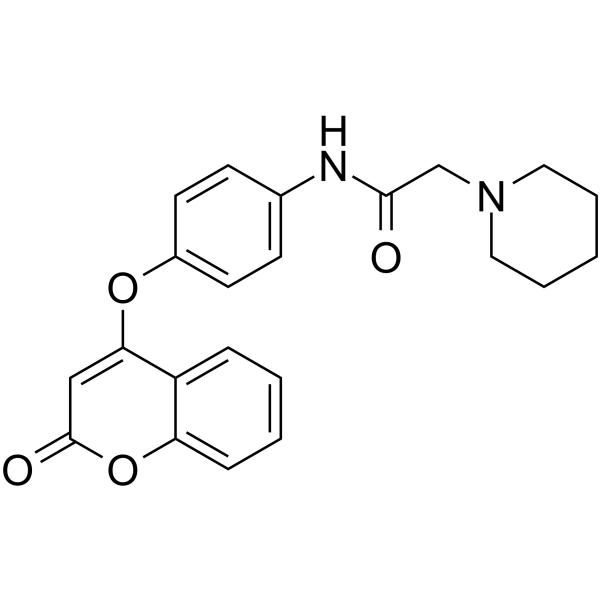
TGFβ-IN-2 is an orally active TGF-β inhibitor. TGFβ-IN-2 suppresses the TGF-β-induced protein expression of COL1A1, α-SMA, and p-Smad3 in vitro. TGFβ-IN-2 demonstrates excellent anti-fibrotic efficacy in Bleomycin (HY-108345)-induced pulmonary fibrosis model. TGFβ-IN-2 can be used for the study of pulmonary fibrosis.
For research use only. We do not sell to patients.
- Purity: 99.37%
- CAS No.: 2387678-02-4
- Formula: C22H22N2O4
- Molecular Weight:378.42
-
Storage:Powder -20°C, 3 years , 4°C, 2 years ; In solvent -80°C, 6 months , -20°C, 1 month


-
 Biological Activity
-
Chemical Information
-
Solvent & Solubility
- Purity & Documentation
- References
-
 Help & FAQs
-


Immunology/Inflammation Compound Library
HY-L007
-
Stem Cell Signaling Compound Library
HY-L017
-
TGF-beta/Smad Compound Library
HY-L018
-
Wnt/Hedgehog/Notch Compound Library
HY-L020
-
Anti-Aging Compound Library
HY-L034
-
Angiogenesis-Related Compound Library
HY-L088
-
Transcription Factor-Targeted Library
HY-L090
-
Anti-Colorectal Cancer Compound Library
HY-L103
-
Anti-Prostate Cancer Compound Library
HY-L124
-
Anti-Pulmonary Fibrosis Compound Library
HY-L125
-
Osteogenesis Compound Library
HY-L131
-
Cancer Stem Cells Compound Library
HY-L135
-
Heterocyclic Compound Library
HY-L138
-
Bioactive Compound Library Max
HY-L181
-
MCE Bioactive Compound Library
HY-L001V
-
Bioactive Compound Library
HY-L001
-
Anti-Fibrosis Compound Library
HY-L185
-
Cell Proliferation Compound Library
HY-L201
-
High-Throughput Bioactive Compound Library
HY-L205


Publications Citing Use of MedChemExpress (MCE) TGFβ-IN-2
More

Biological Activity
|
Cell Line

|
Type | Value | Description | References |
|---|---|---|---|---|
| NRK-49F | IC50 |
4.31 μM
Compound: 9d
|
Inhibition of TGF-beta-induced collagen accumulation in rat NRK-49F cells incubated for 2 days by PSR staining based microscopic analysis
Inhibition of TGF-beta-induced collagen accumulation in rat NRK-49F cells incubated for 2 days by PSR staining based microscopic analysis
|
[PMID: 31699535] |
TGFβ-IN-2 (Compound 9d) (10 μM, 72 h) shows 85.14% inhibition at 10 μM of TGF-β-induced total collagen accumulation in NRK-49F cells with a 93.62% cell survival rate[1].
TGFβ-IN-2 (10 μM) inhibits TGF-β-induced total collagen accumulation in NRK-49F cells with an IC50 of 4.31 μM[1].
TGFβ-IN-2 (1 μM, 24 h) exhibits the most potent inhibition on fibroblasts-driven macrophage migration in vitro compared to other compounds[1].
TGFβ-IN-2 (20-40 μM) suppresses TGF-β1-induced protein expression of COL1A1, α-SMA, and p-Smad3 in NRK-49F cells, indicating inhibition of the TGF-β/Smad3 pathway[1].
MedChemExpress (MCE) has not independently confirmed the accuracy of these methods. They are for reference only.
MedChemExpress (MCE) has not independently confirmed the accuracy of these methods. They are for reference only.
-
Animal Model:Bleomycin (HY-108345) (2 U/kg) was intratracheally instilled into 7-8-week-old male C57BL/6 mice to induce pulmonary fibrosis model[1].
-
Dosage:50, 100 mg/kg
-
Administration:p.o. daily for 4 weeks
-
Result:Reduced hydroxyproline content in lung tissues.
Alleviated alveolar structure destruction.
Decreased inflammatory cell infiltration in lung tissue and bronchoalveolar lavage fluid (BALF).
Improved survival rate to about 90% in bleomycin-induced pulmonary fibrosis model.
Did not inhibit fibrosis50 mg/kg.


Chemical Information
-
CAS No. 2387678-02-4
-
Appearance Solid
-
Molecular Weight 378.42
-
Formula C22H22N2O4
-
Color White to off-white
-
SMILES
O=C(NC1=CC=C(C=C1)OC2=CC(OC3=CC=CC=C32)=O)CN4CCCCC4
-
Shipping
Room temperature in continental US; may vary elsewhere.
-
Storage
Powder -20°C 3 years 4°C 2 years In solvent -80°C 6 months -20°C 1 month


Publications (1)
-
Journal Impact Factor
-
Most Recent
-
Adv Sci (Weinh)
Highly Bioadaptable Hybrid Conduits with Spatially Bidirectional Structure for Precision Nerve Fiber Regeneration via Gene Therapy. [Abstract]2024 May;11(19):e2309306. PMID: 38483934


Solvent & Solubility
DMSO : 100 mg/mL (264.26 mM; Need ultrasonic; Hygroscopic DMSO has a significant impact on the solubility of product, please use newly opened DMSO)
Please refer to the solubility information to select the appropriate solvent. Once prepared, please aliquot and store the solution to prevent product inactivation from repeated freeze-thaw cycles.
Storage method and period of stock solution: -80°C, 6 months; -20°C, 1 month. When stored at -80°C, please use it within 6 months. When stored at -20°C, please use it within 1 month.
Please refer to the solubility information to select the appropriate solvent. Once prepared, please aliquot and store the solution to prevent product inactivation from repeated freeze-thaw cycles.
Storage method and period of stock solution: -80°C, 6 months; -20°C, 1 month. When stored at -80°C, please use it within 6 months. When stored at -20°C, please use it within 1 month.
Concentration (start) × Volume (start) = Concentration (final) × Volume (final)
Select the appropriate dissolution method based on your experimental animal and administration route.
- For the following dissolution methods, please ensure to first prepare a clear stock solution using an In Vitro approach and then sequentially add co-solvents:
- To ensure reliable experimental results, the clarified stock solution can be appropriately stored based on storage conditions. As for the working solution for In Vivo experiments, it is recommended to prepare freshly and use it on the same day.
- The percentages shown for the solvents indicate their volumetric ratio in the final prepared solution. If precipitation or phase separation occurs during preparation, heat and/or sonication can be used to aid dissolution.
Add each solvent one by one: 10% DMSO 40% PEG300 5% Tween-80 45% Saline
Solubility: ≥ 5 mg/mL (13.21 mM); Clear solution
This protocol yields a clear solution of ≥ 5 mg/mL (saturation unknown).
Taking 1 mL working solution as an example, add 100 μL DMSO stock solution (50.0 mg/mL) to 400 μL PEG300, and mix evenly; then add 50 μL Tween-80 and mix evenly; then add 450 μL Saline to adjust the volume to 1 mL.
Preparation of Saline: Dissolve 0.9 g sodium chloride in ddH₂O and dilute to 100 mL to obtain a clear Saline solution.
Add each solvent one by one: 10% DMSO 90% (20% SBE-β-CD in Saline)
Solubility: ≥ 5 mg/mL (13.21 mM); Clear solution
This protocol yields a clear solution of ≥ 5 mg/mL (saturation unknown).
Taking 1 mL working solution as an example, add 100 μL DMSO stock solution (50.0 mg/mL) to 900 μL 20% SBE-β-CD in Saline, and mix evenly.
Preparation of 20% SBE-β-CD in Saline (4°C, storage for one week): 2 g SBE-β-CD powder is dissolved in 10 mL Saline, completely dissolve until clear.
Please enter the basic information of animal experiments:
-
-
-
-
Recommended: Prepare an additional quantity of animals to account for potential losses during experiments.
Please enter your animal formula composition:
-
%DMSO +
Recommended: Keep the proportion of DMSO in working solution below 2% if your animal is weak.
-
%+
-
+%Tween-80 + +
-
%Saline +
The co-solvents required include: DMSO, . All of co-solvents are available by MedChemExpress (MCE). , Tween 80. All of co-solvents are available by MedChemExpress (MCE).
Working solution concentration: 0.22 mg/mL
Method for preparing stock solution: mg drug dissolved in μL DMSO. Stock solution concentration: mg/mL.
1. Take μL DMSO stock solution;
2. Add μL .
μL , mix evenly;
3. Then add μL Tween 80, mix evenly;
4. Then add μL
Please ensure that the stock solution in the first step is dissolved to a clear state, and add co-solvents in sequence. You can use ultrasonic heating (ultrasonic cleaner, recommended frequency 20-40 kHz), vortexing, etc. to assist dissolution.


Purity & Documentation
-
Data Sheet (276 KB)
-
SDS (254 KB)
- English - EN (254 KB)
- Français - FR (254 KB)
- Deutsch - DE (254 KB)
- Norwegian - NO (254 KB)
- Español - ES (254 KB)
- Swedish - SV (254 KB)
- Italian - IT (254 KB)
- Portuguese - PT (254 KB)
-
Handling Instructions (2659 KB)
References


Complete Stock Solution Preparation Table
Please refer to the solubility information to select the appropriate solvent. Once prepared, please aliquot and store the solution to prevent product inactivation from repeated freeze-thaw cycles.
Storage method and period of stock solution: -80°C, 6 months; -20°C, 1 month. When stored at -80°C, please use it within 6 months. When stored at -20°C, please use it within 1 month.
| Optional Solvent | Concentration Solvent Mass | 1 mg | 5 mg | 10 mg | 25 mg |
|---|---|---|---|---|---|
| DMSO | 1 mM | 2.6426 mL | 13.2128 mL | 26.4257 mL | 66.0642 mL |
| 5 mM | 0.5285 mL | 2.6426 mL | 5.2851 mL | 13.2128 mL | |
| 10 mM | 0.2643 mL | 1.3213 mL | 2.6426 mL | 6.6064 mL | |
| 15 mM | 0.1762 mL | 0.8809 mL | 1.7617 mL | 4.4043 mL | |
| 20 mM | 0.1321 mL | 0.6606 mL | 1.3213 mL | 3.3032 mL | |
| 25 mM | 0.1057 mL | 0.5285 mL | 1.0570 mL | 2.6426 mL | |
| 30 mM | 0.0881 mL | 0.4404 mL | 0.8809 mL | 2.2021 mL | |
| 40 mM | 0.0661 mL | 0.3303 mL | 0.6606 mL | 1.6516 mL | |
| 50 mM | 0.0529 mL | 0.2643 mL | 0.5285 mL | 1.3213 mL | |
| 60 mM | 0.0440 mL | 0.2202 mL | 0.4404 mL | 1.1011 mL | |
| 80 mM | 0.0330 mL | 0.1652 mL | 0.3303 mL | 0.8258 mL | |
| 100 mM | 0.0264 mL | 0.1321 mL | 0.2643 mL | 0.6606 mL |


 Powered by Bioz