



Smad1
Smad1 is a BMP-responsive receptor-regulated Smad whose phosphorylation is rapidly induced by BMP2, driving nuclear accumulation and BMP signal transduction[1]. Mechanistically, BMP receptors phosphorylate Smad1, Smad1 associates with Smad4, and the complex enters the nucleus to activate transcription[2]. In BMP-responsive promoters such as ID1, Smad1/Smad4-dependent DNA binding supports BMP-specific transcriptional activation[3]. In developmental models, canonical Smad1/5 signaling is required for endochondral bone formation, and SMAD1/5 activity controls spinal neural progenitor division modes[4][5]. In disease-relevant models, BMP-Smad1 signaling participates in DNA damage response and oncogenesis through the Atm-p53 pathway[6]. Compared with related BMP-regulated isoforms, Smad9 shows lower transcriptional activity than Smad1 or Smad5 despite Smad4 association and target-DNA binding, distinguishing Smad1 as a stronger BMP transcriptional effector[7]. For experimental applications, Smad6 blocks BMP/Smad1 signaling by competing with Smad4, while dorsomorphin and LDN-193189 inhibit BMP-mediated Smad signaling in C2C12 cells[2][8].
References:
- [1]. Hoodless PA, et al. MADR1, a MAD-related protein that functions in BMP2 signaling pathways. Cell. 1996 May 17;85(4):489-500. [Content Brief]
- [2]. Hata A, et al. Smad6 inhibits BMP/Smad1 signaling by specifically competing with the Smad4 tumor suppressor. Genes Dev. 1998 Jan 15;12(2):186-97. [Content Brief]
- [3]. López-Rovira T, et al. Direct binding of Smad1 and Smad4 to two distinct motifs mediates bone morphogenetic protein-specific transcriptional activation of Id1 gene. J Biol Chem. 2002 Feb 1;277(5):3176-85. [Content Brief]
- [4]. Retting KN, et al. BMP canonical Smad signaling through Smad1 and Smad5 is required for endochondral bone formation. Development. 2009 Apr;136(7):1093-104. [Content Brief]
- [5]. Le Dréau G, et al. The strength of SMAD1/5 activity determines the mode of stem cell division in the developing spinal cord. J Cell Biol. 2014 Feb 17;204(4):591-605. [Content Brief]
- [6]. Chau JF, et al. A crucial role for bone morphogenetic protein-Smad1 signalling in the DNA damage response. Nat Commun. 2012 May 15;3:836. [Content Brief]
- [7]. Tsukamoto S, et al. Smad9 is a new type of transcriptional regulator in bone morphogenetic protein signaling. Sci Rep. 2014 Dec 23;4:7596. [Content Brief]
- [8]. Li B, et al. Differences in endoplasmic reticulum stress signalling kinetics determine cell survival outcome through activation of MKP-1. Cell Signal. 2011 Jan;23(1):35-45. [Content Brief]
All Product Categories
-
Smad1 Related Products (2)
Related Products (2)

-
Menaquinone-7
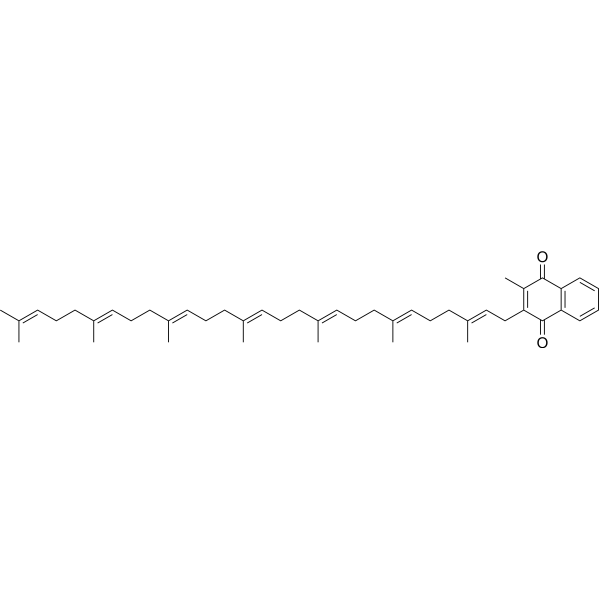 0 ImagesSynonyms: Vitamin K2-7; Vitamin K2(35); Vitamin MK-7Menaquinone-7 (Vitamin K2-7), belongs to a class of K2-vitamin homologs (orally active), is originally discovered as the anti-hemorrhagic factors. Menaquinone-7 inhibits osteoclast bone resorption in vitro and stimulates bone formation in femoral tissue of aged female rats. Menaquinone-7 has a well-researched potential in the prevention of aging-induced bone degeneration. Menaquinone-7 is also a pharmacological option for activating Gla matrix protein and intervening in the progression of calcific aortic stenosis (CAVS).
-
Vicatertide
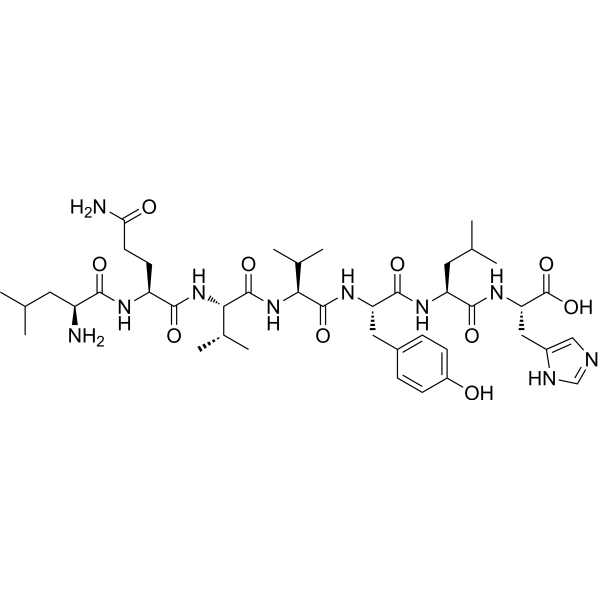 0 ImagesSynonyms: SB-01; Peniel 2000Vicatertide (SB-01, Peniel 2000) is a polypeptide with both competitive inhibitory activity against TGF-β1 and selective inhibitory activity against human factor XIa (hFXIa, with a Ka of 80 nM for hFXIa). Vicatertide binds allosterically to the two binding sites of dimeric hFXI/hFXIa, while directly binding to activated TGF-β1, selectively blocking the Smad1/5/8 pathway and maintaining low-level activation of the Smad2 pathway to enhance the synthesis of type Ⅱ collagen and aggrecan. Vicatertide inhibits thrombus formation in arteriovenous thrombosis models, and also reduces thrombus weight and thrombus incidence in mouse lung cancer models. Vicatertide can be used for research on degenerative disc disease and thrombosis-related diseases.



