



Avosentan

Based on 1 Customer Validation
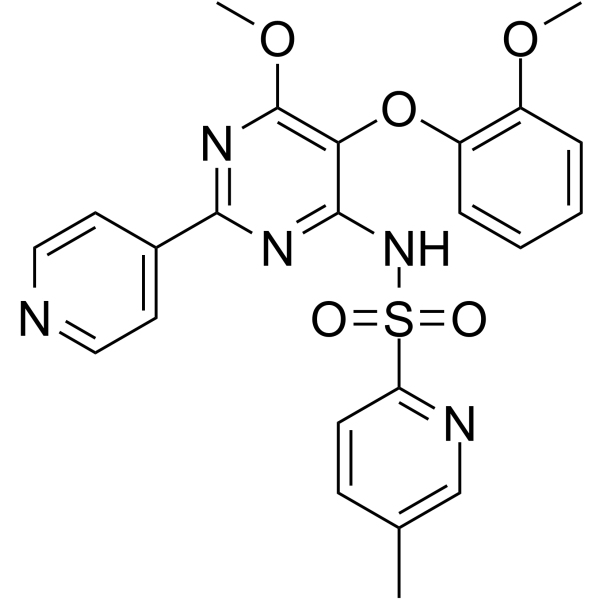
Avosentan (Ro 67-0565; SPP-301) is an orally active endothelin (ETA) receptor antagonist. Avosentan can block the ETA receptor, thereby reducing vascular contraction and exerting a renal protective effect. Avosentan inhibits vascular contraction caused by ET-1 and alleviates the reduction in retinal and optic nerve head blood flow induced by it, lowering intraocular pressure in the glaucoma monkey model. Avosentan non-specifically blocks ETB receptors at high doses, inhibiting ETB-mediated diuresis and natriuresis, and may cause fluid retention. Avosentan can be used to reduce proteinuria with diabetic nephropathy, but induces significant fluid overload and congestive heart failure.
For research use only. We do not sell to patients.
- Purity: 98.15%
- CAS No.: 290815-26-8
- Formula: C23H21N5O5S
- Molecular Weight:479.51
-
Storage:Powder -20°C, 3 years , 4°C, 2 years ; In solvent -80°C, 2 years , -20°C, 1 year


-
 Biological Activity
-
Chemical Information
-
Solvent & Solubility
- Purity & Documentation
- References
-
 Help & FAQs
-

GPCR/G Protein Compound Library
HY-L006
-
Clinical Compound Library
HY-L026
-
Drug Repurposing Compound Library
HY-L035
-
Anti-diabetic Compound Library
HY-L040
-
Anti-Cardiovascular Disease Compound Library
HY-L046
-
Endocrinology Compound Library
HY-L047
-
Anti-COVID-19 Compound Library
HY-L052
-
Orally Active Compound Library
HY-L061
-
Neurotransmitter Receptor Compound Library
HY-L062
-
Angiogenesis-Related Compound Library
HY-L088
-
Human Metabolite Library
HY-L123
-
Coagulation and Anti-coagulation Compound Library
HY-L136
-
Pain-Related Compound Library
HY-L139
-
Antihypertensive Compound Library
HY-L145
-
Membrane Protein-targeted Compound Library
HY-L149
-
Membrane Receptor-targeted Compound Library
HY-L150
-
Highly Selective Inhibitors Library
HY-L158
-
Bioactive Compound Library Max
HY-L181
-
MCE Bioactive Compound Library
HY-L001V
-
Drug Repurposing Compound Library Plus
HY-L035P
-
Clinical Compound Library Plus
HY-L026P
-
Bioactive Compound Library
HY-L001
-
High-Throughput Bioactive Compound Library
HY-L205
-
Lactylation Compound Library
HY-L249




Biological Activity
|
ETA |
|
Cell Line

|
Type | Value | Description | References |
|---|---|---|---|---|
| CHO | IC50 |
1.4 nM
Compound: 25; Avosentan
|
Displacement of 125I-ET1 from ETA receptor (unknown origin) expressed in CHO cells
Displacement of 125I-ET1 from ETA receptor (unknown origin) expressed in CHO cells
|
[PMID: 27321813] |
Avosentan (0.01-1 μM, 30 min) has no direct effect on quiescent vessels but has a strong inhibitory effect on the endothelin-1 induced contractions in isolated porcine ciliary arteries and shows stronger effect in endothelium-denuded vessels[2].
MedChemExpress (MCE) has not independently confirmed the accuracy of these methods. They are for reference only.
Avosentan (0.1-100 mg/kg, i.g., single dose or once daily for 5 weeks) is protective in hypertensive nephropathy at doses not causing fluid retention in rats[3].
Avosentan (0.003%-0.3%, topically applied to the glaucomatous eye, twice daily for 5 days) reduces intraocular pressure (IOP) in glaucomatous monkey eyes in a dose-dependent manner[4].
MedChemExpress (MCE) has not independently confirmed the accuracy of these methods. They are for reference only.
-
Animal Model:Renal excretory function assay established male Sprague-Dawley (SD) rats (12-14 weeks)[1]
-
Dosage:Incremental doses of 0.003, 0.03, 3 mg/kg, BQ-788 (HY-15894A) was administered 30 min after the highest dose
-
Administration:Intravenous administration (i.v.), at 30-min intervals
-
Result:Decreased urine output and fractional excretion of water in a concentration-dependent manner.
Returned sodium excretion to control values and slightly decreased mean arterial pressure (MAP)
Did not further decrease urine output or water excretion and was without effect.
Significantly decreased hematocrite.
-
Animal Model:Hypertensive nephropathy model established male double transgenic rats (dTGR) with human angiotensinogen and renin genes[3]
-
Dosage:0.1, 1, 10, 100 mg/kg (single dose) and 10 mg/kg (long-term)
-
Administration:Oral gavage (i.g.), single dose or once daily for 5 weeks
-
Result:Caused 18.3% decrease in diuresis, 8.3% drop in hematocrit at 100 mg/kg and No significant fluid retention at 10 mg/kg.
Reduced proteinuria and significantly lowered the scores of renal glomerular fibrosis and other damages after 5-week treatments.
Significantly increased survival rate combined with Valsartan (HY-18204).
-
Animal Model:IOP model established in adult female cynomolgus monkeys each weighing 3-5 kg, in which glaucoma had been induced unilaterally by repeated diode laser photocoagulation of the mid-trabecular meshwork[4]
-
Dosage:Topically applied to the glaucomatous eye, twice daily for 5 days
-
Administration:Oral gavage (i.g.), single dose or once daily for 5 weeks
-
Result:Significantly reduced IOP only at 2 hrs after the first dose, and at 2 and 3 hrs after the 9th dose.
Produced a longer duration of action at 0.03% and 0.3% concentrations.
No anterior chamber cellular response was observed in any eye during the 5 days of treatment by slit-lamp examination.
| NCT Number | Sponsor | Condition | Start Date |
Phase
|
|---|---|---|---|---|
| NCT01329991 | Plexxikon| | 2011-05 | PHASE1 |


Chemical Information
-
CAS No. 290815-26-8
-
Appearance Solid
-
Molecular Weight 479.51
-
Formula C23H21N5O5S
-
Color White to off-white
-
SMILES
COC1=C(OC(C(NS(C2=NC=C(C=C2)C)(=O)=O)=NC(C3=CC=NC=C3)=N4)=C4OC)C=CC=C1
-
Synonyms
Ro 67-0565; SPP-301
-
Shipping
Room temperature in continental US; may vary elsewhere.
-
Storage
Powder -20°C 3 years 4°C 2 years In solvent -80°C 2 years -20°C 1 year


Solvent & Solubility
DMSO : 6.67 mg/mL (13.91 mM; Need ultrasonic; Hygroscopic DMSO has a significant impact on the solubility of product, please use newly opened DMSO)
Please refer to the solubility information to select the appropriate solvent. Once prepared, please aliquot and store the solution to prevent product inactivation from repeated freeze-thaw cycles.
Storage method and period of stock solution: -80°C, 2 years; -20°C, 1 year. When stored at -80°C, please use it within 2 years. When stored at -20°C, please use it within 1 year.
Please refer to the solubility information to select the appropriate solvent. Once prepared, please aliquot and store the solution to prevent product inactivation from repeated freeze-thaw cycles.
Storage method and period of stock solution: -80°C, 2 years; -20°C, 1 year. When stored at -80°C, please use it within 2 years. When stored at -20°C, please use it within 1 year.
Concentration (start) × Volume (start) = Concentration (final) × Volume (final)
Select the appropriate dissolution method based on your experimental animal and administration route.
- For the following dissolution methods, please ensure to first prepare a clear stock solution using an In Vitro approach and then sequentially add co-solvents:
- To ensure reliable experimental results, the clarified stock solution can be appropriately stored based on storage conditions. As for the working solution for In Vivo experiments, it is recommended to prepare freshly and use it on the same day.
- The percentages shown for the solvents indicate their volumetric ratio in the final prepared solution. If precipitation or phase separation occurs during preparation, heat and/or sonication can be used to aid dissolution.
Add each solvent one by one: 10% DMSO 40% PEG300 5% Tween-80 45% Saline
Solubility: ≥ 0.67 mg/mL (1.40 mM); Clear solution
This protocol yields a clear solution of ≥ 0.67 mg/mL (saturation unknown).
Taking 1 mL working solution as an example, add 100 μL DMSO stock solution (6.7 mg/mL) to 400 μL PEG300, and mix evenly; then add 50 μL Tween-80 and mix evenly; then add 450 μL Saline to adjust the volume to 1 mL.
Preparation of Saline: Dissolve 0.9 g sodium chloride in ddH₂O and dilute to 100 mL to obtain a clear Saline solution.
Please enter the basic information of animal experiments:
-
-
-
-
Recommended: Prepare an additional quantity of animals to account for potential losses during experiments.
Please enter your animal formula composition:
-
%DMSO +
Recommended: Keep the proportion of DMSO in working solution below 2% if your animal is weak.
-
%+
-
+%Tween-80 + +
-
%Saline +
The co-solvents required include: DMSO, . All of co-solvents are available by MedChemExpress (MCE). , Tween 80. All of co-solvents are available by MedChemExpress (MCE).
Working solution concentration: 0.22 mg/mL
Method for preparing stock solution: mg drug dissolved in μL DMSO. Stock solution concentration: mg/mL.
1. Take μL DMSO stock solution;
2. Add μL .
μL , mix evenly;
3. Then add μL Tween 80, mix evenly;
4. Then add μL
Please ensure that the stock solution in the first step is dissolved to a clear state, and add co-solvents in sequence. You can use ultrasonic heating (ultrasonic cleaner, recommended frequency 20-40 kHz), vortexing, etc. to assist dissolution.


Purity & Documentation
-
Data Sheet (284 KB)
-
SDS (393 KB)
- English - EN (393 KB)
- Français - FR (393 KB)
- Deutsch - DE (393 KB)
- Norwegian - NO (393 KB)
- Español - ES (393 KB)
- Swedish - SV (393 KB)
- Italian - IT (393 KB)
- Portuguese - PT (393 KB)
-
Handling Instructions (2659 KB)
References
[1]. Baltatu OC, Iliescu R, Zaugg CE, Reckelhoff JF, Louie P, Schumacher C, Campos LA. Antidiuretic effects of the endothelin receptor antagonist avosentan. Front Physiol. 2012;3:103. [Content Brief]
[2]. Konieczka K, Meyer P, Schoetzau A, Neutzner A, Mozaffarieh M, Flammer J. Effect of avosentan (SPP-301) in porcine ciliary arteries. Curr Eye Res. 2011 Feb;36(2):118-24. [Content Brief]
[3]. Baltatu OC, et al. Avosentan is protective in hypertensive nephropathy at doses not causing fluid retention. Pharmacol Res. 2014 Feb;80:9-13. [Content Brief]


Complete Stock Solution Preparation Table
Please refer to the solubility information to select the appropriate solvent. Once prepared, please aliquot and store the solution to prevent product inactivation from repeated freeze-thaw cycles.
Storage method and period of stock solution: -80°C, 2 years; -20°C, 1 year. When stored at -80°C, please use it within 2 years. When stored at -20°C, please use it within 1 year.
| Optional Solvent | Concentration Solvent Mass | 1 mg | 5 mg | 10 mg | 25 mg |
|---|---|---|---|---|---|
| DMSO | 1 mM | 2.0855 mL | 10.4273 mL | 20.8546 mL | 52.1366 mL |
| 5 mM | 0.4171 mL | 2.0855 mL | 4.1709 mL | 10.4273 mL | |
| 10 mM | 0.2085 mL | 1.0427 mL | 2.0855 mL | 5.2137 mL |


 Powered by Bioz