



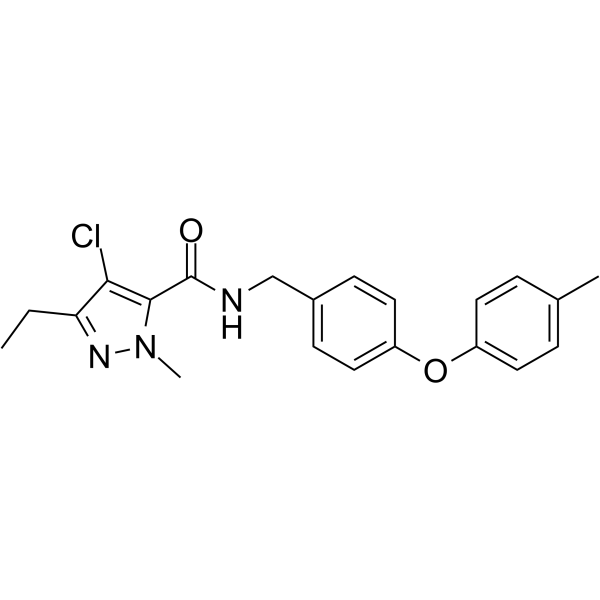
Tolfenpyrad

Based on 1 Customer Validation
Tolfenpyrad is an insecticide approved for marketing in Japan in 2002.
Para uso exclusivo en investigación. No vendemos a pacientes.
- Pureza: 98.64%
- No. CAS: 129558-76-5
- Fòrmula: C21H22ClN3O2
- Peso molecular:383.87
-
Almacenamiento:Powder -20°C, 3 years , 4°C, 2 years ; In solvent -80°C, 2 years , -20°C, 1 year


-
 Actividad biológica
-
Chemical Information
-
Solvente y solubilidad
- Pureza y Documentación
- Referencias
-
 Help & FAQs
-

Anti-Infection Compound Library
HY-L002
-
Metabolism/Protease Compound Library
HY-L012
-
Stem Cell Signaling Compound Library
HY-L017
-
Anti-Aging Compound Library
HY-L034
-
Reprogramming Compound Library
HY-L039
-
Antibacterial Compound Library
HY-L049
-
Orally Active Compound Library
HY-L061
-
Glutamine Metabolism Compound Library
HY-L064
-
Anti-Cancer Metabolism Compound Library
HY-L083
-
Anti-Parkinson's Disease Compound Library
HY-L085
-
Neurodegenerative Disease-related Compound Library
HY-L086
-
Mitochondria-Targeted Compound Library
HY-L089
-
Glucose Metabolism Compound Library
HY-L092
-
Cuproptosis Compound Library
HY-L133
-
Cancer Stem Cells Compound Library
HY-L135
-
Mitochondrial Protection Compound Library
HY-L144
-
Metabolic Enzyme Compound Library
HY-L146
-
Bioactive Compound Library Max
HY-L181
-
MCE Bioactive Compound Library
HY-L001V
-
Bioactive Compound Library
HY-L001
-
Pesticide Compound Library
HY-L183
-
Non-Alcoholic Fatty Liver Disease (NAFLD) Compound Library
HY-L199
-
High-Throughput Bioactive Compound Library
HY-L205
-
Environmental Pollutant Compound Library
HY-L247




Actividad biológica
|
Cell Line

|
Type | Value | Description | References |
|---|---|---|---|---|
| MCF-10A | IC50 |
33.7 μM
Compound: MIPS-0015978
|
Toxicity in human MCF-10A cells
Toxicity in human MCF-10A cells
|
[PMID: 33352050] |
Tolfenpyrad (12.5 μM) inhibits the growth of Francisella novicida in liquid media and on solid agar, with an IC50 of 1.2 µM or 1.5 µM (depending on the source of Tolfenpyrad)[2].
Tolfenpyrad (100 μM; 24 h-7 days) inhibits the motility, growth, and development of exsheathed third-stage (xL3) and fourth-stage (L4) larvae of H. contortus, with IC50 values ranging from 0.02 to 3 μM[3].
Tolfenpyrad (0.242-7.760 g a.i./hm2) reduces the survival rate, pupation rate, adult emergence rate, fecundity, and egg hatchability of the parent generation of Coccinella septempunctata, prolongs the development time, and also affects the development time, longevity, and population parameters of the offspring[4].
MedChemExpress (MCE) has not independently confirmed the accuracy of these methods. They are for reference only.
Tolfenpyrad (5 mg/kg; p.o.) shows no toxicity symptoms and a reduction in worm burden in one sheep infected with Haemonchus contortus[7].
MedChemExpress (MCE) has not independently confirmed the accuracy of these methods. They are for reference only.


Chemical Information
-
No. CAS 129558-76-5
-
Appearance Solid
-
Peso molecular 383.87
-
Fòrmula C21H22ClN3O2
-
Color White to off-white
-
SMILES
O=C(C1=C(Cl)C(CC)=NN1C)NCC2=CC=C(OC3=CC=C(C)C=C3)C=C2
-
Envío
Room temperature in continental US; may vary elsewhere.
-
Almacenamiento
Powder -20°C 3 years 4°C 2 years In solvent -80°C 2 years -20°C 1 year


Solvente y solubilidad
DMSO : 110 mg/mL (286.56 mM; Need ultrasonic; Hygroscopic DMSO has a significant impact on the solubility of product, please use newly opened DMSO)
Please refer to the solubility information to select the appropriate solvent. Once prepared, please aliquot and store the solution to prevent product inactivation from repeated freeze-thaw cycles.
Storage method and period of stock solution: -80°C, 2 years; -20°C, 1 year. When stored at -80°C, please use it within 2 years. When stored at -20°C, please use it within 1 year.
Please refer to the solubility information to select the appropriate solvent. Once prepared, please aliquot and store the solution to prevent product inactivation from repeated freeze-thaw cycles.
Storage method and period of stock solution: -80°C, 2 years; -20°C, 1 year. When stored at -80°C, please use it within 2 years. When stored at -20°C, please use it within 1 year.
Concentration (start) × Volume (start) = Concentration (final) × Volume (final)
Select the appropriate dissolution method based on your experimental animal and administration route.
- For the following dissolution methods, please ensure to first prepare a clear stock solution using an In Vitro approach and then sequentially add co-solvents:
- To ensure reliable experimental results, the clarified stock solution can be appropriately stored based on storage conditions. As for the working solution for In Vivo experiments, it is recommended to prepare freshly and use it on the same day.
- The percentages shown for the solvents indicate their volumetric ratio in the final prepared solution. If precipitation or phase separation occurs during preparation, heat and/or sonication can be used to aid dissolution.
Add each solvent one by one: 10% DMSO 40% PEG300 5% Tween-80 45% Saline
Solubility: 2.75 mg/mL (7.16 mM); Suspended solution; Need ultrasonic
This protocol yields a suspended solution of 2.75 mg/mL. Suspended solution can be used for oral and intraperitoneal injection.
Taking 1 mL working solution as an example, add 100 μL DMSO stock solution (27.5 mg/mL) to 400 μL PEG300, and mix evenly; then add 50 μL Tween-80 and mix evenly; then add 450 μL Saline to adjust the volume to 1 mL.
Preparation of Saline: Dissolve 0.9 g sodium chloride in ddH₂O and dilute to 100 mL to obtain a clear Saline solution.
Add each solvent one by one: 10% DMSO 90% (20% SBE-β-CD in Saline)
Solubility: 2.75 mg/mL (7.16 mM); Suspended solution; Need ultrasonic
This protocol yields a suspended solution of 2.75 mg/mL. Suspended solution can be used for oral and intraperitoneal injection.
Taking 1 mL working solution as an example, add 100 μL DMSO stock solution (27.5 mg/mL) to 900 μL 20% SBE-β-CD in Saline, and mix evenly.
Preparation of 20% SBE-β-CD in Saline (4°C, storage for one week): 2 g SBE-β-CD powder is dissolved in 10 mL Saline, completely dissolve until clear.
Please enter the basic information of animal experiments:
-
-
-
-
Recommended: Prepare an additional quantity of animals to account for potential losses during experiments.
Please enter your animal formula composition:
-
%DMSO +
Recommended: Keep the proportion of DMSO in working solution below 2% if your animal is weak.
-
%+
-
+%Tween-80 + +
-
%Saline +
The co-solvents required include: DMSO, . All of co-solvents are available by MedChemExpress (MCE). , Tween 80. All of co-solvents are available by MedChemExpress (MCE).
Working solution concentration: 0.22 mg/mL
Method for preparing stock solution: mg drug dissolved in μL DMSO. Stock solution concentration: mg/mL.
1. Take μL DMSO stock solution;
2. Add μL .
μL , mix evenly;
3. Then add μL Tween 80, mix evenly;
4. Then add μL
Please ensure that the stock solution in the first step is dissolved to a clear state, and add co-solvents in sequence. You can use ultrasonic heating (ultrasonic cleaner, recommended frequency 20-40 kHz), vortexing, etc. to assist dissolution.


Pureza y Documentación
-
Ficha de datos (273 KB)
-
SDS (596 KB)
- English - EN (596 KB)
- Français - FR (596 KB)
- Deutsch - DE (596 KB)
- Norwegian - NO (596 KB)
- Español - ES (596 KB)
- Swedish - SV (596 KB)
- Italian - IT (596 KB)
- Portuguese - PT (596 KB)
-
Instrucciones de manejo (2659 KB)
Referencias
[1]. Khan MA, et al. Lethal and behavioral effects of selected novel pesticides on adults of Trichogramma pretiosum (Hymenoptera: Trichogrammatidae). Pest Manag Sci. 2015 Dec;71(12):1640-8. [Content Brief]
[2]. Clarke A, et al. Tolfenpyrad displays Francisella-targeted antibiotic activity that requires an oxidative stress response regulator for sensitivity. Microbiol Spectr. 2023 Dec 12;11(6):e0271323. [Content Brief]
[3]. Preston S, et al. Screening of the 'Pathogen Box' identifies an approved pesticide with major anthelmintic activity against the barber's pole worm. Int J Parasitol Drugs Drug Resist. 2016 Dec;6(3):329-334. [Content Brief]
[4]. Chi W, et al. The influence of tolfenpyrad on fitness, development, and reproduction in parents and offspring of Coccinella septempunctata. Ecotoxicol Environ Saf. 2021 Mar 1;210:111875. [Content Brief]
[5]. Hikiji W, et al. Acute fatal poisoning with Tolfenpyrad. J Forensic Leg Med. 2013 Nov;20(8):962-4. [Content Brief]
[6]. Jiang X, et al. Combination of biotransformation and metabolomics reveals tolfenpyrad-induced hepatocytotoxicity. Sci Total Environ. 2024 Nov 15;951:175320. [Content Brief]
[7]. Preston S, et al. 1-Methyl-1H-pyrazole-5-carboxamide Derivatives Exhibit Unexpected Acute Mammalian Toxicity. J Med Chem. 2021 Jan 14;64(1):840-844. [Content Brief]
[8]. Yamaguchi K, et al. Analysis of tolfenpyrad and its metabolites in plasma in a tolfenpyrad poisoning case. J Anal Toxicol. 2012 Sep;36(7):529-37. [Content Brief]


Complete Stock Solution Preparation Table
Please refer to the solubility information to select the appropriate solvent. Once prepared, please aliquot and store the solution to prevent product inactivation from repeated freeze-thaw cycles.
Storage method and period of stock solution: -80°C, 2 years; -20°C, 1 year. When stored at -80°C, please use it within 2 years. When stored at -20°C, please use it within 1 year.
| Optional Solvent | Concentration Solvent Mass | 1 mg | 5 mg | 10 mg | 25 mg |
|---|---|---|---|---|---|
| DMSO | 1 mM | 2.6050 mL | 13.0252 mL | 26.0505 mL | 65.1262 mL |
| 5 mM | 0.5210 mL | 2.6050 mL | 5.2101 mL | 13.0252 mL | |
| 10 mM | 0.2605 mL | 1.3025 mL | 2.6050 mL | 6.5126 mL | |
| 15 mM | 0.1737 mL | 0.8683 mL | 1.7367 mL | 4.3417 mL | |
| 20 mM | 0.1303 mL | 0.6513 mL | 1.3025 mL | 3.2563 mL | |
| 25 mM | 0.1042 mL | 0.5210 mL | 1.0420 mL | 2.6050 mL | |
| 30 mM | 0.0868 mL | 0.4342 mL | 0.8683 mL | 2.1709 mL | |
| 40 mM | 0.0651 mL | 0.3256 mL | 0.6513 mL | 1.6282 mL | |
| 50 mM | 0.0521 mL | 0.2605 mL | 0.5210 mL | 1.3025 mL | |
| 60 mM | 0.0434 mL | 0.2171 mL | 0.4342 mL | 1.0854 mL | |
| 80 mM | 0.0326 mL | 0.1628 mL | 0.3256 mL | 0.8141 mL | |
| 100 mM | 0.0261 mL | 0.1303 mL | 0.2605 mL | 0.6513 mL |


 Powered by Bioz