16 Results for "

LPAR1

" in MedChemExpress (MCE) Product Catalog:
Products (16)

16 Results for "LPAR1" in MCE Product Catalog:

  • Isoforms Recommended:
Referencia número: HY-162267
No. CAS: 3032275-33-2
Target:  

LPL Receptor

Áreas de investigación:  

Inflammation/Immunology

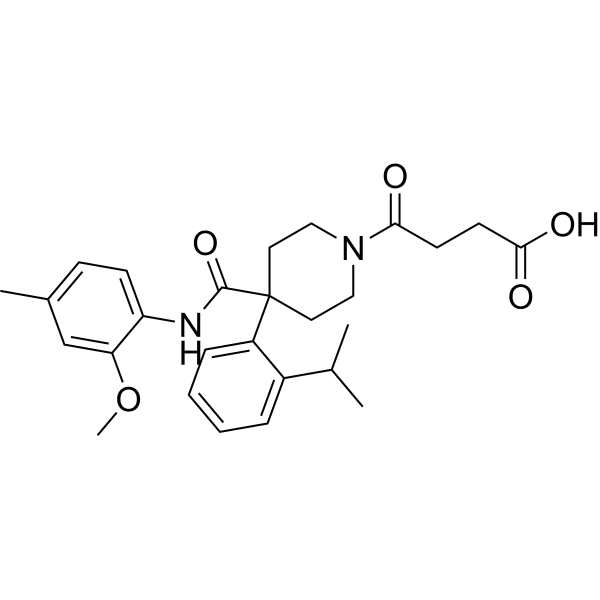
LPAR1 antagonist 1 (compound 18) is a potent, oral active and selective LPAR1 antagonist with the IC50 of 3.3 nM. LPAR1 antagonist 1 can be used for study of fibrosis [1].
loading...
    loading...
Referencia número: HY-159983
No. CAS: 2750508-72-4
Target:  

LPL Receptor

Áreas de investigación:  

Inflammation/Immunology

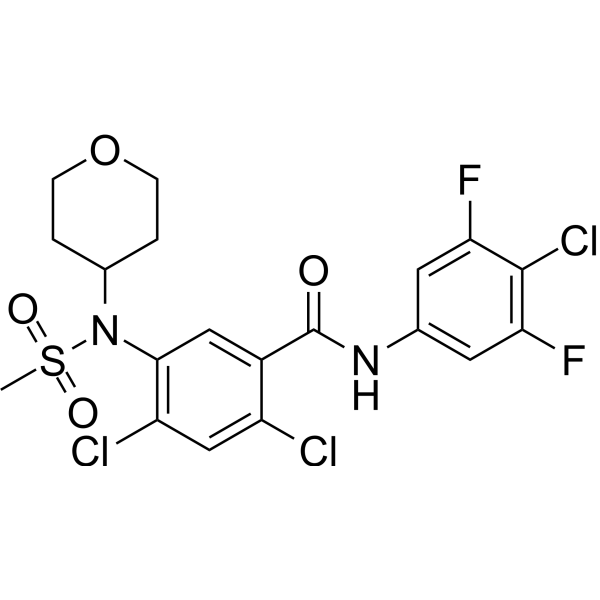
GS-2278 is an LPAR1 (lysophosphatidic acid receptor 1) antagonist with potential for research in idiopathic pulmonary fibrosis (IPF) [1].
loading...
    loading...
Referencia número: HY-160661
No. CAS: 1664336-46-2
Target:  

LPL Receptor

Áreas de investigación:  

Others

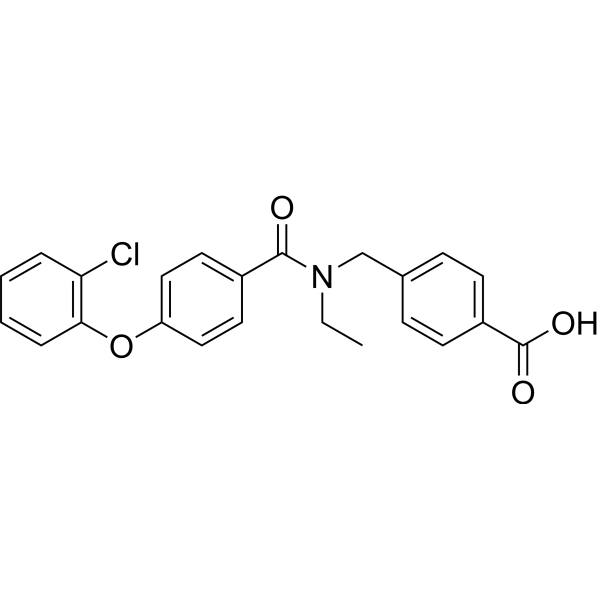
LPAR1 antagonist 2 (example 76) is an LPAR1 antagonist with an average IC50 of 130 nM [1].
loading...
    loading...
Referencia número: HY-65255
No. CAS: 5521-58-4
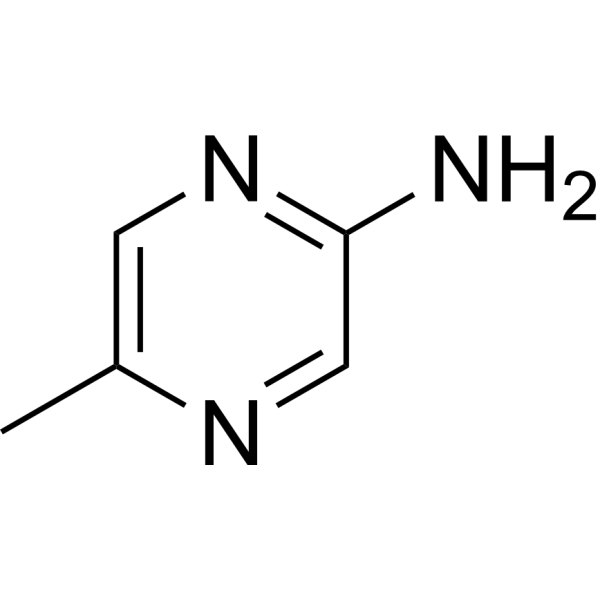
2-Amino-5-methylpyrazine is an intermediate. 2-Amino-5-methylpyrazine can be used to synthesize LPAR1 antagonists [1].
loading...
    loading...
Referencia número: HY-RS07746
Áreas de investigación:  

Others

LPAR1 Human Pre-designed siRNA Set A contains three designed siRNAs for LPAR1 gene (Human), as well as a negative control, a positive control, and a FAM-labeled negative control.

loading...
    loading...
Referencia número: HY-RS07747
Áreas de investigación:  

Others

Lpar1 Mouse Pre-designed siRNA Set A contains three designed siRNAs for Lpar1 gene (Mouse), as well as a negative control, a positive control, and a FAM-labeled negative control.

loading...
    loading...
Referencia número: HY-RS07748
Áreas de investigación:  

Others

Lpar1 Rat Pre-designed siRNA Set A contains three designed siRNAs for Lpar1 gene (Rat), as well as a negative control, a positive control, and a FAM-labeled negative control.

loading...
    loading...
Referencia número: HY-171806
No. CAS: 1257213-96-9
Target:  

LPL Receptor

Áreas de investigación:  

Cancer

BMT-136088 is a LPAR1 antagonist [1]. 11C-BMT-136088 can be used as a positron emission tomography (PET) radioligand to quantify specific binding to LPA1 in lung.
loading...
    loading...
Referencia número: HY-149018
No. CAS: 2969213-59-8
Áreas de investigación:  

Cancer

ATX inhibitor 22 is a novel inhibitor of ATX (autotaxin) with IC50 of 218 nM but lost its inhibitory activity of LPAR1 [1].
loading...
    loading...
Referencia número: HY-120282
No. CAS: 1802079-45-3
Target:  

LPL Receptor

Áreas de investigación:  

Inflammation/Immunology

ONO-9910539 is a lysophosphatidic acid receptor 1 (LPAR1) antagonist. ONO-9910539 is applicable to the research of idiopathic pulmonary fibrosis [1].
loading...
    loading...
Referencia número: HY-P83630
Synonyms: Lysophosphatidic acid receptor 1; LPA receptor 1; LPA-1; Lysophosphatidic acid receptor Edg-2; LPAR1; EDG2; LPA1

Host:  

Rabbit

Application:  

WB, IHC-P, ICC/IF, FC, IP

Reactivity:  

Human

loading...
    loading...
Referencia número: HY-184986
No. CAS: 2901868-37-7
PIPE-791 is an orally active, blood-brain barrier-permeable selective antagonist of LPAR1. PIPE-791 inhibits LPA-induced calcium mobilization, collagen expression, histamine release, and the activation of fibroblasts, microglia and macrophages. PIPE-791 induces oligodendrocyte precursor cell differentiation, myelination and remyelination, and increases the number of microglia in the retina of normotensive rats. PIPE-791 protects mature oligodendrocytes from cytokine-induced death, reduces the levels of pulmonary fibrosis markers and alleviates neuroinflammation in preclinical models. PIPE-791 can be used in the research of glaucoma, neuroinflammatory diseases, chronic osteoarthritis pain, idiopathic pulmonary fibrosis and multiple sclerosis [1] .
loading...
    loading...
Referencia número: HY-181931
No. CAS: 3058084-21-9
Áreas de investigación:  

Inflammation/Immunology

Autotaxin-IN-8 (Compound 14E) is an orally active Autotaxin inhibitor with an IC50 of 14.2 nM against hAutotaxin. Autotaxin-IN-8 inhibits Autotaxin activity, MAPK activation, LPAR1 and p-ERK1/2. Autotaxin-IN-8 reduces the phosphorylation levels of JNK and p38. Autotaxin-IN-8 decreases collagen deposition in a mouse model of pulmonary fibrosis. Autotaxin-IN-8 can be used in research related to pulmonary fibrosis [1].
loading...
    loading...
Referencia número: HY-182787
No. CAS: 3057457-78-7
Target:  

LPL Receptor

Áreas de investigación:  

Cancer

LPA1 receptor antagonist-7 is a LPA1 antagonist. LPA1 receptor antagonist-7 blocks downstream signaling pathways mediated by LPA1. LPA1 receptor antagonist-7 inhibits LPA-induced migration and invasion of cancer cells. LPA1 receptor antagonist-7 can be used for the research of triple-negative breast cancer [1].
loading...
    loading...
Referencia número: HY-183657
Target:  

Orphan GPCR

Áreas de investigación:  

Neurological Disease

GPR3 inverse agonist-1 is a GPR3 inverse agonist with low micromolar potency in conformational analysis. GPR3 inverse agonist-1 inhibits GPR3-dependent Gs activity in HEK293A cells with an EC50 of 250 nM, and exhibits an EC50 of 2 μM in cAMP assays. GPR3 inverse agonist-1 induces concentration-dependent changes in BRET signals in GPR3 conformational biosensors (EC50 = 5 μM), reduces basal Gs activity downstream of GPR3, and competes for binding sites with the GPR3 agonist DPI (HY-100965). GPR3 inverse agonist-1 can be used in research related to Alzheimer's disease [1].
loading...
    loading...
Referencia número: HY-183657A
Target:  

Orphan GPCR

Áreas de investigación:  

Neurological Disease

GPR3 inverse agonist-1 TFA is a GPR3 inverse agonist with low micromolar potency in conformational analysis. GPR3 inverse agonist-1 TFA inhibits GPR3-dependent Gs activity in HEK293A cells with an EC50 of 250 nM, and exhibits an EC50 of 2 μM in cAMP assays. GPR3 inverse agonist-1 TFA induces concentration-dependent BRET signal changes in GPR3 conformational biosensors (EC50 = 5 μM), reduces basal Gs activity downstream of GPR3, competes for binding sites with the GPR3 agonist DPI (HY-100965). GPR3 inverse agonist-1 TFA can be used in research related to Alzheimer's disease [1].
loading...
    loading...
  • 1

