



Pyrimethanil
Based on 1 publication(s) in Google Scholar
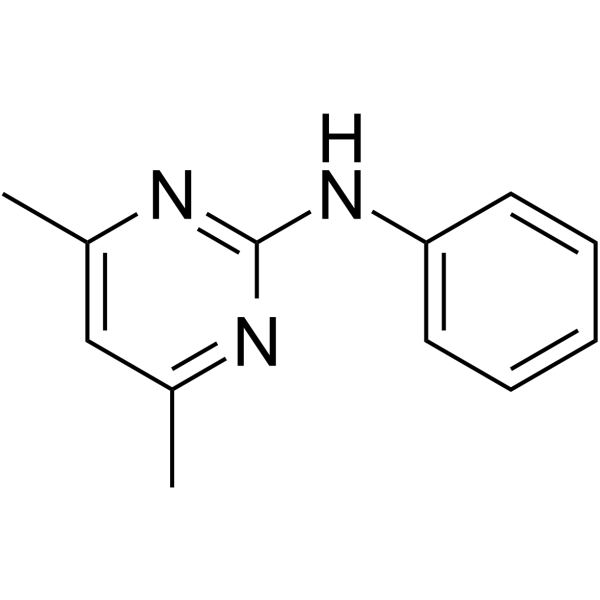
Pyrimethanil is an anilinopyrimidine and broad-spectrum contact fungicide for the control of Botrytis spp. on a wide variety of crops. Pyrimethanil inhibits the biosynthesis of methionine and other amino acids in Botrytis cinerea. Pyrimethanil can be used for the research of fungal diseases prevention on fruit, vegetable and ornamental plants with mold infection.
For research use only. We do not sell to patients.
- Purity : 99.85%
- CAS No.: 53112-28-0
- Formula: C12H13N3
- Molecular Weight:199.25
-
Storage:
4°C, protect from light
* In solvent : -80°C, 6 months; -20°C, 1 month (protect from light)

To place orders, for customer services and technical support, please contact: MedChemExpress USA
Tel: 609-228-6898 E-mail: [email protected] [email protected]


-
 Biological Activity
-
Chemical Information
-
Solvent & Solubility
- Protocols
- Purity & Documentation
- References
-
 Help & FAQs


Publications Citing Use of MedChemExpress (MCE) Pyrimethanil
More

Biological Activity
Description
In Vitro
Pyrimethanil is a strobilurin fungicide belonging to the anilinopyrimidine class. Pyrimethanil (5 and 50 μg/L) elicits a range of toxic responses, has the potential to induce histological alterations in tissues of the Italian tree frog H. intermedia after a long term exposure to two environmentally relevant concentrations of Pyrimethanil[2].Pyrimethanil decreases polygalacturonase, cellulase, proteinase and laccase activities in the medium of three day-old cultures. The pyrimethanil results in 50% reduction (IC50) in total enzyme activities are approximately 0.25 μM for polygalacturonase, cellulase and proteinase, and approximately 1.0 μM for laccase[3].
MedChemExpress (MCE) has not independently confirmed the accuracy of these methods. They are for reference only. Further protocols information, click here.


Chemical Information
-
CAS No. 53112-28-0
-
Appearance Solid
-
Molecular Weight 199.25
-
Formula C12H13N3
-
Color White to off-white
-
SMILES
CC1=CC(C)=NC(NC2=CC=CC=C2)=N1
-
Shipping
Room temperature in continental US; may vary elsewhere.
-
Storage
4°C, protect from light
* In solvent : -80°C, 6 months; -20°C, 1 month (protect from light)


Publications (1)
-
Journal Impact Factor
-
Most Recent
-
Ecotoxicol Environ Saf
Asiaticoside ameliorates pyrimethanil-induced autophagy-dependent liver injury by suppressing CRHR1. [Abstract]2025 Dec:308:119482. PMID: 41338089


Solvent & Solubility
In Vitro:
DMSO : 130 mg/mL (652.45 mM; Need ultrasonic; Hygroscopic DMSO has a significant impact on the solubility of product, please use newly opened DMSO)
Please refer to the solubility information to select the appropriate solvent. Once prepared, please aliquot and store the solution to prevent product inactivation from repeated freeze-thaw cycles.
Storage method and period of stock solution: -80°C, 6 months; -20°C, 1 month (protect from light). When stored at -80°C, please use it within 6 months. When stored at -20°C, please use it within 1 month.
Please refer to the solubility information to select the appropriate solvent. Once prepared, please aliquot and store the solution to prevent product inactivation from repeated freeze-thaw cycles.
Storage method and period of stock solution: -80°C, 6 months; -20°C, 1 month (protect from light). When stored at -80°C, please use it within 6 months. When stored at -20°C, please use it within 1 month.
Concentration (start) × Volume (start) = Concentration (final) × Volume (final)
In Vivo:
Select the appropriate dissolution method based on your experimental animal and administration route.
- For the following dissolution methods, please ensure to first prepare a clear stock solution using an In Vitro approach and then sequentially add co-solvents:
- To ensure reliable experimental results, the clarified stock solution can be appropriately stored based on storage conditions. As for the working solution for In Vivo experiments, it is recommended to prepare freshly and use it on the same day.
- The percentages shown for the solvents indicate their volumetric ratio in the final prepared solution. If precipitation or phase separation occurs during preparation, heat and/or sonication can be used to aid dissolution.
Add each solvent one by one: 10% DMSO 40% PEG300 5% Tween-80 45% Saline
Solubility: ≥ 3.25 mg/mL (16.31 mM); Clear solution
This protocol yields a clear solution of ≥ 3.25 mg/mL (saturation unknown).
Taking 1 mL working solution as an example, add 100 μL DMSO stock solution (32.5 mg/mL) to 400 μL PEG300, and mix evenly; then add 50 μL Tween-80 and mix evenly; then add 450 μL Saline to adjust the volume to 1 mL.
Preparation of Saline: Dissolve 0.9 g sodium chloride in ddH₂O and dilute to 100 mL to obtain a clear Saline solution.
Add each solvent one by one: 10% DMSO 90% (20% SBE-β-CD in Saline)
Solubility: 3.25 mg/mL (16.31 mM); Suspended solution; Need ultrasonic
This protocol yields a suspended solution of 3.25 mg/mL. Suspended solution can be used for oral and intraperitoneal injection.
Taking 1 mL working solution as an example, add 100 μL DMSO stock solution (32.5 mg/mL) to 900 μL 20% SBE-β-CD in Saline, and mix evenly.
Preparation of 20% SBE-β-CD in Saline (4°C, storage for one week): 2 g SBE-β-CD powder is dissolved in 10 mL Saline, completely dissolve until clear.
In Vivo Dissolution Calculator
Please enter the basic information of animal experiments:
-
-
-
-
Recommended: Prepare an additional quantity of animals to account for potential losses during experiments.
Please enter your animal formula composition:
-
%DMSO +
Recommended: Keep the proportion of DMSO in working solution below 2% if your animal is weak.
-
%+
-
+%Tween-80 + +
-
%Saline +
The co-solvents required include: DMSO, . All of co-solvents are available by MedChemExpress (MCE). , Tween 80. All of co-solvents are available by MedChemExpress (MCE).
Working solution concentration: 0.22 mg/mL
Method for preparing stock solution: mg drug dissolved in μL DMSO. Stock solution concentration: mg/mL. * In solvent : -80°C, 6 months; -20°C, 1 month (protect from light)
1. Take μL DMSO stock solution;
2. Add μL .
μL , mix evenly;
3. Then add μL Tween 80, mix evenly;
4. Then add μL
Please ensure that the stock solution in the first step is dissolved to a clear state, and add co-solvents in sequence. You can use ultrasonic heating (ultrasonic cleaner, recommended frequency 20-40 kHz), vortexing, etc. to assist dissolution.

Protocols
-
Research Protocol for Infectious Diseases
Infectious-disease experiments test how pathogens interact with host barriers, innate immune receptors, inflammatory signaling, pathogen replication, and tissue injury; pattern-recognition receptors such as TLRs, RIG-I-like receptors, NOD-like receptors, and inflammasomes detect microbial molecules and activate NF-κB, interferon, and cytokine responses. The central hypothesis is that infection severity reflects the balance between pathogen burden and host response: protective inflammation restricts pathogen growth, whereas excessive or mislocalized inflammation contributes to tissue damage and disease phenotype. Unresolved questions include which host pathways are protective versus pathogenic, why some infection models fail to translate to human disease, and which combined readouts best predict clinically relevant infection outcomes.


Purity & Documentation
-
Data Sheet (274 KB)
-
SDS (393 KB)
- English - EN (393 KB)
- Français - FR (393 KB)
- Deutsch - DE (393 KB)
- Norwegian - NO (393 KB)
- Español - ES (393 KB)
- Swedish - SV (393 KB)
- Italian - IT (393 KB)
- Korean - KR (393 KB)
- Portuguese - PT (393 KB)
-
Handling Instructions (2659 KB)
References
[2]. L Kanetis, et al. Characterization of genetic and biochemical mechanisms of fludioxonil and pyrimethanil resistance in field isolates of Penicillium digitatum. Phytopathology [Content Brief]
[4]. Salvatore D'Aquino, et al. Residue levels and effectiveness of pyrimethanil vs imazalil when using heated postharvest dip treatments for control of Penicillium decay on citrus fruit. J Agric Food Chem. 2006 Jun 28;54(13):4721-6. [Content Brief]


Complete Stock Solution Preparation Table
Please refer to the solubility information to select the appropriate solvent. Once prepared, please aliquot and store the solution to prevent product inactivation from repeated freeze-thaw cycles.
Storage method and period of stock solution: -80°C, 6 months; -20°C, 1 month (protect from light). When stored at -80°C, please use it within 6 months. When stored at -20°C, please use it within 1 month.
| Optional Solvent | Concentration Solvent Mass | 1 mg | 5 mg | 10 mg | 25 mg |
|---|---|---|---|---|---|
| DMSO | 1 mM | 5.0188 mL | 25.0941 mL | 50.1882 mL | 125.4705 mL |
| 5 mM | 1.0038 mL | 5.0188 mL | 10.0376 mL | 25.0941 mL | |
| 10 mM | 0.5019 mL | 2.5094 mL | 5.0188 mL | 12.5471 mL | |
| 15 mM | 0.3346 mL | 1.6729 mL | 3.3459 mL | 8.3647 mL | |
| 20 mM | 0.2509 mL | 1.2547 mL | 2.5094 mL | 6.2735 mL | |
| 25 mM | 0.2008 mL | 1.0038 mL | 2.0075 mL | 5.0188 mL | |
| 30 mM | 0.1673 mL | 0.8365 mL | 1.6729 mL | 4.1824 mL | |
| 40 mM | 0.1255 mL | 0.6274 mL | 1.2547 mL | 3.1368 mL | |
| 50 mM | 0.1004 mL | 0.5019 mL | 1.0038 mL | 2.5094 mL | |
| 60 mM | 0.0836 mL | 0.4182 mL | 0.8365 mL | 2.0912 mL | |
| 80 mM | 0.0627 mL | 0.3137 mL | 0.6274 mL | 1.5684 mL | |
| 100 mM | 0.0502 mL | 0.2509 mL | 0.5019 mL | 1.2547 mL |


Pyrimethanil Related Classifications
HY-B2033 Related Classifications
 Powered by Bioz