527 Results for "

VEGF-R2

" in MedChemExpress (MCE) Product Catalog:
Products (527)

527 Results for "VEGF-R2" in MCE Product Catalog:

Cat. No.: HY-173496
CAS No.: 192876-13-4
Research Areas:  

Cancer

ST6GAL1-IN-1 is an orally active selective ST6GAL1 inhibitor (IC50 = 20 μM). ST6GAL1-IN-1 exhibits high antimetastatic potential, effectively inhibiting the migration of MDA-MB-231 cells at noncytotoxic concentrations. ST6GAL1-IN-1 can disrupt integrin sialylation in MDA-MB-231 cells. ST6GAL1-IN-1 inhibits tumor angiogenesis and cancer metastasis via the Integrin/VEGFR2-mediated signaling pathway. ST6GAL1-IN-1 effectively suppresses both tumor growth and cancer metastasis on the MDA-MB-231 xenograft model. ST6GAL1-IN-1 can be used for the study of Triple-negative breast cancer (TNBC) .
loading...
    loading...
Cat. No.: HY-176498
CAS No.: 1246952-34-0
Synonyms: BMX
NBM-T-BMX-OS01 (BMX) is a derivative of Osthole (HY-N0054). NBM-T-BMX-OS01 attenuates the phosphorylation levels of ERK and Akt in an AMPK-dependent manner. NBM-T-BMX-OS01 induces oxidative stress through the production of ROS. NBM-T-BMX-OS01 enhances Cisplatin-induced cell proliferation inhibition, colony formation inhibition, apoptosis (apoptosis) and cell cycle arrest. NBM-T-BMX-OS01 inhibits VEGF-induced phosphorylation of VEGFR2 and FAK. NBM-T-BMX-OS01 inhibits VEGF-induced endothelial cell proliferation, migration and tube formation, as well as microvessel sprouting in rat aortic rings and angiogenesis induced by colorectal cancer cells. NBM-T-BMX-OS01 inhibits the growth of subcutaneous colorectal cancer xenografts in nude mice. NBM-T-BMX-OS01 can be used in studies related to lung cancer, colorectal cancer and angiogenesis [2].
loading...
    loading...
Cat. No.: HY-N0819R
CAS No.: 89412-79-3
Raddeanin A (Standard) is the analytical standard of Raddeanin A (HY-N0819). This product is intended for research and analytical applications. Raddeanin A is an oleanane-type triterpenoid saponin with oral activity. Raddeanin A inhibits SRC, mTOR, JNK, VEGFR2, NLRP3 inflammasome, Wnt/β-catenin, Wee1, PI3K/AKT signaling pathway, MAPK/ERK signaling pathway, AR-FL, AR-Vs, and downregulates the expression of p-PI3K and p-AKT. Raddeanin A inhibits osteoclast formation, bone resorption, osteolysis, cancer cell invasion, migration, proliferation, angiogenesis and epithelial-mesenchymal transition, while induces apoptosis, cell cycle arrest, ROS production, immunogenic cell death and dendritic cell maturation. Raddeanin A improves blood-retinal barrier function, alleviates inflammation, regulates the tumor microenvironment, and enhances the activity of anti-PD-1 antibody. Raddeanin A is applicable to the research of breast cancer-associated osteolysis, human osteosarcoma, colorectal cancer, glioblastoma, Alzheimer's disease, cholangiocarcinoma, melanoma, non-small cell lung cancer, castration-resistant prostate cancer and multiple myeloma.
loading...
    loading...
Cat. No.: HY-183684
Target:  

RET VEGFR PDGFR Akt ERK

Research Areas:  

Endocrinology Cancer

RET-IN-33 is a moderately selective inhibitor of RET mutants. RET-IN-33 potently inhibits G810 mutants, with IC50 values of 4.43 nM (G810R), 3.28 nM (G810C) and 0.51 nM (G810S), respectively. RET-IN-33 also inhibits other RET mutants: V804M (IC50 0.73 nM), V804L (IC50 0.36 nM), Y806H (IC50 0.74 nM) and M918T (IC50 0.55 nM). RET-IN-33 also inhibits other kinases, with an IC50 of 1.50 nM against VEGFR2 and 1.60 nM against PDGFRα. RET-IN-33 blocks the autophosphorylation of RET mutants and the downstream SHC/AKT/ERK signaling pathway. RET-IN-33 selectively inhibits the proliferation of RET-driven cell models without affecting non-RET-dependent or normal cells. RET-IN-33 exhibits dose-dependent antitumor efficacy in RET-driven xenograft models. RET-IN-33 can be used for the research of medullary thyroid carcinoma, papillary thyroid carcinoma and non-small cell lung cancer .
loading...
    loading...
Cat. No.: HY-170576
Target:  

FLT3 STAT Apoptosis

Research Areas:  

Cancer

FLT3-IN-28 (Compound 12y) is an orally active FLT3 inhibitor with antitumor activity. FLT3-IN-28 selectively inhibits cancer cells harboring the FLT3 internal tandem duplication (ITD) mutation, with IC50 values of 85, 290, 130, 65, and 220 nM for BaF3-FLT3-ITD, BaF3-TEL-VEGFR2, MV4-11, MOLM-13, and MOLM-14 cell lines respectively (MV4-11 and MOLM-13/14 are acute myeloid leukemia (AML) cell lines carrying the FLT3-ITD mutation). Additionally, FLT3-IN-28 can downregulate the phosphorylation levels of FLT3 and STAT5 in MOLM-13 cells and induce cell cycle arrest and Apoptosis. FLT3-IN-28 has an oral bioavailability of 19.2% in SD rats and can prolong survival in a dose-dependent manner in NSG mice xenografted with MOLM-13 cells. FLT3-IN-28 holds promise for research in cancer fields related to FLT3-ITD .
loading...
    loading...
Cat. No.: HY-N0660
CAS No.: 55466-05-2
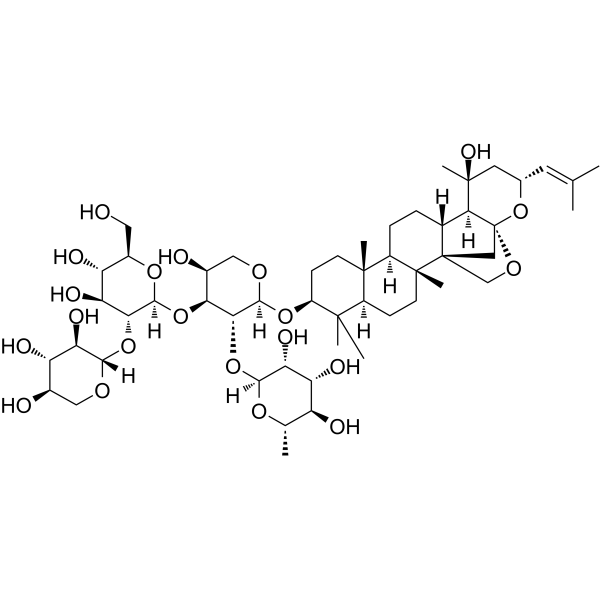
Jujuboside B is a bioactive saponin component isolated from Ziziphi Spinosae Semen (sour jujube seed), with oral efficacy and blood-brain barrier permeability. Jujuboside B induces acute leukemia cell death and drives necroptosis apoptosis by activating the RIPK1/RIPK3/MLKL pathway. Jujuboside B upregulates the expression of NOXA, PARP and caspase-3, activates AMPK, inhibits the proliferation of breast cancer cells, and induces cell apoptosis and autophagy. Jujuboside B inhibits angiogenesis and tumor growth by blocking the VEGFR-2 signaling pathway. Jujuboside B alleviates liver injury in mice by regulating the Nrf2-STING signaling pathway . Jujuboside B alleviates liver injury by regulating anti-inflammatory responses and downregulating the expression of 11β-HSD2. Jujuboside B induces ferroptosis and overcomes radioresistance in non-small cell lung cancer via the PPARγ-ATF3-Gpx4 signaling pathway. Jujuboside B exerts inhibitory effects on platelet aggregation. Jujuboside B inhibits febrile seizures by suppressing the activity of AMPA receptors. Jujuboside B reverses chronic unpredictable mild stress-promoted tumor progression by blocking the PI3K/Akt and MAPK/ERK pathways and dephosphorylating CREB signaling. Jujuboside B is applicable to related studies on acute leukemia, breast cancer, PM2.5-induced lung injury, hepatotoxicity, liver injury, colorectal cancer, non-small cell lung cancer, thromboembolic diseases, cardiovascular diseases associated with high platelet aggregation, febrile seizures, and depressive-like phenotypes [2] .
loading...
    loading...
Cat. No.: HY-N0660R
CAS No.: 55466-05-2
Jujuboside B (Standard) is the analytical standard of Jujuboside B. This product is intended for research and analytical applications. Jujuboside B is a bioactive saponin component isolated from Ziziphi Spinosae Semen (sour jujube seed), with oral efficacy and blood-brain barrier permeability. Jujuboside B induces acute leukemia cell death and drives necroptosis apoptosis by activating the RIPK1/RIPK3/MLKL pathway. Jujuboside B upregulates the expression of NOXA, PARP and caspase-3, activates AMPK, inhibits the proliferation of breast cancer cells, and induces cell apoptosis and autophagy. Jujuboside B inhibits angiogenesis and tumor growth by blocking the VEGFR-2 signaling pathway. Jujuboside B alleviates liver injury in mice by regulating the Nrf2-STING signaling pathway . Jujuboside B alleviates liver injury by regulating anti-inflammatory responses and downregulating the expression of 11β-HSD2. Jujuboside B induces ferroptosis and overcomes radioresistance in non-small cell lung cancer via the PPARγ-ATF3-Gpx4 signaling pathway. Jujuboside B exerts inhibitory effects on platelet aggregation. Jujuboside B inhibits febrile seizures by suppressing the activity of AMPA receptors. Jujuboside B reverses chronic unpredictable mild stress-promoted tumor progression by blocking the PI3K/Akt and MAPK/ERK pathways and dephosphorylating CREB signaling. Jujuboside B is applicable to related studies on acute leukemia, breast cancer, PM2.5-induced lung injury, hepatotoxicity, liver injury, colorectal cancer, non-small cell lung cancer, thromboembolic diseases, cardiovascular diseases associated with high platelet aggregation, febrile seizures, and depressive-like phenotypes.
loading...
    loading...

