19 Results for "

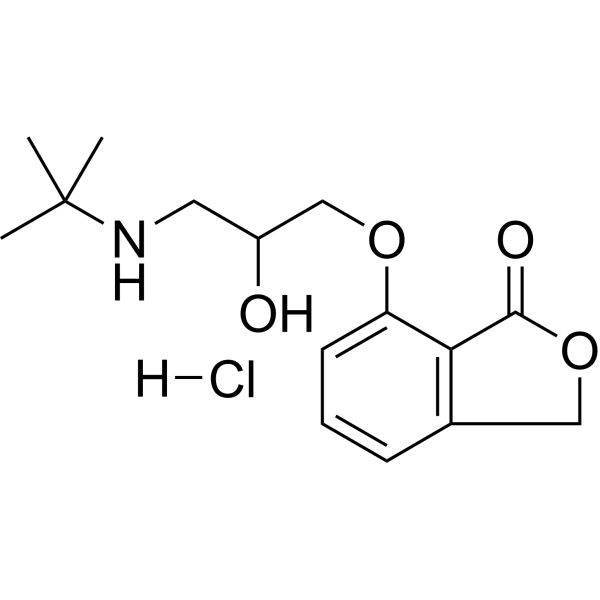
DL 071IT

" in MedChemExpress (MCE) Product Catalog:
Products (19)

19 Results for "DL 071IT" in MCE Product Catalog:

Cat. No.: HY-106667
CAS No.: 55104-39-7
Purity:  98.81%
Target:  

Adrenergic Receptor

DL 071IT is a potent non-selective beta-adrenergic receptor blocker. DL 071IT exhibits intrinsic sympathomimetic activity and weak membrane stabilizing activity. DL 071IT reduces exercise heart rate and systolic blood pressure, and even significantly lowers resting heart rate .
loading...
    loading...
Cat. No.: HY-NP071
Synonyms: LEL
Lycopersicon esculentum (Tomato) Lectin (LEL) specifically recognizes and binds to sugar structures, that combines with fluorescein for fluorescent labeling and imaging of cells and tissues. Lycopersicon esculentum (Tomato) Lectin is used to visualizes the vasculature within transplanted tissues by labeling with fluorescein .
loading...
    loading...
Cat. No.: HY-NP071A
Synonyms: LEL-AF350
Lycopersicon esculentum (Tomato) Lectin-AF350 (LEL-AF350) is Lycopersicon esculentum lectin (LEL) labeled with the AF350 fluorescent dye. Lycopersicon esculentum (Tomato) lectin specifically recognizes and binds to glycan structures, primarily targeting N-acetyl-β-D-glucosamine residues. Lycopersicon esculentum (Tomato) Lectin-AF350 can be used to study glycosylation and localize glycan structures on cell surfaces and in tissue sections (Ex/Em = 346/445 nm).
loading...
    loading...
Cat. No.: HY-NP071B
Synonyms: LEL-AF405
Lycopersicon esculentum (Tomato) Lectin-AF405 (LEL-AF405) is Lycopersicon esculentum lectin (LEL) labeled with the AF405 fluorescent dye. Lycopersicon esculentum (Tomato) lectin specifically recognizes and binds to glycan structures, primarily targeting N-acetyl-β-D-glucosamine residues. Lycopersicon esculentum (Tomato) Lectin-AF405 can be used to study glycosylation and localize glycan structures on cell surfaces and in tissue sections (Ex/Em = 405/435 nm).
loading...
    loading...
Cat. No.: HY-NP071C
Synonyms: LEL-AF488
Lycopersicon esculentum (Tomato) Lectin-AF488 (LEL-AF488) is Lycopersicon esculentum lectin (LEL) labeled with the AF488 fluorescent dye. Lycopersicon esculentum (Tomato) lectin specifically recognizes and binds to glycan structures, primarily targeting N-acetyl-β-D-glucosamine residues. Lycopersicon esculentum (Tomato) Lectin-AF488 can be used to study glycosylation and localize glycan structures on cell surfaces and in tissue sections (Ex/Em = 470/520 nm).
loading...
    loading...
Cat. No.: HY-NP071D
Synonyms: LEL-AF568
Lycopersicon esculentum (Tomato) Lectin-AF568 (LEL-AF568) is Lycopersicon esculentum lectin (LEL) labeled with the AF568 fluorescent dye. Lycopersicon esculentum (Tomato) lectin specifically recognizes and binds to glycan structures, primarily targeting N-acetyl-β-D-glucosamine residues. Lycopersicon esculentum (Tomato) Lectin-AF568 can be used to study glycosylation and localize glycan structures on cell surfaces and in tissue sections (Ex/Em = 579/603 nm).
loading...
    loading...
Cat. No.: HY-NP071E
Synonyms: LEL-AF594
Lycopersicon esculentum (Tomato) Lectin-AF594 (LEL-AF594) is Lycopersicon esculentum lectin (LEL) labeled with the AF594 fluorescent dye. Lycopersicon esculentum (Tomato) lectin specifically recognizes and binds to glycan structures, primarily targeting N-acetyl-β-D-glucosamine residues. Lycopersicon esculentum (Tomato) Lectin-AF594 can be used to study glycosylation and localize glycan structures on cell surfaces and in tissue sections (Ex/Em = 590/617 nm).
loading...
    loading...
Cat. No.: HY-NP071H
Synonyms: LEL-AF647
Lycopersicon esculentum (Tomato) Lectin-AF647 (LEL-AF647) is Lycopersicon esculentum lectin (LEL) labeled with the AF647 fluorescent dye. Lycopersicon esculentum (Tomato) lectin specifically recognizes and binds to glycan structures, primarily targeting N-acetyl-β-D-glucosamine residues. Lycopersicon esculentum (Tomato) Lectin-AF647 can be used to study glycosylation and localize glycan structures on cell surfaces and in tissue sections (Ex/Em = 650/665 nm).
loading...
    loading...
Cat. No.: HY-NP071I
Synonyms: LEL-AF680
Lycopersicon esculentum (Tomato) Lectin-AF680 (LEL-AF680) is Lycopersicon esculentum lectin (LEL) labeled with the AF680 fluorescent dye. Lycopersicon esculentum (Tomato) lectin specifically recognizes and binds to glycan structures, primarily targeting N-acetyl-β-D-glucosamine residues. Lycopersicon esculentum (Tomato) Lectin-AF680 can be used to study glycosylation and localize glycan structures on cell surfaces and in tissue sections (Ex/Em = 684/707 nm).
loading...
    loading...
Cat. No.: HY-NP071J
Synonyms: LEL-Cy3
Lycopersicon esculentum (Tomato) Lectin-Cy3 (LEL-Cy3) is Lycopersicon esculentum lectin (LEL) labeled with the Cy3 fluorescent dye. Lycopersicon esculentum (Tomato) lectin specifically recognizes and binds to glycan structures, primarily targeting N-acetyl-β-D-glucosamine residues. Lycopersicon esculentum (Tomato) Lectin-Cy3 can be used to study glycosylation and localize glycan structures on cell surfaces and in tissue sections (Ex/Em = 554/568 nm).
loading...
    loading...
Cat. No.: HY-NP071K
Synonyms: LEL-Cy5
Lycopersicon esculentum (Tomato) Lectin-Cy5 (LEL-Cy5) is Lycopersicon esculentum lectin (LEL) labeled with the Cy5 fluorescent dye. Lycopersicon esculentum (Tomato) lectin specifically recognizes and binds to glycan structures, primarily targeting N-acetyl-β-D-glucosamine residues. Lycopersicon esculentum (Tomato) Lectin-Cy5 can be used to study glycosylation and localize glycan structures on cell surfaces and in tissue sections (Ex/Em = 554/568 nm).
loading...
    loading...
Cat. No.: HY-NP071L
Synonyms: LEL-Cy7
Lycopersicon esculentum (Tomato) Lectin-Cy7 (LEL-Cy7) is Lycopersicon esculentum lectin (LEL) labeled with the Cy7 fluorescent dye. Lycopersicon esculentum (Tomato) lectin specifically recognizes and binds to glycan structures, primarily targeting N-acetyl-β-D-glucosamine residues. Lycopersicon esculentum (Tomato) Lectin-Cy7 can be used to study glycosylation and localize glycan structures on cell surfaces and in tissue sections (Ex/Em = 554/568 nm).
loading...
    loading...
Cat. No.: HY-L071
605 compounds

Alkaloids are a large and complex group of cyclic compounds that contain N. About 2,000 different alkaloids have been isolated. Important alkaloids include morphine, strychnine, atropine, colchicine, ephedrine, quinine, and nicotine. Alkaloids are useful as diet ingredients, supplements, and pharmaceuticals, in medicine and in other applications in human life. They showed anti-inflammatory, anticancer, analgesics, local anesthetic and pain relief, neuropharmacologic, antimicrobial, antifungal, and many other activities. Alkaloids are also important compounds in organic synthesis for searching new semisynthetic and synthetic compounds with possibly better biological activity than parent compounds.

MCE designs a unique collection of 605 alkaloids that all come from natural products. MCE Alkaloids Library is a useful tool for drug discovery that can be used for high throughput screening (HTS) and high content screening (HCS).

Cat. No.: HY-P8F071B
Synonyms: IFN-γ,IFN-Γ-AF488,XMG1.2

Host:  

Rat

Application:  

FC

Reactivity:  

Mouse

loading...
    loading...
Cat. No.: HY-P8F071C
Synonyms: IFN-γ,IFN-Γ-PE,XMG1.2

Host:  

Rat

Application:  

FC

Reactivity:  

Mouse

loading...
    loading...
Cat. No.: HY-P8F071D
Synonyms: IFN-γ,IFN-Γ-PE-Cy7,XMG1.2

Host:  

Rat

Application:  

FC

Reactivity:  

Mouse

loading...
    loading...
Cat. No.: HY-P8F071I
Synonyms: IFN-γ,IFN-Γ-APC,XMG1.2

Host:  

Rat

Application:  

FC

Reactivity:  

Mouse

loading...
    loading...
Cat. No.: HY-P8F071K
Synonyms: IFN-γ,IFN-Γ-AF700,XMG1.2

Host:  

Rat

Application:  

FC

Reactivity:  

Mouse

loading...
    loading...
Cat. No.: HY-P8F071L
Synonyms: IFN-γ,IFN-Γ-PC Blue,XMG1.2

Host:  

Rat

Application:  

FC

Reactivity:  

Mouse

loading...
    loading...
  • 1

