6 Results for "

MHCC97-H

" in MedChemExpress (MCE) Product Catalog:
Products (6)

6 Results for "MHCC97-H" in MCE Product Catalog:

1
1 Cited Publications
Cat. No.: HY-123931
CAS No.: 667880-38-8
Purity:  98.78%
Research Areas:  

Cancer

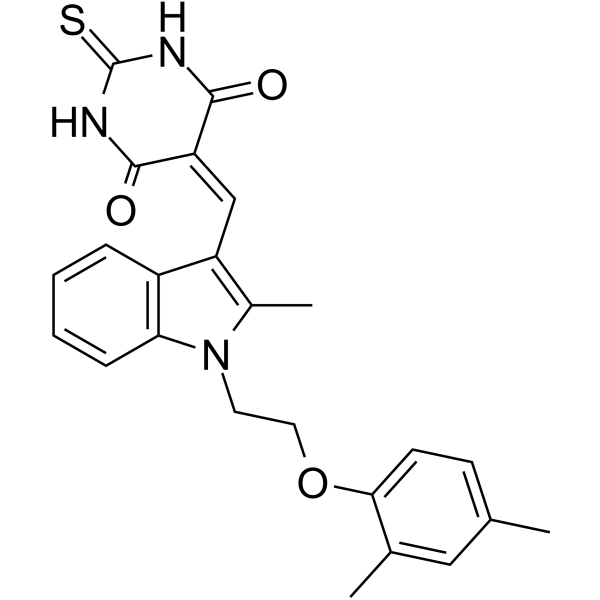
ZLDI-8 is a Notch activating/cleaving enzyme ADAM-17 inhibitor and inhibits the cleavage of Notch protein. ZLDI-8 decreases the expression of pro-survival/anti-apoptosis and epithelial-mesenchymal transition (EMT) related proteins. ZLDI-8 is also a competitive and irreversible tyrosine phosphatase (Lyp) inhibitor with an IC50 of 31.6 μM and a Ki of 26.22 μM. ZLDI-8 inhibits the growth of MHCC97-H cells with an IC50 of 5.32 μM .
loading...
    loading...
Cat. No.: HY-177796
CAS No.: 2923531-50-2
Target:  

Apoptosis CDK Caspase PARP

Research Areas:  

Cancer

TMLB-C16 is a potent and orally active B3GAT3 inhibitor with a KD of 3.962 μM. TMLB-C16 suppresses proliferation and migration, and induces cell cycle arrest and apoptosis in MHCC-97H (IC50 = 6.53 μM) and HCCLM3 cells (IC50 = 6.22 μM). TMLB-C16 inhibits tumor growth in both MHCC-97H and HCCLM3 xenograft tumor mouse models without causing obvious toxicity. TMLB-C16 can be used for hepatocellular carcinoma research .
loading...
    loading...
Cat. No.: HY-162679
Target:  

c-Met/HGFR Apoptosis

Research Areas:  

Cancer

c-Met degrader-1 (Compound H11) is an orally active c-Met degrader (through the ubiquitin proteasome system). c-Met degrader-1 has anti-hepatocellular carcinoma activity (HCC) and inhibits tumor growth in MHCC97H xenografts. c-Met degrader-1 inhibits HCC cell growth, arrests cell cycle, and induces apoptosis. c-Met degrader-1 may overcome resistance to type Ib inhibitors .
loading...
    loading...
Cat. No.: HY-183780
FGFR-IN-27 is an orally active, broad-spectrum FGFR inhibitor, with an IC50 of 0.24 nM against human FGFR1, 0.71 nM against FGFR2, 0.87 nM against FGFR3, and 6.50 nM against FGFR4. FGFR-IN-27 inhibits cancer cell proliferation and blocks tumor growth. FGFR-IN-27 reduces the phosphorylation levels of AKT and ERK, induces apoptosis and ferroptosis, increases ROS levels, and decreases GSH levels. FGFR-IN-27 can be used in the research of hepatocellular carcinoma .
loading...
    loading...
Cat. No.: HY-181153
Target:  

PROTACs FGFR

Research Areas:  

Cancer

PROTAC FGFR3 Degrader-1 is a fibroblast growth factor receptor 3 (FGFR3) PROTAC degrader, promotes FGFR3 degradation via the ubiquitin-proteasome pathway, and inhibits the downstream FGFR3/PI3K/AKT signaling pathway. PROTAC FGFR3 Degrader-1 can be used for the research of hepatocellular carcinoma .
loading...
    loading...
Cat. No.: HY-181152
Target:  

FGFR

Research Areas:  

Cancer

FGFR3-IN-11(compound B11) is a Fibroblast growth factor receptor 3 (FGFR3) inhibitor with a Ka value of 4.8 μM. FGFR3-IN-11 induces apoptosis, suppresses colony formation, and causes dose-dependent G0/G1 cell cycle arrest in cancer cells. FGFR3-IN-11 exerts anticancer activity against cancer cells with minimal toxicity toward normal hepatocytes and demonstrates tumor growth suppression in xenograft mouse models. FGFR3-IN-11 can be used for the research of hepatocellular carcinoma .
loading...
    loading...

