5 Results for "

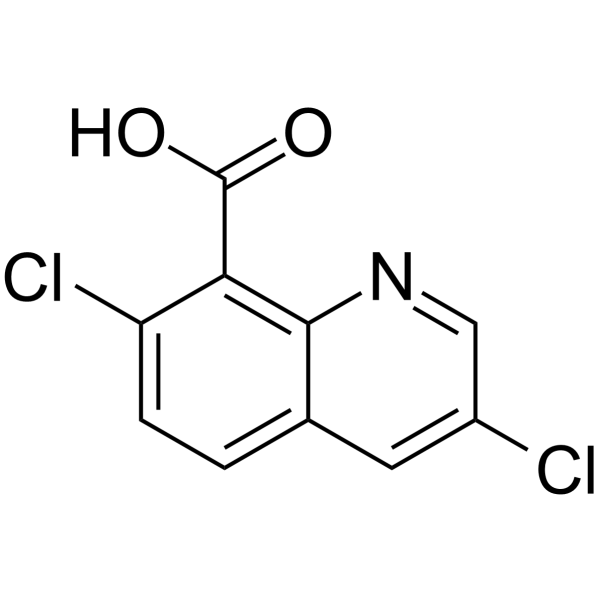
Quinclorac

" in MedChemExpress (MCE) Product Catalog:
Products (5)

5 Results for "Quinclorac" in MCE Product Catalog:

Cat. No.: HY-B0871
CAS No.: 84087-01-4
Research Areas:  

Others

Quinclorac is a highly selective quinoline carboxylic acid synthetic auxin herbicide. Quinclorac weakly inhibits HPPD, accompanied by a transient decrease in carotenoids. Quinclorac upregulates ACC synthase (ACS), leading to the co-accumulation of ethylene and cyanide, while increasing the ABA/IAA ratio, which induces ROS burst, membrane lipid peroxidation (MDA) and lethal growth inhibition. Residual Quinclorac in soil can cause abnormal growth of subsequent tobacco crops. In calli of Phaseolus vulgaris, Quinclorac induces oxidative stress (increased MDA and decreased RGR), but cells after stepwise pressurized acclimation acquire a constitutive antioxidant state, which remains stable after de-acclimation and tolerates oxidative damage caused by Quinclorac. Quinclorac can be used in studies related to herbicide action mechanisms, bioremediation of soil residues, and adaptive responses of plant cells to oxidative stress .
loading...
    loading...
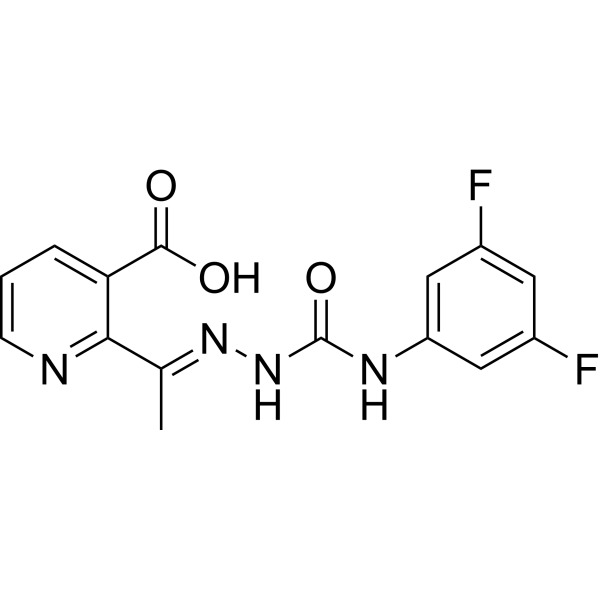
Cat. No.: HY-123158
CAS No.: 109293-97-2
Synonyms: SAN 835H
Target:  

Herbicide

Research Areas:  

Others

Diflufenzopyr (SAN 835H) is an auxin transport inhibitor. Diflufenzopyr can enhance the activity of auxin herbicides, such as quinclorac (HY-B0871) and picloram (HY-B2034), and of the synthetic auxin, 1-naphthaleneacetic acid (HY-18570) .
loading...
    loading...
Cat. No.: HY-B0871R
CAS No.: 84087-01-4
Quinclorac (Standard) is the analytical standard of Quinclorac (HY-B0871). This product is intended for research and analytical applications. Quinclorac is a highly selective quinoline carboxylic acid synthetic auxin herbicide. Quinclorac weakly inhibits HPPD, accompanied by a transient decrease in carotenoids. Quinclorac upregulates ACC synthase (ACS), leading to the co-accumulation of ethylene and cyanide, while increasing the ABA/IAA ratio, which induces ROS burst, membrane lipid peroxidation (MDA) and lethal growth inhibition. Residual Quinclorac in soil can cause abnormal growth of subsequent tobacco crops. In calli of Phaseolus vulgaris, Quinclorac induces oxidative stress (increased MDA and decreased RGR), but cells after stepwise pressurized acclimation acquire a constitutive antioxidant state, which remains stable after de-acclimation and tolerates oxidative damage caused by Quinclorac. Quinclorac can be used in studies related to herbicide action mechanisms, bioremediation of soil residues, and adaptive responses of plant cells to oxidative stress .
loading...
    loading...
Cat. No.: HY-B0871S
Quinclorac- 13C is the 13C-labeled Quinclorac (HY-B0871). Quinclorac is a highly selective quinoline carboxylic acid synthetic auxin herbicide. Quinclorac weakly inhibits HPPD, accompanied by a transient decrease in carotenoids. Quinclorac upregulates ACC synthase (ACS), leading to the co-accumulation of ethylene and cyanide, while increasing the ABA/IAA ratio, which induces ROS burst, membrane lipid peroxidation (MDA) and lethal growth inhibition. Residual Quinclorac in soil can cause abnormal growth of subsequent tobacco crops. In calli of Phaseolus vulgaris, Quinclorac induces oxidative stress (increased MDA and decreased RGR), but cells after stepwise pressurized acclimation acquire a constitutive antioxidant state, which remains stable after de-acclimation and tolerates oxidative damage caused by Quinclorac. Quinclorac can be used in studies related to herbicide action mechanisms, bioremediation of soil residues, and adaptive responses of plant cells to oxidative stress .
loading...
    loading...
Cat. No.: HY-123158R
CAS No.: 109293-97-2
Synonyms: SAN 835H (Standard)
Research Areas:  

Others

Diflufenzopyr (Standard) is the analytical standard of Diflufenzopyr. This product is intended for research and analytical applications. Diflufenzopyr (SAN 835H) is an auxin transport inhibitor. Diflufenzopyr can enhance the activity of auxin herbicides, such as quinclorac (HY-B0871) and picloram (HY-B2034), and of the synthetic auxin, 1-naphthaleneacetic acid (HY-18570) .
loading...
    loading...

