
40 Results for "

TIMP

" in MedChemExpress (MCE) Product Catalog:
Products (40)

40 Results for "TIMP" in MCE Product Catalog:

4
4 Cited Publications
Art. -Nr.: HY-154919
Reinheit:  99.52%
Forschungsgebiete:  

Endocrinology Cancer

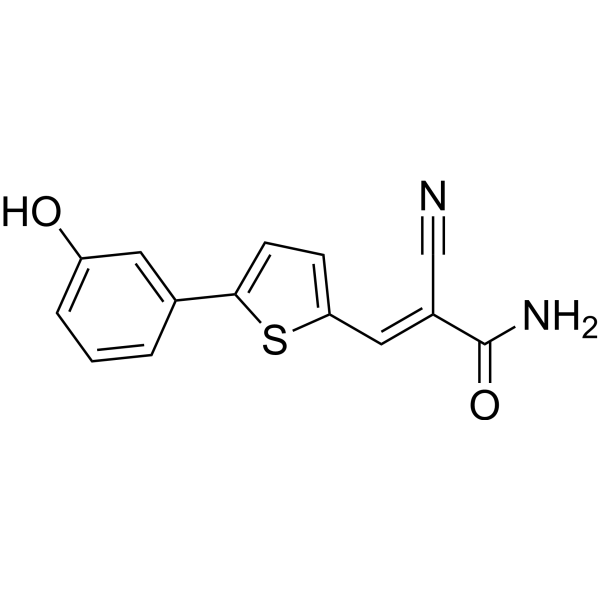
DC-Y13-27 is a DC-Y13 derivative and YTHDF2 inhibitor (KD: 37.9 μM). DC-Y13-27 inhibits YTHDF2, restores FOXO3 and TIMP1 protein levels, and reduces MMP1/3/7/9 expression. DC-Y13-27 induces Pyroptosis and increases IL-1β secretion. DC-Y13-27 reduces intervertebral disc degeneration and enhances the response to radiotherapy in colon cancer and melanoma. DC-Y13-27 has antitumor activity against breast cancer .
1
1 Cited Publications
Art. -Nr.: HY-151932
CAS. Nr.: 3037847-72-3
Reinheit:  95.94%
Target:  

FXR

Forschungsgebiete:  

Inflammation/Immunology

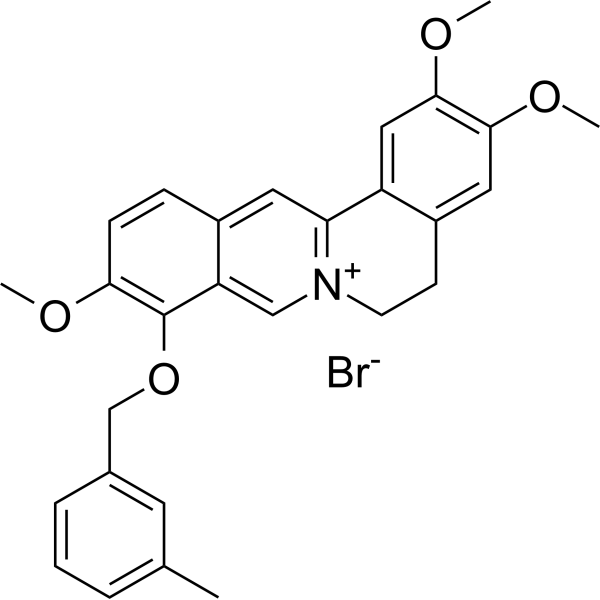
FXR agonist 3 is an anti-NASH agent, acting by activating FXR. FXR agonist 3 inhibits COL1A1, TGF-β1, α-SMA and TIMP1 expression with anti-fibrogenic activity. FXR agonist 3 significantly reduces liver steatosis and inflammation, improves liver fibrosis level .
1
1 Cited Publications
Art. -Nr.: HY-P71110
Reinheit:  ≥ 95%, as determined by reducing SDS-PAGE.
Synonyms: Metalloproteinase Inhibitor 1; Erythroid-Potentiating Activity; EPA; Fibroblast collagenase Inhibitor; Collagenase Inhibitor; Tissue Inhibitor of Metalloproteinases 1; TIMP-1; TIMP1; CLGI; TIMP
Species:  
Source:  
1
1 Cited Publications
Art. -Nr.: HY-P80356
Synonyms: Metalloproteinase inhibitor 2 precursor; Tissue inhibitor of metalloproteinases 2; Collagenase inhibitor; CSC 21K; CSC21K; TIMP2; TIMP 2; TIMP 2; TIMP metallopeptidase inhibitor 2; TIMP2_HUMAN; Metalloproteinase inhibitor 2; CSC-21K; TIMP-2.

Host:  

Mouse

Application:  

WB, IHC-P, FC

Reactivity:  

Human

1
1 Cited Publications
Art. -Nr.: HY-P81133
Synonyms: Clgi; Collagenase inhibitor; EPA; EPO; Erythroid Potentiating Activity; Fibroblast collagenase inhibitor; FLJ90373; HC; Human Collagenase Inhibitor; Metalloproteinase inhibitor 1; Metalloproteinase inhibitor 1 precursor; OTTHUMP00000023214; TIMP 1; TIMP; TIMP metallopeptidase inhibitor 1; TIMP1 protein; Tissue Inhibitor of Metalloproteinase 1; Tissue inhibitor of metalloproteinases; Ttissue inhibitor of metalloproteinase 1 erythroid potentiating activity collagenase inhibitor.

Host:  

Rabbit

Application:  

WB, IHC-P, ICC/IF

Reactivity:  

Human

1
1 Cited Publications
Art. -Nr.: HY-P71117
Reinheit:  ≥ 95%, as determined by reducing SDS-PAGE.
Synonyms: Metalloproteinase Inhibitor 2; CSC-21K; Tissue Inhibitor of Metalloproteinases 2; TIMP-2; TIMP2
Species:  
Source:  
1
1 Cited Publications
Art. -Nr.: HY-P71137
Reinheit:  ≥ 90%, as determined by reducing SDS-PAGE.
Synonyms: TIMP-2; CSC-21Ktissue inhibitor of metalloproteinase 2; metalloproteinase inhibitor 2; TIMP metalloproteinase inhibitor 2; Tissue inhibitor of metalloproteinase 2.
Species:  
Source:  
Art. -Nr.: HY-W075770
CAS. Nr.: 1313-99-1
Synonyms: Nickel monoxide
Nickel(II) oxide (nickel monoxide) is a chemical warfare agent that can enter the body through the respiratory tract and other routes, distributing to organs such as the lungs and testes. The nanoparticle form of nickel(II) oxide (NiO NPs) exhibits antibacterial, anti-leishmanial, anti-diabetic, and anti-cancer activities. NiO NPs can be activated by ultraviolet and visible light, generating reactive oxygen species (ROS). Nickel(II) oxide induces oxidative stress by generating reactive oxygen species, activating the TGF-β1-mediated MAPK and PI3K/AKT pathways, disrupting the MMPs/TIMPs balance, and upregulating the expression of inflammatory factors (IL-1β, IL-6) and apoptosis-related molecules (Bax, caspase-3, p53), while inhibiting the activity of the anti-apoptotic molecule Bcl-2. Nickel(II) oxide induces cytotoxicity, promotes fibrosis, triggers inflammatory responses, and causes apoptosis. Nickel(II) oxide can be applied in research on the safety assessment of nanomaterials, such as in the context of pulmonary fibrosis and reproductive system toxicity .
Art. -Nr.: HY-145426
CAS. Nr.: 1817802-18-8
Reinheit:  98.76%
Target:  

HDAC

Forschungsgebiete:  

Cancer

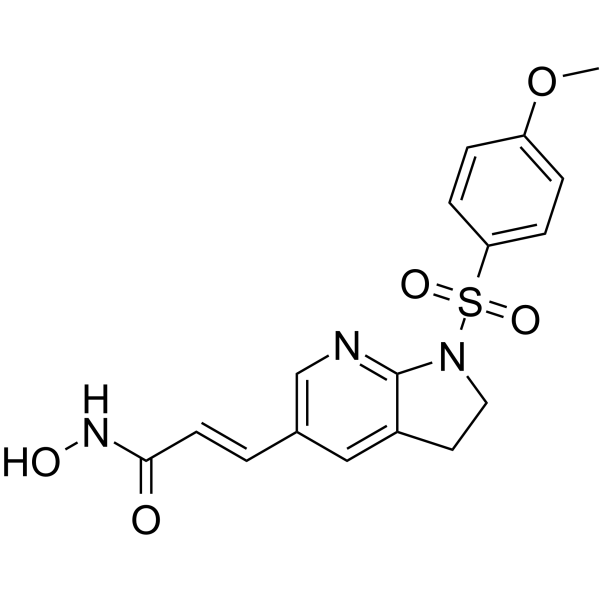
MPT0B390 is an arylsulfonamide-based derivative with potent HDAC inhibitory ability. MPT0B390, TIMP3 inducer, inhibits tumor growth, metastasis and angiogenesis. MPT0B390 shows antiproliferative activity against human colon cancer cell line HCT116 with the GI50 of 0.03 μM .
Art. -Nr.: HY-W012856
CAS. Nr.: 620-14-4
Synonyms: 3-Methylethylbenzene
3-Ethyltoluene (3-Methylethylbenzene) is an isomer of Ethyltoluenes. 3-Ethyltoluene inhibits cell survival and proliferation and increases ROS production. 3-Ethyltoluene upregulates cellular inflammatory gene expression. 3-Ethyltoluene induces cell fibrosis with increased level of AST, FGF-23, Cyt-7 p21, TGFβ, TIMP2, and MMP2. 3-Ethyltoluene can be used for liver diseases such as NAFLD research .
Art. -Nr.: HY-RS14538
Forschungsgebiete:  

Others

TIMP1 Human Pre-designed siRNA Set A contains three designed siRNAs for TIMP1 gene (Human), as well as a negative control, a positive control, and a FAM-labeled negative control.

Art. -Nr.: HY-178477
LIFR/GPBAR1 modulator 1 is an orally active, potent GPBAR1 agonist (EC50 = 0.2 μM) and LIFR inhibitor (IC50 = 7.9 μM). LIFR/GPBAR1 modulator 1 upregulates leukaemia inhibitory factor (LIF)-mediated mRNA expression of LIFR and GPBAR1 and significantly reduces the expression of pro-fibrosis markers (COL1A1, ASMA, and TGFβ), and reduces TIMP1 expression and increases MMP9 expression. LIFR/GPBAR1 modulator 1 can be used for the study of human fibrotic disorders .
Art. -Nr.: HY-P4890
CAS. Nr.: 1158181-62-4
Relaxin H3 (human) is a relaxin peptide with anti-inflammatory, anti-apoptotic, anti-pyroptotic, anti-migratory, protective and anti-fibrotic activities. Relaxin H3 (human) acts on RXFP1 to generate cAMP and reduce the levels of ATP and ROS. Relaxin H3 (human) inhibits renal inflammatory pyroptosis (pyroptosis), NLRP3 inflammasome activation, caspase-1 activation, IL-1β/IL-18 secretion, collagen synthesis, TGF-β1 signaling pathway, Smad2 phosphorylation, myofibroblast differentiation, TIMP expression, and HRMEC migration. Relaxin H3 (human) activates AMPK, upregulates MFN2 expression, improves mitochondrial quality control and membrane potential, inhibits apoptosis (apoptosis) and pyroptosis, restores retinal ultrastructure, and reverses excessive left ventricular collagen expression. Relaxin H3 (human) can be used in studies related to kidney stones, nephrocalcinosis, diabetic cardiomyopathy, fibrotic cardiomyopathy, and diabetic retinopathy .
Art. -Nr.: HY-RS14539
Forschungsgebiete:  

Others

TIMP2 Human Pre-designed siRNA Set A contains three designed siRNAs for TIMP2 gene (Human), as well as a negative control, a positive control, and a FAM-labeled negative control.

Art. -Nr.: HY-RS14540
Forschungsgebiete:  

Others

TIMP3 Human Pre-designed siRNA Set A contains three designed siRNAs for TIMP3 gene (Human), as well as a negative control, a positive control, and a FAM-labeled negative control.

Art. -Nr.: HY-RS14541
Forschungsgebiete:  

Others

TIMP4 Human Pre-designed siRNA Set A contains three designed siRNAs for TIMP4 gene (Human), as well as a negative control, a positive control, and a FAM-labeled negative control.

Art. -Nr.: HY-RS18302
Forschungsgebiete:  

Others

Timp3 Mouse Pre-designed siRNA Set A contains three designed siRNAs for Timp3 gene (Mouse), as well as a negative control, a positive control, and a FAM-labeled negative control.

Art. -Nr.: HY-RS20115
Forschungsgebiete:  

Others

Timp4 Mouse Pre-designed siRNA Set A contains three designed siRNAs for Timp4 gene (Mouse), as well as a negative control, a positive control, and a FAM-labeled negative control.

Art. -Nr.: HY-RS23838
Forschungsgebiete:  

Others

Timp2 Rat Pre-designed siRNA Set A contains three designed siRNAs for Timp2 gene (Rat), as well as a negative control, a positive control, and a FAM-labeled negative control.

Art. -Nr.: HY-RS26619
Forschungsgebiete:  

Others

Timp4 Rat Pre-designed siRNA Set A contains three designed siRNAs for Timp4 gene (Rat), as well as a negative control, a positive control, and a FAM-labeled negative control.

