5 Results for "

diffusible signal factor

" in MedChemExpress (MCE) Product Catalog:
Products (5)

5 Results for "diffusible signal factor" in MCE Product Catalog:

Cat. No.: HY-W127393
CAS No.: 177158-21-3
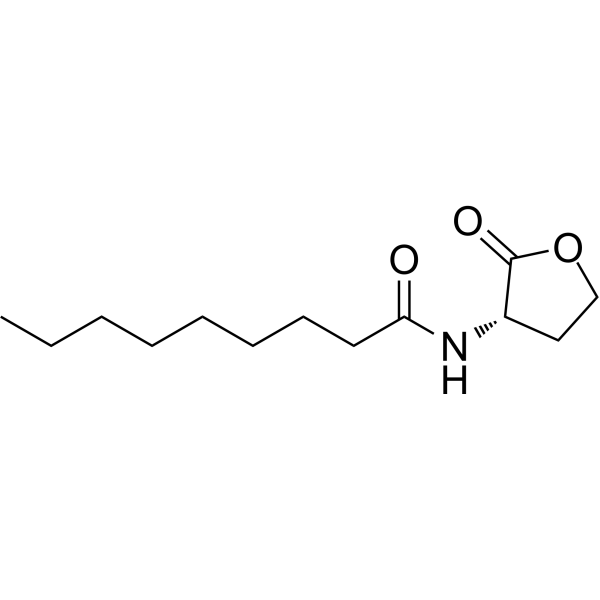
Quorum sensing is a regulatory system used by bacteria to control gene expression in response to increased cell density. This regulatory process manifests itself in a variety of phenotypes, including biofilm formation and virulence factor production. Coordinated gene expression is achieved through the production, release and detection of small diffusible signaling molecules called autoinducers. N-acylated homoserine lactones (AHLs) comprise a class of such autoinducers, each of which generally consists of a fatty acid coupled to a homoserine lactone (HSL). Modulation of bacterial quorum-sensing signaling systems to suppress pathogenesis represents a new approach to antimicrobial research for infectious diseases. AHLs differ in acyl length (C4-C18), C3 substitution (hydrogen, hydroxyl, or oxo group), and the presence or absence of one or more carbon-carbon double bonds in the fatty acid chain. These differences confer signaling specificity through the affinity of the LuxR family of transcriptional regulators. C9-HSL is a rare odd-numbered acyl carbon chain produced by wild-type Erwinia carotovora strain SCC 3193 grown in nutrient-rich Luria-Bertani broth (LB) medium.
loading...
    loading...
Cat. No.: HY-162624
Target:  

Bacterial

Research Areas:  

Infection

Quorum sensing-IN-5 is a RpfF-targeted quorum-sensing inhibitor. Quorum sensing-IN-5 inhibits Xanthomonas oryzae pv oryzae (Xoo) and Xanthomonas axonopodis pv. citri (Xac) with EC50 values of 9.91 μg/mL and 7.04 μg/mL. Quorum sensing-IN-5 has antimicrobial activity .
loading...
    loading...
Cat. No.: HY-114773
CAS No.: 216596-71-3
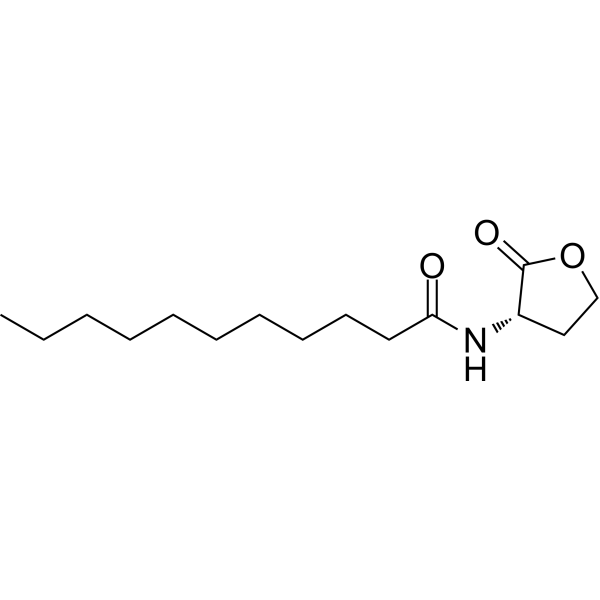
Quorum sensing is a regulatory system used by bacteria to control gene expression in response to increased cell density. This regulatory process manifests itself in a variety of phenotypes, including biofilm formation and virulence factor production. Coordinated gene expression is achieved through the production, release and detection of small diffusible signaling molecules called autoinducers. N-acylated homoserine lactones (AHLs) comprise a class of such autoinducers, each of which generally consists of a fatty acid coupled to a homoserine lactone (HSL). Modulation of bacterial quorum-sensing signaling systems to suppress pathogenesis represents a new approach to antimicrobial research for infectious diseases. AHLs differ in acyl length (C4-C18), C3 substitution (hydrogen, hydroxyl, or oxo group), and the presence or absence of one or more carbon-carbon double bonds in the fatty acid chain. These differences confer signaling specificity through the affinity of the LuxR family of transcriptional regulators. C11-HSL has a rare odd-numbered acyl carbon chain and may be a minor quorum-sensing signaling molecule in Pseudomonas aeruginosa strains.
loading...
    loading...
Cat. No.: HY-W127487
CAS No.: 479050-96-9
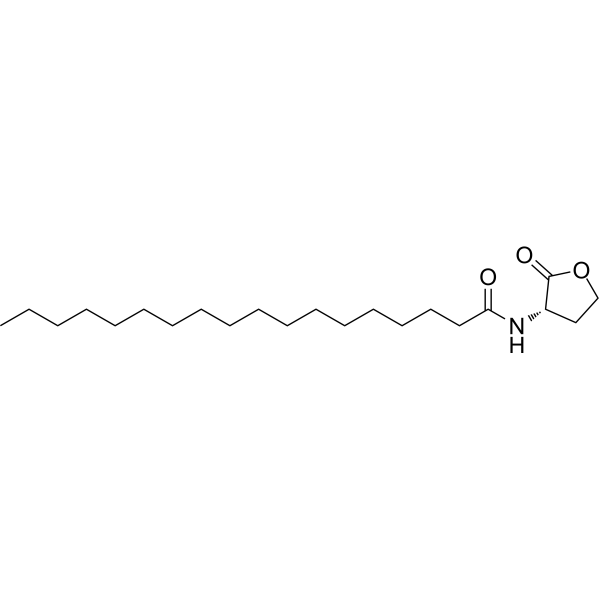
Quorum sensing is a regulatory system used by bacteria to control gene expression in response to increased cell density. This regulatory process manifests itself in a variety of phenotypes, including biofilm formation and virulence factor production. Coordinated gene expression is achieved through the production, release and detection of small diffusible signaling molecules called autoinducers. N-acylated homoserine lactones (AHLs) comprise a class of such autoinducers, each of which generally consists of a fatty acid coupled to a homoserine lactone (HSL). Modulation of bacterial quorum-sensing signaling systems to suppress pathogenesis represents a new approach to antimicrobial research for infectious diseases. AHLs differ in acyl length (C4-C18), C3 substitution (hydrogen, hydroxyl, or oxo group), and the presence or absence of one or more carbon-carbon double bonds in the fatty acid chain. These differences confer signaling specificity through the affinity of the LuxR family of transcriptional regulators. C18-HSL, one of four lipophilic long acyl side chain AHLs produced by the LuxI AHL synthase homolog SinI, is involved in quorum-sensing signaling in strains of Rhizobium meliloti (a nitrogen-fixing bacterial symbiont of the legume M. sativa) . C18-HSL and other hydrophobic AHLs tend to localize in the relatively lipophilic environment of bacterial cells and cannot diffuse freely across the cell membrane. Long-chain N-acyl homoserine lactones can be exported from cells by efflux pumps, or can be transported between communicating cells by extracellular outer membrane vesicles.
loading...
    loading...
Cat. No.: HY-L125
2,769 compounds

Pulmonary fibrosis (PF), also known as diffuse interstitial pulmonary fibrosis, is a very common end-stage manifestation of several diseases, including idiopathic pulmonary fibrosis (IPF), pulmonary hypertension, and scleroderma, characterised by excessive matrix deposition and destruction of the lung architecture, finally leading to respiratory insufficiency. PF has become a global disease with significantly increased incidence rate, and the most common form of pulmonary fibrosis is idiopathic pulmonary fibrosis (IPF).

Lung fibrosis is a complex disease, a multitude of signal factors and signaling pathways is disrupted in this complex disease, such as TGF-β, Wnt, VEGF and PI3K–Akt. MCE offers a unique collection of 2,769 compounds with identified and potential anti-pulmonary fibrosis activity. MCE Anti-Pulmonary Fibrosis Compound Library is a useful tool for anti-pulmonary fibrosis drugs screening and other related research.

