5 Results for "

reductive carboxylation

" in MedChemExpress (MCE) Product Catalog:
Products (5)

5 Results for "reductive carboxylation" in MCE Product Catalog:

Cat. No.: HY-164642
CAS No.: 24218-00-6
Synonyms: RuBP
Ribulose 1,5-bisphosphate (RUBP) is a vital photosynthetic intermediate and substrate. Ribulose 1,5-bisphosphate acts as both product and substrate for Thermococcus kodakarensis KOD1 R15Pi. Ribulose 1,5-bisphosphate tightly binds to inactive RuBP carboxylase sites in plant leaves.Ribulose 1,5-bisphosphate serves as the key substrate for CO2 fixation in photosynthesis. Ribulose 1,5-bisphosphate supports carboxylation and regeneration processes in photosynthesis. Ribulose 1,5-bisphosphate determines the dynamic transition temperature of photosynthetic control. Ribulose 1,5-bisphosphate can be used for photosynthesis and enzyme mechanism research .
loading...
    loading...
Cat. No.: HY-W783829
CAS No.: 10018-93-6
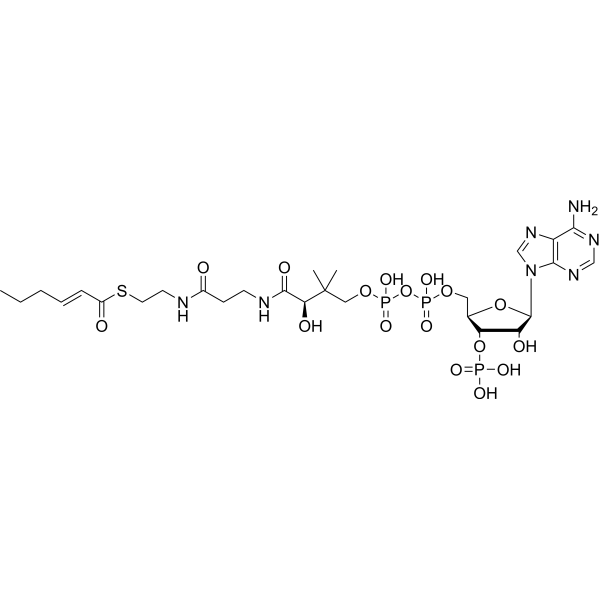
Synonyms: Hex-2-trans-enoyl-CoA
Target:  

Endogenous Metabolite

Research Areas:  

Metabolic Disease

(2E)-Hexenoyl-CoA (Hex-2-trans-enoyl-CoA) is an intermediate in fatty acid metabolism. (2E)-Hexenoyl-CoA undergoes reductive carboxylation to yield butylmalonyl-CoA .
loading...
    loading...
Cat. No.: HY-164642B
CAS No.: 1897433-92-9
Synonyms: RuBP sodium hydrate (purity ≥90%,TLC)
Ribulose 1,5-bisphosphate sodium hydrate (purity ≥90%,TLC) (RUBP sodium hydrate (purity ≥90%,TLC)) is a vital photosynthetic intermediate and substrate. Ribulose 1,5-bisphosphate sodium hydrate (purity ≥90%,TLC) acts as both product and substrate for Thermococcus kodakarensis KOD1 R15Pi. Ribulose 1,5-bisphosphate sodium hydrate (purity ≥90%,TLC) tightly binds to inactive RuBP carboxylase sites in plant leaves.Ribulose 1,5-bisphosphate sodium hydrate (purity ≥90%,TLC) serves as the key substrate for CO2 fixation in photosynthesis. Ribulose 1,5-bisphosphate sodium hydrate (purity ≥90%,TLC) supports carboxylation and regeneration processes in photosynthesis. Ribulose 1,5-bisphosphate sodium hydrate (purity ≥90%,TLC) determines the dynamic transition temperature of photosynthetic control. Ribulose 1,5-bisphosphate sodium hydrate (purity ≥90%,TLC) can be used for photosynthesis and enzyme mechanism research .
loading...
    loading...
Cat. No.: HY-164642C
CAS No.: 1897433-92-9
Synonyms: RuBP sodium hydrate (purity≥99.0%,TLC)
Ribulose 1,5-bisphosphate sodium hydrate (purity≥99.0%,TLC) (RUBP sodium hydrate (purity≥99.0%,TLC)) is a vital photosynthetic intermediate and substrate. Ribulose 1,5-bisphosphate sodium hydrate (purity≥99.0%,TLC) acts as both product and substrate for Thermococcus kodakarensis KOD1 R15Pi. Ribulose 1,5-bisphosphate sodium hydrate (purity≥99.0%,TLC) tightly binds to inactive RuBP carboxylase sites in plant leaves.Ribulose 1,5-bisphosphate sodium hydrate (purity≥99.0%,TLC) serves as the key substrate for CO2 fixation in photosynthesis. Ribulose 1,5-bisphosphate sodium hydrate (purity≥99.0%,TLC) supports carboxylation and regeneration processes in photosynthesis. Ribulose 1,5-bisphosphate sodium hydrate (purity≥99.0%,TLC) determines the dynamic transition temperature of photosynthetic control. Ribulose 1,5-bisphosphate sodium hydrate (purity≥99.0%,TLC) can be used for photosynthesis and enzyme mechanism research .
loading...
    loading...
Cat. No.: HY-L064
1,796 compounds

Glutamine is an important metabolic fuel that helps rapidly proliferating cells meet the increased demand for ATP, biosynthetic precursors, and reducing agents. Glutamine Metabolism pathway involves the initial deamination of glutamine by glutaminase(GLS), yielding glutamate and ammonia. Glutamate is converted to the TCA cycle intermediate α-ketoglutarate (α-KG) by either glutamate dehydrogenase (GDH) or by the alanine or aspartate transaminases (TAs), to produce both ATP and anabolic carbons for the synthesis of amino acids, nucleotides and lipids. During periods of hypoxia or mitochondrial dysfunction, α-KG can be converted to citrate in a reductive carboxylation reaction catalyzed by IDH2. The newly formed citrate exits the mitochondria where it is used to synthesize fatty acids and amino acids and produce the reducing agent, NADPH.

Cancer cells display an altered metabolic circuitry that is directly regulated by oncogenic mutations and loss of tumor suppressors. Mounting evidence indicates that altered glutamine metabolism in cancer cells has critical roles in supporting macromolecule biosynthesis, regulating signaling pathways, and maintaining redox homeostasis, all of which contribute to cancer cell proliferation and survival. Thus, intervention in glutamine metabolic processes could provide novel approaches to improve cancer treatment.

MCE owns a unique collection of 1,796 compounds targeting the mainly proteins and enzymes involved in glutamine metabolism pathway. Glutamine Metabolism compound library is a useful tool for intervention in glutamine metabolic processes.

