8 Results for "

sudden death

" in MedChemExpress (MCE) Product Catalog:
Products (8)

8 Results for "sudden death" in MCE Product Catalog:

Cat. No.: HY-19004
CAS No.: 94899-83-9
Target:  

Sodium Channel

Research Areas:  

Cardiovascular Disease

711389-S hydrochloride is an antiarrhythmic compound that demonstrates its antiarrhythmic activity by increasing the ventricular fibrillation threshold (VFT). 711389-S hydrochloride also has strong anti-fibrillation effects and safety, and can be used in the study of ventricular fibrillation and sudden cardiac death. 711389-S hydrochloride also inhibits the sodium current .
loading...
    loading...
Cat. No.: HY-W704968
CAS No.: 372078-42-7
Research Areas:  

Cardiovascular Disease

2-Oxo-zoniporide hydrochloride is an oral active sodium-hydrogen exchanger type 1 (NHE-1) inhibitor and can be used for study of myocardial ischemic injury .
loading...
    loading...
Cat. No.: HY-W008125S
Synonyms: Methyl acetobromo-α-D-glucuronate-13C6 methyl ester
Acetobromo-a-D-glucuronic acid- 13C6 methyl ester (Methyl acetobromo-α-D-glucuronate- 13C6 methyl ester) is 13C labeled Acetobromo-α-D-glucuronic acid methyl ester, 98% (HY-W008125). Acetobromo-α-D-glucuronic acid methyl ester, 98% is an intermediate. Acetobromo-α-D-glucuronic acid methyl ester, 98% can be used to synthesize HMR1098-S-Glucuronide Methyl Ester. HMR1098 is a novel KATP blocker that is metabolized to S-glucuronide in rat and dog bile. Acetobromo-α-D-glucuronic acid methyl ester, 98% can be used in the research of sudden cardiac death .
loading...
    loading...
Cat. No.: HY-W1145919
CAS No.: 861143-34-2
Synonyms: CAL Fluor Red 610 Amidite
Research Areas:  

Infection

CAL Fluor Red 610 Phosphoramidite is a fluorescent reporter dye phosphoramidite that can be used for 5'-end labeling of plant-targeted TaqMan probes in real-time PCR. CAL Fluor Red 610 Phosphoramidite is applicable to studies on sudden oak death (caused by Phytophthora ramorum) .
loading...
    loading...
Cat. No.: HY-P5494
Target:  

Peptides

Research Areas:  

Others

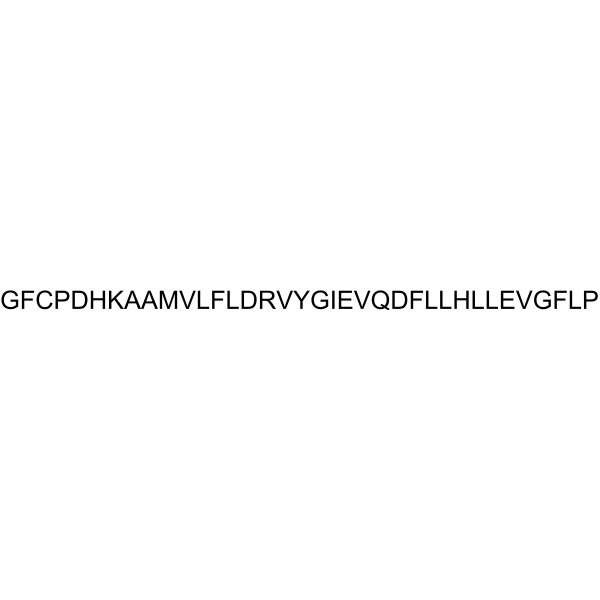
DPc10 is a biological active peptide. (This is amino acids 2460 to 2495 fragment of cardiac ryanodine receptor (RyR2). RyR2 controls calcium release from the sarcoplasmic reticulum, which begins muscle contraction. Mutated RyR2 is associated to ventricular tachycardia (VT) and sudden death.)
loading...
    loading...
Cat. No.: HY-L144
1,088 compounds

Normal mitochondrial function is critical for maintaining cellular homeostasis because mitochondria produce ATP and are the major intracellular source of free radicals. Cellular dysfunctions induced by intracellular or extracellular insults converge on mitochondria and induce a sudden increase in permeability on the inner mitochondrial membrane, the so-called mitochondrial membrane permeability transition (MMPT). MMPT is caused by the opening of pores in the inner mitochondrial membrane, matrix swelling, and outer membrane rupture. The MMPT is an endpoint to initiate cell death because the pore opening together with the release of mitochondrial cytochrome c activates the apoptotic pathway of caspases.

The normal operation of mitochondrial function is important for maintaining normal cell death and treatment of mitochondrial diseases. MCE offers a unique collection of 1,088 compounds with identified and potential mitochondrial protective activity. MCE Mitochondrial Protection Compound Library is critical for drug discovery and development.

Cat. No.: HY-13551C
CAS No.: 80277-14-1
Synonyms: m-AMSA isethionate; Acridinyl anisidide isethionate
Amsacrine isethionate (m-AMSA isethionate) is a Topoisomerase II inhibitor. Amsacrine isethionate intercalates into DNA. Amsacrine isethionate induces Ca 2+-mediated inactivation of ERK, and also downregulates AKT, promoting MCL1 downregulation mediated by GSK3β via reducing the phosphorylation level of GSK3β. Amsacrine isethionate induces Apoptosis by activating Caspase-9 and Caspase-3. Amsacrine isethionate blocks HERG potassium channels in the open/inactivated state. Amsacrine isethionate induces chromosomal aberrations and sister chromatid exchanges, and inhibits the synthesis of RNA and DNA. Amsacrine isethionate exhibits anti-leukemic activity. Amsacrine isethionate causes cardiac repolarization disorders, QT interval prolongation, ventricular arrhythmias, and increases the risk of sudden cardiac death. Amsacrine isethionate can be used in research related to acute myeloid leukemia, lymphoma and progressive malignancies .
loading...
    loading...
Cat. No.: HY-13551D
CAS No.: 80277-11-8
Synonyms: m-AMSA lactate; Acridinyl anisidide lactate
Amsacrine lactate (m-AMSA lactate) is a Topoisomerase II inhibitor. Amsacrine lactate intercalates into DNA. Amsacrine lactate induces Ca 2+-mediated inactivation of ERK, and also downregulates AKT, promoting MCL1 downregulation mediated by GSK3β via reducing the phosphorylation level of GSK3β. Amsacrine lactate induces Apoptosis by activating Caspase-9 and Caspase-3. Amsacrine lactate blocks HERG potassium channels in the open/inactivated state. Amsacrine lactate induces chromosomal aberrations and sister chromatid exchanges, and inhibits the synthesis of RNA and DNA. Amsacrine lactate exhibits anti-leukemic activity. Amsacrine lactate causes cardiac repolarization disorders, QT interval prolongation, ventricular arrhythmias, and increases the risk of sudden cardiac death. Amsacrine lactate can be used in research related to acute myeloid leukemia, lymphoma and progressive malignancies .
loading...
    loading...

