4 Results for "

various oncogenes

" in MedChemExpress (MCE) Product Catalog:
Products (4)

4 Results for "various oncogenes" in MCE Product Catalog:

2
2 Cited Publications
Cat. No.: HY-103019
CAS No.: 1610408-97-3
Purity:  99.89%
Synonyms: (+)-BAY-1251152; (+)-VIP152; (S)-Enitociclib
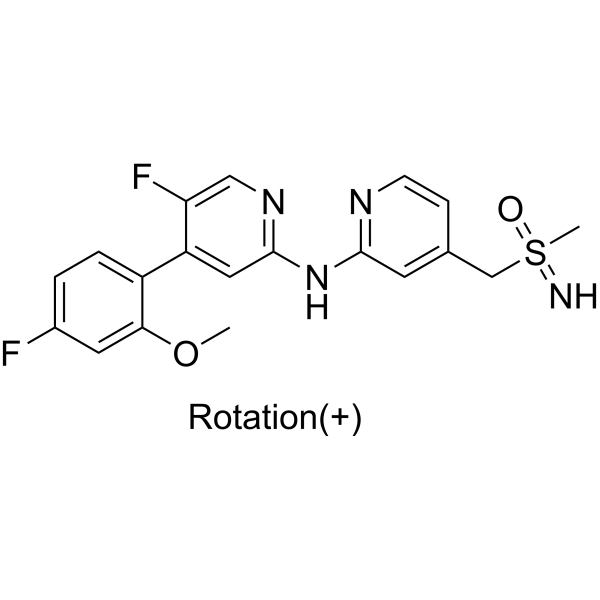
Enitociclib ((+)-BAY-1251152; (+)-VIP152) is a selective CDK9 inhibitor (IC50=3 nM) that inhibits transcriptional elongation by blocking Ser2/Ser5 phosphorylation of RNA polymerase II. Enitociclib specifically depletes key short-lived proteins such as c-MYC, MCL-1 and induces tumor cell apoptosis. Enitociclib also interferes with the production of enhancer RNAs (eRNA) and enhancer-promoter interactions, and downregulates oncogene expression at the epigenetic level. Enitociclib exerts synergistic effects with agents including Bortezomib (HY-10227), Lenalidomide (HY-A0003), Pomalidomide (HY-10984), Venetoclax (HY-15531) and Paclitaxel (HY-B0015), and even reverses paclitaxel resistance. Enitociclib serves as a vital research tool for various malignancies such as double-hit diffuse large B-cell lymphoma, multiple myeloma and pancreatic ductal adenocarcinoma .
loading...
    loading...
1
1 Cited Publications
Cat. No.: HY-145935
CAS No.: 1198078-60-2
Purity:  98.57%
Target:  

Insulin Receptor STAT

Research Areas:  

Cancer

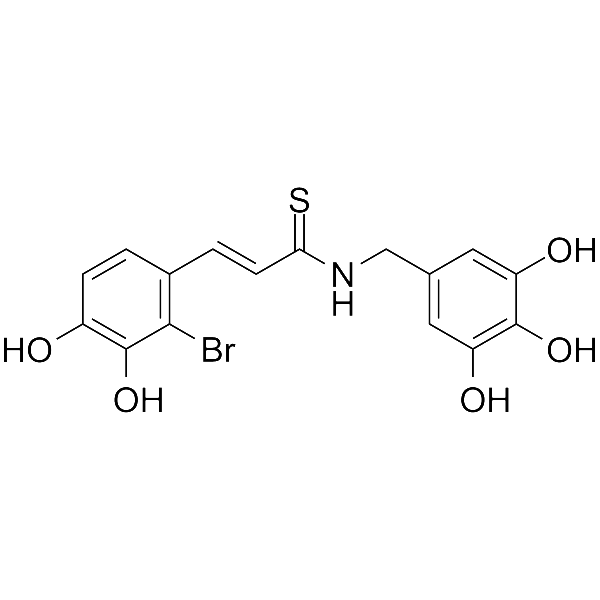
NT219 is a potent and dual inhibitor of insulin receptor substrates 1/2 (IRS1/2) and STAT3. IRS1/2 and STAT3 are major signaling junctions regulated by various oncogenes. NT219 affects IRS1/2 degradation and inhibits STAT3 phosphorylation. NT219 has the potential for the research of cancer diseases .
loading...
    loading...
Cat. No.: HY-103019R
CAS No.: 1610408-97-3
Synonyms: (+)-BAY-1251152 (Standard); (+)-VIP152 (Standard); (S)-Enitociclib (Standard)
Enitociclib (Standard) is the analytical standard of Enitociclib (HY-103019). This product is intended for research and analytical applications. Enitociclib ((+)-BAY-1251152; (+)-VIP152) is a selective CDK9 inhibitor (IC50=3 nM) that inhibits transcriptional elongation by blocking Ser2/Ser5 phosphorylation of RNA polymerase II. Enitociclib specifically depletes key short-lived proteins such as c-MYC, MCL-1 and induces tumor cell apoptosis. Enitociclib also interferes with the production of enhancer RNAs (eRNA) and enhancer-promoter interactions, and downregulates oncogene expression at the epigenetic level. Enitociclib exerts synergistic effects with agents including Bortezomib (HY-10227), Lenalidomide (HY-A0003), Pomalidomide (HY-10984), Venetoclax (HY-15531) and Paclitaxel (HY-B0015), and even reverses paclitaxel resistance. Enitociclib serves as a vital research tool for various malignancies such as double-hit diffuse large B-cell lymphoma, multiple myeloma and pancreatic ductal adenocarcinoma .
loading...
    loading...
Cat. No.: HY-L083
3,737 compounds

Mutations in oncogenes and tumor suppressor genes can modify multiple signaling pathways and in turn cell metabolism, which facilitates tumorigenesis. The paramount hallmark of tumor metabolism is “aerobic glycolysis” or the Warburg effect, coined by Otto Warburg in 1926, in which cancer cells produce most of energy from glycolysis pathway regardless of whether in aerobic or anaerobic condition. Usually, cancer cells are highly glycolytic (glucose addiction) and take up more glucose than do normal cells from outside. The increased uptake of glucose is facilitated by the overexpression of several isoforms of membrane glucose transporters (GLUTs). Likewise, the metabolic pathways of glutamine, amino acid and fat metabolism are also altered. Recent trends in anti-cancer drug discovery suggests that targeting the altered metabolic pathways of cancer cells result in energy crisis inside the cancer cells and can selectively inhibit cancer cell proliferation by delaying or suppressing tumor growth.

MCE provides a unique collection of 3,737 compounds which cover various tumor metabolism-related signaling pathways. These compounds can be used for anti-cancer metabolism targets identification, validation as well anti-cancer drug discovery.

