



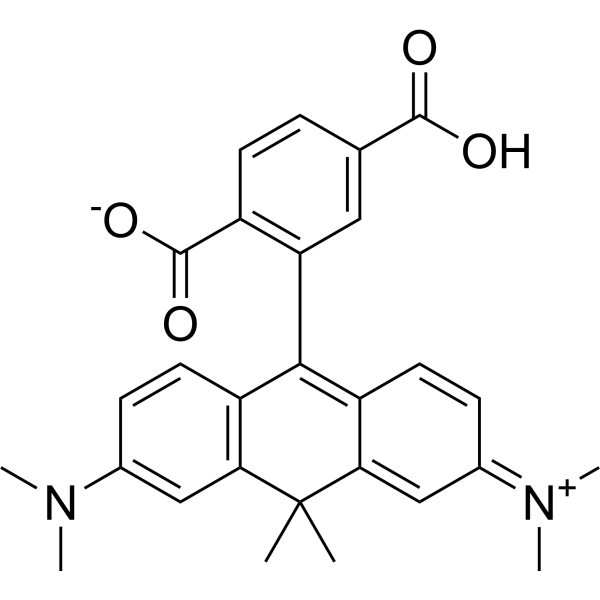
610CP
610CP is a new type of actin labeling dye. It dissolves in organic solvents. In DMSO the 610CP excitation/emission wavelength is between 609 and 634 nm. 610CP is a fluorescent dye that penetrates living cells. Upon cell entry, 610CP binds to Bromo-des-methyl-Jasplakinolide Therefore, 610CP dye can be used to stain actin fluorescence images with low background and high resolution.
Nur für Forschungszwecke. Wir verkaufen nicht an Patienten.
- CAS. Nr.: 1877282-17-1
- Formel: C28H28N2O4
- Molecular Weight:456.53
-
Speicherung:
Please store the product under the recommended conditions in the Certificate of Analysis.

To place orders, for customer services and technical support, please contact: MedChemExpress USA
Tel: 609-228-6898 E-mail: [email protected] [email protected]


-
 Biologische Aktivität
-
Chemical Information
- Reinheit & Dokumentation
- Verweise
-
 Help & FAQs




Biologische Aktivität
Beschreibung
In Vitro
Guide (The following is our recommended protocol. This protocol only provides guidance and should be modified according to your specific needs).
1. Preparation of 610CP working solution
1.1 Preparation of stock solution
Prepare a 10 mM 610CP stock solution using DMSO.
Note: It is recommended to aliquot the 610CP stock solution and store at -20°C or -80°C, protected from light.
1.2 Preparation of working solution
Dilute the stock solution with pre-warmed serum-free cell culture medium or PBS to prepare a 5-10 μM 610CP working solution.
Note: Please adjust the concentration of the 610CP working solution according to actual conditions and prepare fresh before use.
2. Cell staining (suspension cells)
2.1 Collect cells by centrifugation, wash twice with PBS for 5 minutes each time. Adjust the cell density to 1×10⁶/mL.
2.2 Add 1 mL 610CP working solution and incubate at room temperature for 30-60 minutes.
2.3 Centrifuge at 400 g for 3-4 minutes and discard the supernatant.
2.4 Wash the cells twice with PBS for 5 minutes each time.
2.5 Resuspend the cells in 1 mL serum-free medium or PBS, then observe using a fluorescence microscope or flow cytometer.
3. Cell staining (adherent cells)
3.1 Culture adherent cells on sterile coverslips.
3.2 Remove the coverslips from the culture medium and aspirate excess medium.
3.3 Add 100 μL staining working solution, gently shake to ensure complete coverage of the cells, and incubate for 30-60 minutes.
3.4 Remove the staining working solution and wash with culture medium 2-3 times for 5 minutes each time, then observe using a fluorescence microscope.
MedChemExpress (MCE) has not independently confirmed the accuracy of these methods. They are for reference only.
Emission (Em)
634
Excitation (Ex)
609


Chemical Information
-
CAS. Nr. 1877282-17-1
-
Molecular Weight 456.53
-
Formel C28H28N2O4
-
SMILES
O=C(C1=C(C(C2=C(C(C)(C)C3=C/4)C=C(N(C)C)C=C2)=C3C=CC4=[N+](C)\C)C=C(C(O)=O)C=C1)[O-]
-
Versand
Room temperature in continental US; may vary elsewhere.
-
Speicherung
Please store the product under the recommended conditions in the Certificate of Analysis.


Reinheit & Dokumentation
Verweise
[1]. Vladimir N Belov, et al. Synthesis of Fluorescent Jasplakinolide Analogues for Live-Cell STED Microscopy of Actin. J Org Chem. 2020 Jun 5;85(11):7267-7275. [Content Brief]
[2]. Vladimir N Belov, et al. Synthesis of Fluorescent Jasplakinolide Analogues for Live-Cell STED Microscopy of Actin. J Org Chem. 2020 Jun 5;85(11):7267-7275. [Content Brief]

Calculators
Konzentration (Stammlösung) × Volumen (Stammlösung) = Konzentration (Ziellösung) × Volumen (Ziellösung)


610CP Related Classifications
HY-D1346 Related Classifications
 Powered by Bioz