



VDAC3
VDAC3 (Voltage-Dependent Anion Channel 3) is a member of the mitochondrial porin family located in the outer mitochondrial membrane and contributes to the exchange of ATP and other small metabolites across mitochondria-associated pathways[1][2]. Mechanistically, current evidence highlights a specialized role for VDAC3 in the cellular response to oxidative stress, where depletion of VDAC3 promotes uncontrolled accumulation of mitochondrial reactive oxygen species (ROS) and increases susceptibility to oxidative injury induced by redox-active compounds and respiratory complex I inhibitors[3]. The redox-sensitive cysteine residues of VDAC3 are critical for this protective function, supporting the concept that VDAC3 acts as a sensor and regulator of mitochondrial redox homeostasis[3][4]. In disease-relevant and experimental models, altered VDAC3 activity has been associated with mitochondrial dysfunction, increased ROS levels, and defects in cellular stress adaptation, making the protein a useful target for studying oxidative stress-related pathophysiology[3][5]. Compared with the closely related isoforms VDAC1 and VDAC2, VDAC3 exhibits distinct structural and biophysical properties, including unique cysteine-rich features and lower affinity for several cytosolic interaction partners, indicating isoform-specific functions rather than a redundant role in mitochondrial biology[2][4]. Furthermore, VDAC3 has been implicated in centrosome-associated processes, including regulation of centriole assembly, extending its biological relevance beyond metabolite transport and mitochondrial homeostasis[5]. No widely established selective VDAC3 agonists or inhibitors are currently supported by the cited literature, and most experimental studies instead rely on genetic depletion, knockout systems, or cysteine-directed mutational approaches to investigate VDAC3 function[3][4].
Références:
- [1]. VDAC3 gene information from NCBI.
- [2]. Reina S, et al. Voltage-Dependent Anion Selective Channel 3: Unraveling Structural and Functional Features of the Least Known Porin Isoform. Front Physiol. 2022 Jan 10;12:784867. [Content Brief]
- [3]. Reina S, et al. Voltage Dependent Anion Channel 3 (VDAC3) protects mitochondria from oxidative stress. Redox Biol. 2022 May;51:102264. [Content Brief]
- [4]. Reina S, et al. VDAC3 as a sensor of oxidative state of the intermembrane space of mitochondria: the putative role of cysteine residue modifications. Oncotarget. 2016 Jan 19;7(3):2249-68. [Content Brief]
- [5]. Lee H, et al. Origin of DNA replication at the human lamin B2 locus: OBR or ABR? Cell Cycle. 2012 Nov 15;11(22):4281-3. [Content Brief]
All Product Categories
-
VDAC3 Produits associés (2)
Produits associés (2)

-
Erastin
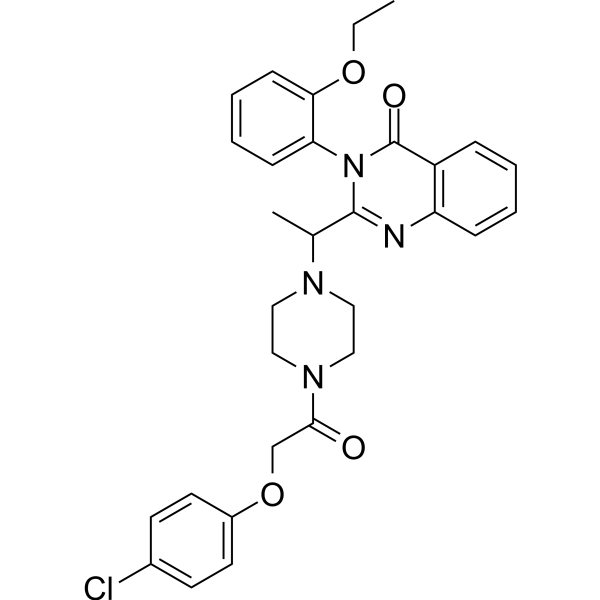 0 ImagesErastin is a ferroptosis inducer. Erastin exhibits the mechanism of ferroptosis induction related to ROS and iron-dependent signaling. Erastin inhibits voltage-dependent anion channels (VDAC2/VDAC3) and accelerates oxidation, leading to the accumulation of endogenous reactive oxygen species. Erastin also disrupts mitochondrial permeability transition pore (mPTP) with anti-tumor activity. Furthermore, Erastin can block the uptake of cystine mediated by SLC7A11 and also spares UMRC6-EV and -C91A cells from disulfidptosis under glucose starvation.
-
NCATS-SM0225
 0 ImagesCat. No.: HY-181529CAS No.: 1212623-02-3NCATS-SM0225 is an endoplasmic reticulum-associated degradation (ERAD) inhibitor and a direct binder of VDAC1, VDAC2 and VDAC3. NCATS-SM0225 exhibits an IC50of 1.02 μM for ERAD and a Kd of 3.13 μM for human VDAC1 binding. NCATS-SM0225 disrupts cellular calcium homeostasis, enhances VDAC1-IP3R coupling and activating PERK. NCATS-SM0225 selectively kills cancer cells, exhibits tumor growth inhibitory effects in melanoma xenograft models. NCATS-SM0225 can be used for research on multiple cancers including melanoma, as well as the molecular mechanisms of ERAD and calcium homeostasis regulation.



