21 Results for "

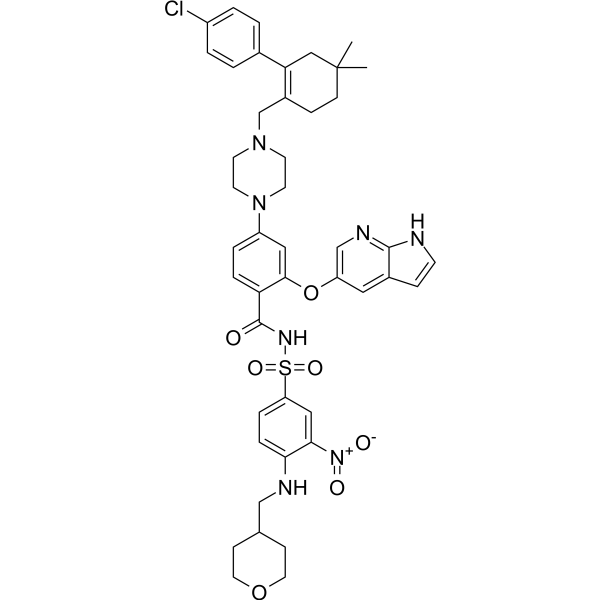
Venetoclax

" in MedChemExpress (MCE) Product Catalog:
Products (21)

21 Results for "Venetoclax" in MCE Product Catalog:

246
246 Publications Verification
Cat. No.: HY-15531
CAS No.: 1257044-40-8
Purity:  99.95%
Synonyms: ABT-199; GDC-0199; RG7601
Target:  

Bcl-2 Family Autophagy

Research Areas:  

Cancer

Venetoclax (ABT-199; GDC-0199) is a highly potent, selective and orally bioavailable Bcl-2 inhibitor with a Ki of less than 0.01 nM. Venetoclax induces autophagy .
2
2 Cited Publications
Cat. No.: HY-103019
CAS No.: 1610408-97-3
Purity:  99.89%
Synonyms: (+)-BAY-1251152; (+)-VIP152; (S)-Enitociclib
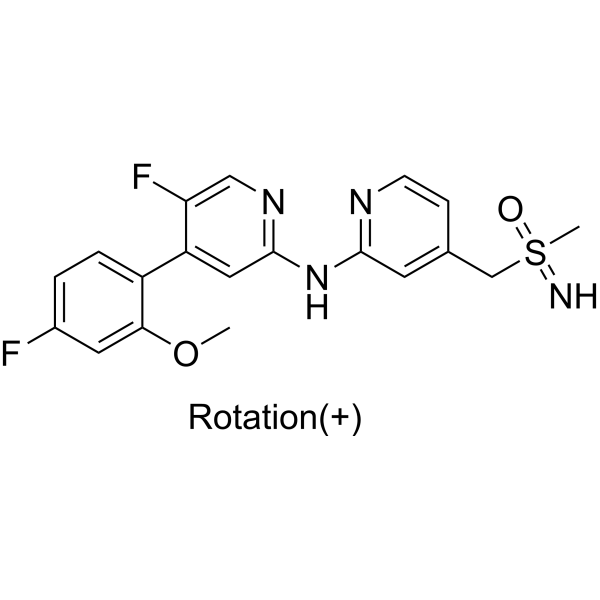
Enitociclib ((+)-BAY-1251152; (+)-VIP152) is a selective CDK9 inhibitor (IC50=3 nM) that inhibits transcriptional elongation by blocking Ser2/Ser5 phosphorylation of RNA polymerase II. Enitociclib specifically depletes key short-lived proteins such as c-MYC, MCL-1 and induces tumor cell apoptosis. Enitociclib also interferes with the production of enhancer RNAs (eRNA) and enhancer-promoter interactions, and downregulates oncogene expression at the epigenetic level. Enitociclib exerts synergistic effects with agents including Bortezomib (HY-10227), Lenalidomide (HY-A0003), Pomalidomide (HY-10984), Venetoclax (HY-15531) and Paclitaxel (HY-B0015), and even reverses paclitaxel resistance. Enitociclib serves as a vital research tool for various malignancies such as double-hit diffuse large B-cell lymphoma, multiple myeloma and pancreatic ductal adenocarcinoma .
1
1 Cited Publications
Cat. No.: HY-170451
CAS No.: 2713618-08-5
Synonyms: KT-253
Research Areas:  

Cancer

Seldegamadlin (KT-253) is a selective p53 stabilizer and a MDM2 PROTAC degrader (DC50 = 0.4 nM). Seldegamadlin inhibits the proliferation of cancer cell RS4;11 with an IC50 of 0.3 nM, arrests the cell cycle at G2/M phase, and induces apoptosis. Seldegamadlin upregulates p53 activity and overcomes the p53-MDM2 feedback loop. Seldegamadlin can be used for the study of hematologic and solid tumors, such as acute myeloid leukemia (AML) and acute lymphoblastic leukemia (ALL) .
Cat. No.: HY-15531S
CAS No.: 1257051-06-1
Purity:  99.76%
Synonyms: ABT-199-d8; GDC-0199-d8; RG7601-d8
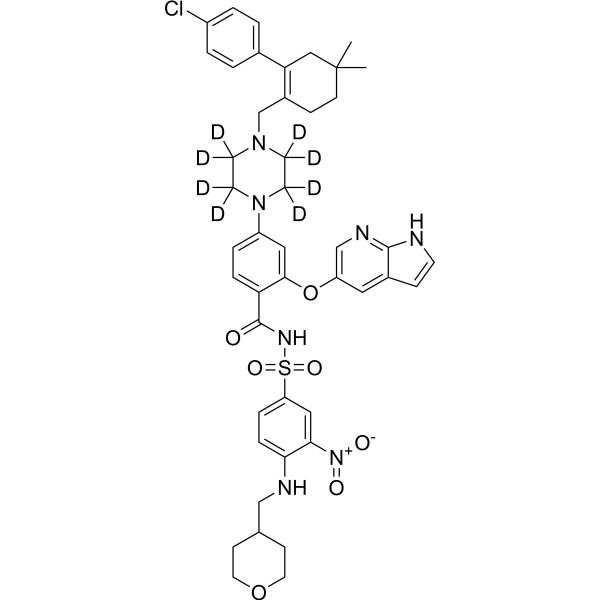
Venetoclax-d8 is deuterium labeled Venetoclax. Venetoclax (ABT-199; GDC-0199) is a highly potent, selective and orally bioavailable Bcl-2 inhibitor with a Ki of less than 0.01 nM. Venetoclax induces autophagy .
Cat. No.: HY-15531R
CAS No.: 1257044-40-8
Synonyms: ABT-199 (Standard); GDC-0199 (Standard); RG7601 (Standard)
Research Areas:  

Cancer

Venetoclax (Standard) is the analytical standard of Venetoclax. This product is intended for research and analytical applications. Venetoclax (ABT-199; GDC-0199) is a highly potent, selective and orally bioavailable Bcl-2 inhibitor with a Ki of less than 0.01 nM. Venetoclax induces autophagy .
Cat. No.: HY-172262
Research Areas:  

Cancer

WEHI-3773 is a VDAC2 ligand and apoptosis modulator. WEHI-3773 directly binds to the β7-β10 region of VDAC2 and disrupts its interaction with BAX and BAK. WEHI-3773 regulates BAX-mediated apoptosis in BAK-deficient cells by modulating conformational activation of BAX, mitochondrial redistribution, and cytochrome c release. WEHI-3773 overcomes Venetoclax (HY-15531) resistance, resensitizes leukemia cells carrying BAX mutations to BH3 mimetics, and enables long-term clonogenic survival of BAK-deficient cells treated with BH3 mimetics. WEHI-3773 is applicable to research related to acute myeloid leukemia .
Cat. No.: HY-153857
CAS No.: 2127107-15-5
Purity:  98.97%
Synonyms: PHI-101
Research Areas:  

Cancer

Lasmotinib (PHI-101) is a FLT3 and CHK2 inhibitor. Lasmotinib potently inhibits FLT3 single activating mutations (ITD or TKD mutants) and has inhibitory activity against FLT3 double (ITD/D835Y or ITD/F691L) and triple (ITD/D835Y/F691L) resistance mutations. Lasmotinib synergizes with Venetoclax (HY-15531) or Azacytidine to inhibit leukemia. Lasmotinib exhibits anticancer activity against ovarian and breast cancer .
Cat. No.: HY-142209
CAS No.: 1351456-78-4
Purity:  98.10%
Target:  

Bcl-2 Family

Research Areas:  

Cancer

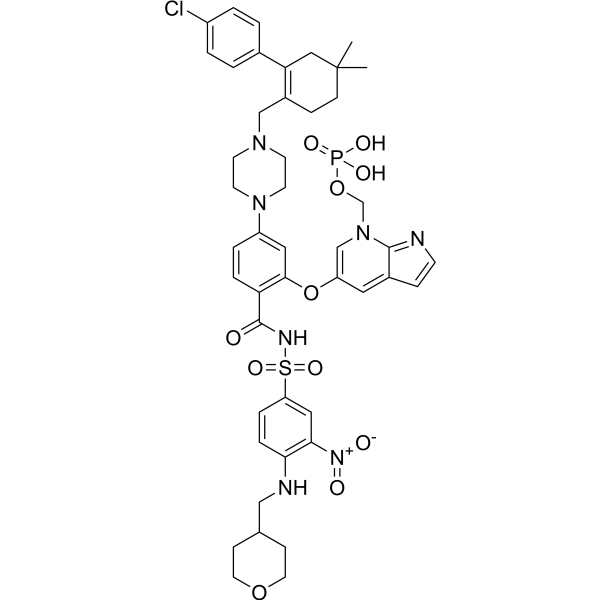
ABBV-167 is a phosphate prodrug of the BCL-2 inhibitor venetoclax .
Cat. No.: HY-133772
CAS No.: 2469279-00-1
Target:  

Drug Metabolite

Research Areas:  

Others

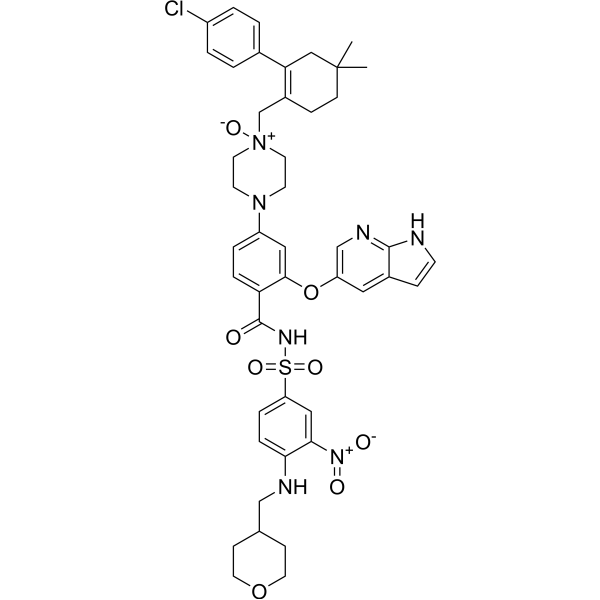
Venetoclax N-oxide is an impurity of Venetoclax. Venetoclax (ABT-199; GDC-0199) is a highly potent, selective and orally bioavailable Bcl-2 inhibitor with a Ki of less than 0.01 nM .
Cat. No.: HY-P991225

Target:  

Fc Receptor (FcR) CD20

Research Areas:  

Inflammation/Immunology Cancer

BI-1206 is a recombinant and antagonistic human monoclonal antibody targeting FcγRIIB (CD32B). BI-1206 can block CD20 internalization induced by Rituximab (HY-P9913) itself or combined with others including Ibrutinib (HY-10997), Venetoclax (HY-15531), and CHOP. BI-1206 can enhance or recover the activity of Rituximab or other anti-CD20 monoclonal antibodies. BI-1206 has cytolytic activity against malignant B cells. BI-1206 can be studied for cancer research such as mantle cell lymphoma (MCL) .
Cat. No.: HY-177306
Target:  

Dynamin

Research Areas:  

Cancer

Opitor-0 is a potent and selective inhibitor of mitochondrial dynamin-related protein Optic Atrophy 1 (OPA1) guanosine triphosphatase (GTPase) with an IC50 of 3 μM. Opitor-0 can induce fragmentation of mitochondria and remodeling of cristae, disrupt the stability of OPA1 oligomers, and significantly enhance the release of cytochrome c and induce apoptosis. Opitor-0 has a synergistic antitumor effect with Bcl-2 inhibitors, such as ABT-737 (HY-50907) and Venetoclax (HY-15531). Opitor-0 can be used for the research of malignant tumors that are resistant to Bcl-2 inhibitors, such as triple-negative breast cancer (TNBC) .
Cat. No.: HY-163678
Research Areas:  

Cancer

Pomalidomide-CO-C7-NH-CO-C3-COOH is a conjugate of a ligand for E3 ligase and a linker. Pomalidomide-CO-C7-NH-CO-C3-COOH can be used for synthesis of PROTAC degrader ARM165 (HY-163677) .
Cat. No.: HY-15531S1
Synonyms: ABT-199-d6; GDC-0199-d6; RG7601-d6
Venetoclax-d6 (ABT-199-d6) is deuterium labeled Venetoclax. Venetoclax (ABT-199; GDC-0199) is a highly potent, selective and orally bioavailable Bcl-2 inhibitor with a Ki of less than 0.01 nM. Venetoclax induces autophagy .
Cat. No.: HY-162769
CAS No.: 3095232-95-1
Target:  

HDAC Apoptosis

Research Areas:  

Cancer

HDAC3-IN-5 (9c) is a HDAC3 selective inhibitor, with IC50 values of 4.2 nM, 1629 nM and 298.2 nM for HDAC3, HDAC2, HDAC1, respectively. HDAC3-IN-5 (9c) can effectively induce apoptosisin MV4-11 cells in vitro and reduce the expression of anti-apoptotic proteins, the development of HDAC3 selective inhibitors may serve as a potential lead compound to reverse Venetoclax resistance .
Cat. No.: HY-168983
CAS No.: 2952589-57-8
Target:  

Bcl-2 Family

Research Areas:  

Cancer

Lonitoclax is a B-cell lymphoma 2 (Bcl-2) inhibitor. Lonitoclax has comparable anti-tumor efficacy to Venetoclax (HY-15531) in both B cell and myeloid malignancy models. Lonitoclax is promising for research of relapsed or refractory chronic lymphocytic leukemia (CLL), small lymphocytic lymphoma, and certain low-grade lymphomas .
Cat. No.: HY-162642
Target:  

Bcl-2 Family

Research Areas:  

Cancer

Bfl-1-IN-3 (Compound 56) is a selective, competitive inhibitor for Bfl-1 on BID binding site with Ki of 105 nM. Bfl-1-IN-3 inhibits the proliferation of cell pfeiffer and MV4-11, with IC50 of 6.92 μM and 12.6 μM. Bfl-1-IN-3 induces apoptosis in pfeiffer cells. Bfl-1-IN-3 overcomes Venetoclax (HY-15531) resistance at the cellular level, and shows synergistically enhanced anti-tumor activity with Venetoclax .
Cat. No.: HY-154971
Target:  

Apoptosis

Research Areas:  

Cancer

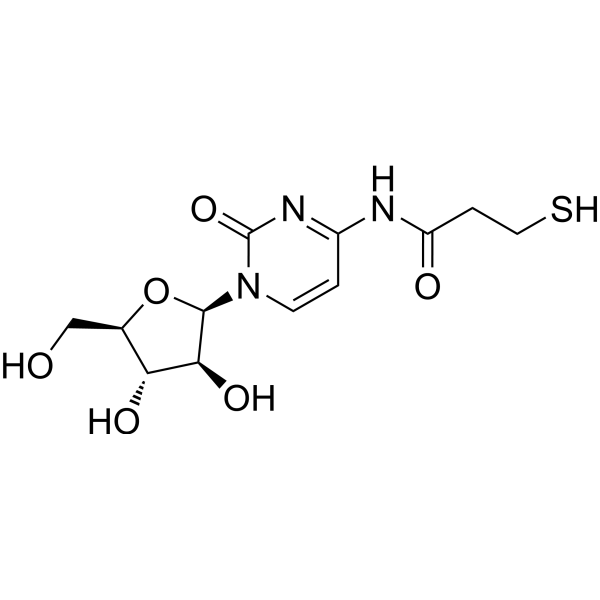
Ara-SH is a Cytarabine mercaptopropionic acid-substituted derivative. Ara-SH is used as the trigger to fabricate a smart Cytarabine and Venetoclax-coloaded nanoparticle (AV-NP) through self-assembly. Ara-SH exhibits remarkable synergistic antileukemia effects in vitro and in vivo .
Cat. No.: HY-178733
CAS No.: 1628314-13-5
Target:  

CDK Apoptosis

Research Areas:  

Cancer

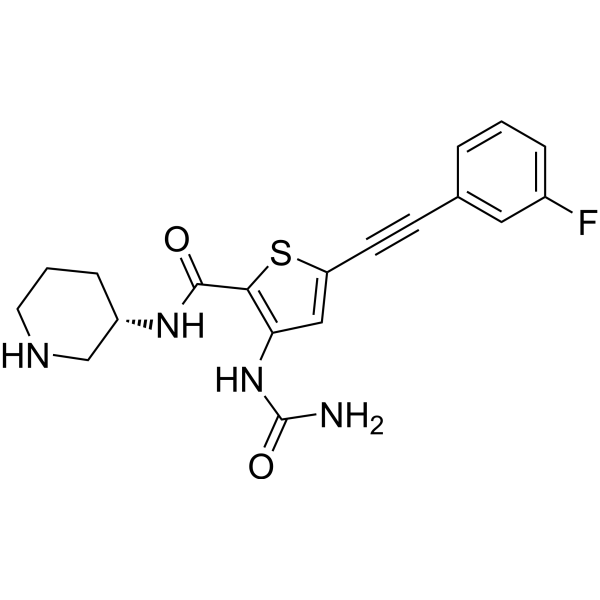
A-1592668 is a selective CDK9 inhibitor. A-1592668 induces Apoptosis. A-1592668 plus Venetoclax (HY-15531) co-treatment inhibits the growth of Jeko-1 tumors .
Cat. No.: HY-L187
2,252 compounds

Fragment-based drug development (FBDD) is a strategy for drug discovery that can be applied both academically and commercially to enhance the identification of some non-drug targets. Fragment-based drug development has identified low molecular weight molecules (<300 Da) capable of binding to related macromolecules. These fragments can cover a wide chemical space and are easy to optimize later. Currently, several fragment-based drugs have entered clinical trials, of which two drugs, Vemurafenib and Venetoclax, have been approved for marketing.

Based on Tanimoto coefficient, MCE uses similarity algorithm to carefully select 2,252 high-structurally diverse 'RO3' compliant fragment molecules from large-scale fragment molecules, which can be applied to fragment based drug development.

Cat. No.: HY-L032
41,368 compounds

Fragment-based drug discovery (FBDD) is well suited for discovering both drug leads and chemical probes of protein function; it can cover broad swaths of chemical space and allows the use of creative chemistry. Fragment-based drug discovery is well-established in industry and has resulted in a variety of drugs entering clinical trials, with two, vemurafenib and venetoclax, already approved. FBDD also has key attractions for academia. Notably, it is able to tackle difficult or novel targets for which no chemical matter may be found in existing HTS collections.

MCE designs a unique collection of 41,368 fragment compounds, all of which obey a heuristic rule called the “Rule of Three (RO3) ”, in which molecular weight ≤300 Da, the number of hydrogen bond donors (H-donors) ≤3, the number of hydrogen bond acceptors (H-acceptors) is ≤3 and cLogP is ≤3. This library is an important source of lead-like drugs.

