



Fasitibant free base
Based on 1 publication(s) in Google Scholar
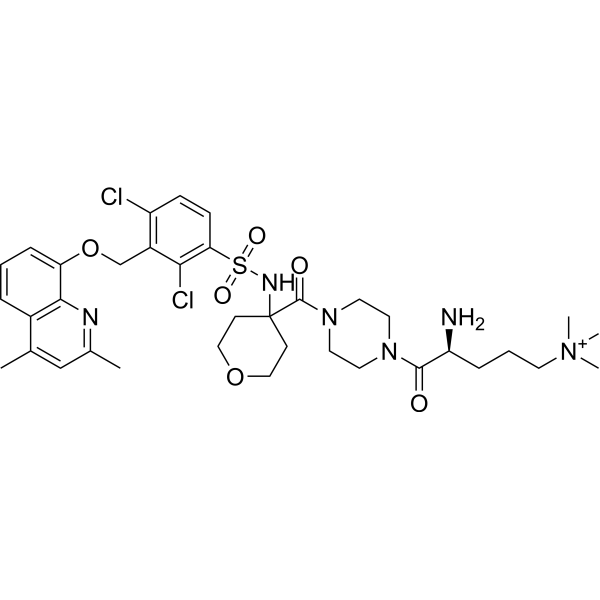
Fasitibant (free base) is a potent, selective, high affinity, and long-lasting nonpeptide bradykinin B2 (BK2) receptor antagonist. Fasitibant (free base) has proinflammatory effects and can be used for the research of osteoarthritis and rheumatoid arthritis.
Nos produits utilisent uniquement pour la recherche. Nous ne vendons pas aux patients.
- CAS No.: 869939-83-3
- Formule: C36H49Cl2N6O6S+
- Masse moléculaire:764.78
-
Stockage:
Please store the product under the recommended conditions in the Certificate of Analysis.


-
 Activité biologique
-
Chemical Information
- Pureté et documentation
- Références
-
 Help & FAQs


Publications Citing Use of MedChemExpress (MCE) Fasitibant free base
MoreVoir tous les produits spécifiques à Isoform Bradykinin Receptor
More

Activité biologique
|
Bradykinin B2 Receptor (B2R) |
MedChemExpress (MCE) has not independently confirmed the accuracy of these methods. They are for reference only.


Chemical Information
-
CAS No. 869939-83-3
-
Masse moléculaire 764.78
-
Formule C36H49Cl2N6O6S+
-
SMILES
O=C(N(CC1)CCN1C([C@@H](N)CCC[N+](C)(C)C)=O)C2(CCOCC2)N[S](=O)(C(C=CC(Cl)=C3COC4=CC=CC(C(C)=C5)=C4N=C5C)=C3Cl)=O
-
Livraison
Room temperature in continental US; may vary elsewhere.
-
Stockage
Please store the product under the recommended conditions in the Certificate of Analysis.


Publications (1)
-
Journal Impact Factor
-
Most Recent
-
Nat Commun
Endothelial Sp1/Sp3 are essential to the effect of captopril on blood pressure in male mice. [Abstract]2023 Sep 21;14(1):5891. PMID: 37735515


Pureté et documentation
Références
[1]. S Meini, et al. Fasitibant prevents the bradykinin and interleukin 1β synergism on prostaglandin E₂ release and cyclooxygenase 2 expression in human fibroblast-like synoviocytes. Naunyn Schmiedebergs Arch Pharmacol. 2012 Aug;385(8):777-86. [Content Brief]
[2]. Claudio Valenti, et al. Fasitibant chloride, a kinin B₂ receptor antagonist, and dexamethasone interact to inhibit carrageenan-induced inflammatory arthritis in rats. Br J Pharmacol. 2012 Jun;166(4):1403-10. [Content Brief]

Calculators
Concentration (start) × Volume (start) = Concentration (final) × Volume (final)


 Powered by Bioz