



Fasitibant chloride
Based on 1 publication(s) in Google Scholar
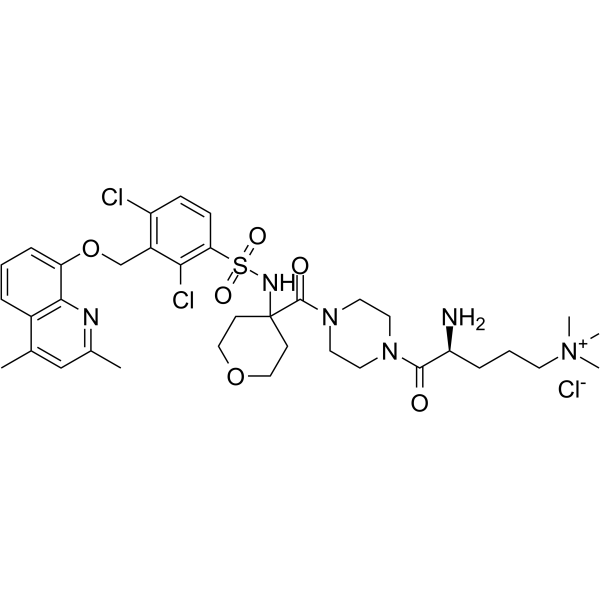
Fasitibant chloride (MEN16132 free base) is a potent and selective nonpeptide bradykinin B2 receptor (B2R) antagonist. Fasitibant chloride reduces joint pain and diminishes joint oedema in Carrageenan-induced arthritis rat model.
For research use only. We do not sell to patients.
- CAS No.: 1157852-02-2
- Formula: C36H49Cl3N6O6S
- Molecular Weight:800.23
-
Storage:
Please store the product under the recommended conditions in the Certificate of Analysis.

To place orders, for customer services and technical support, please contact: MedChemExpress USA
Tel: 609-228-6898 E-mail: [email protected] [email protected]


-
 Biological Activity
-
Chemical Information
- Protocols
- Purity & Documentation
- References
-
 Help & FAQs


Publications Citing Use of MedChemExpress (MCE) Fasitibant chloride
MoreAll Bradykinin Receptor Isoforms
More

Biological Activity
Description
IC50 & Target
Cellular Effect
|
Cell Line

|
Type | Value | Description | References |
|---|---|---|---|---|
| HEK293 | IC50 |
0.05 nM
Compound: 4
|
Displacement of [3H]bradykinin from human recombinant B2 receptor expressed in HEK293 cells
Displacement of [3H]bradykinin from human recombinant B2 receptor expressed in HEK293 cells
|
[PMID: 19552431] |
In Vitro
Fasitibant chloride (MEN16132 free base; 1 µM; pre-treatment 30 min before BK) produces a consistent reduction of the FGF-2 expression (BK induced) and decrement of BK induced-FGFR-1 phosphorylation[2].
Fasitibant chloride inhibits the phosphorylation of FRSα, ERK1/2, STAT3 (BK induced; 1 μM; for 15 min), except AKT in HUVEC[2].
MedChemExpress (MCE) has not independently confirmed the accuracy of these methods. They are for reference only.
-
Cell Line:human umbilical vein endothelial cells (HUVEC)
-
Concentration:1 µM
-
Incubation Time:Pre-treatment 30 min before Bradykinin (BK; 1 μM; for 24 h)
-
Result:Produced a consistent reduction of the FGF-2 expression (BK induced) and decrement of BK induced-FGFR-1 phosphorylation (without affecting FGFR-2 activity).
In Vivo
MedChemExpress (MCE) has not independently confirmed the accuracy of these methods. They are for reference only.
-
Animal Model:Male Wistar rats weighing 250-300 g[1]
-
Dosage:100 µg per knee
-
Administration:Injection into the knee; 30 min before λ-carrageenan
-
Result:Inhibited about 40-45% on the carrageenan-induced joint pain and knee joint oedema.
Reduced the neutrophil infiltration in the synovium by about 60% and the release of prostaglandins by about 30%.


Chemical Information
-
CAS No. 1157852-02-2
-
Molecular Weight 800.23
-
Formula C36H49Cl3N6O6S
-
SMILES
O=C(N(CC1)CCN1C([C@@H](N)CCC[N+](C)(C)C)=O)C2(CCOCC2)N[S](=O)(C(C=CC(Cl)=C3COC4=CC=CC(C(C)=C5)=C4N=C5C)=C3Cl)=O.[Cl-]
-
Synonyms
MEN16132 free base
-
Shipping
Room temperature in continental US; may vary elsewhere.
-
Storage
Please store the product under the recommended conditions in the Certificate of Analysis.


Publications (1)
-
Journal Impact Factor
-
Most Recent
-
Nat Commun
Endothelial Sp1/Sp3 are essential to the effect of captopril on blood pressure in male mice. [Abstract]2023 Sep 21;14(1):5891. PMID: 37735515


Purity & Documentation
References
[1]. Claudio Valenti, et al. Fasitibant Chloride, a Kinin B₂ Receptor Antagonist, and Dexamethasone Interact to Inhibit Carrageenan-Induced Inflammatory Arthritis in Rats. Br J Pharmacol. 2012 Jun;166(4):1403-10. [Content Brief]
[2]. Erika Terzuoli, et al. Bradykinin B2 Receptor Contributes to Inflammatory Responses in Human Endothelial Cells by the Transactivation of the Fibroblast Growth Factor Receptor FGFR-1. Int J Mol Sci. 2018 Sep 6;19(9):2638. [Content Brief]
[3]. Paola Cucchi, et al. MEN16132, a Novel Potent and Selective Nonpeptide Antagonist for the Human Bradykinin B2 Receptor. In Vitro Pharmacology and Molecular Characterization. Eur J Pharmacol. 2005 Dec 28;528(1-3):7-16. [Content Brief]

Calculators
Concentration (start) × Volume (start) = Concentration (final) × Volume (final)


Fasitibant chloride Related Classifications
HY-14886 Related Classifications
 Powered by Bioz