



Catestatin TFA

Based on 1 Customer Validation
Catestatin (Catestatin (cattle)) TFA is a non-competitive nicotinic acetylcholine receptor antagonist. Catestatin TFA blocks acetylcholine-evoked currents at α3β4, α7, α3β2, and α4β2 subtype nAChRs and selectively inhibits catecholamine release triggered by nicotinic cholinergic stimulation. Catestatin TFA acts as an autocrine homeostatic negative feedback inhibitor, accelerating the decline of intracellular calcium signaling following acetylcholine stimulation. Catestatin TFA also promotes histamine (Histamine) (HY-B1204) release, mediates hypotension via H1 receptors, promotes epinephrine release, and antagonizes neuropeptide Y- or Y1 receptor-mediated pressor effects. Catestatin TFA can be used in research on nicotinic cholinergic signaling and cardiovascular-related studies.
For research use only. We do not sell to patients.
- Purity : 99.07%
- Formula: C109H174F3N37O28S
- Molecular Weight:2539.84
-
Storage:
Sealed storage, away from moisture.
Powder -80°C, 2 years , -20°C, 1 year* In solvent : -80°C, 6 months; -20°C, 1 month (sealed storage, away from moisture)

To place orders, for customer services and technical support, please contact: MedChemExpress USA
Tel: 609-228-6898 E-mail: [email protected] [email protected]


-
 Biological Activity
-
Chemical Information
-
Solvent & Solubility
- Protocols
- Purity & Documentation
- References
-
 Help & FAQs




Biological Activity
Description
In Vitro
Catestatin TFA eliminates nicotine-induced 45Ca2+ uptake in PC12 cells[1].
Catestatin TFA strongly inhibits nicotine-induced cytosolic Ca2+ elevation in single bovine chromaffin cells[1].
Catestatin (0.1-10 μM) TFA protects PC12 cells from nicotine-induced desensitization of catecholamine release[1].
Catestatin (1 µM; administered 1 min before and during 20 s ACh) TFA blocks α3β4 nAChR expressed in Xenopus oocytes, with an IC50 of 4.9 µM upon co-administration and 0.4 µM upon preincubation (peak current)[2].
Catestatin (1 µM; administered 1 min before and during the 20 s ACh application) TFA non-competitively reduces α3β4 nAChR responses in Xenopus oocytes, decreasing the ACh EC50 to 66 µM and reducing Imax[2].
Catestatin (0.3 µM; 60 s perfusion) TFA blocks α3β4 nAChR in Xenopus oocytes in a voltage-dependent manner, increasing from 54% at -40 mV to 92% at -100 mV[2].
Catestatin (1 µM; continuous perfusion) TFA blocks α3β4 nAChR in Xenopus oocytes in a use-dependent manner, reducing the current to 36% of the initial value at 5 s ACh intervals[2].
Catestatin (1 µM; administered 1 min before and during ACh) TFA blocks α7, α3β2, and α4β2 nAChRs expressed in Xenopus oocytes, with IC50 values of 0.3 µM, 0.4 µM, and 1.7 µM, respectively[2].
Catestatin (10 µM) TFA does not block native Ca2+-activated chloride currents in Xenopus oocytes[2].
Catestatin (3 µM; administered 1 min before and during 5 s ACh) TFA reduces ACh-evoked [Ca2+]c and catecholamine secretion by approximately 30% in single mouse chromaffin cells without altering exocytotic efficacy[2].
Catestatin (3 µM; administered during the second 30 s ACh pulse) TFA accelerates [Ca2+]c decay and reduces cumulative catecholamine secretion in mouse chromaffin cells without altering normalized secretion kinetics[2].
Catestatin (3 µM; administered during 30 s ACh) TFA does not change the quantal charge or kinetic parameters of individual amperometric spikes in mouse chromaffin cells[2].
Catestatin (2.5-5000 pg; 24 h) TFA immunoreactivity in bovine chromaffin granules resolves into four size peaks, including an approximately 8% peak that co-elutes with bovine chromogranin A344-364, and is detectable in fetal bovine serum and adult horse serum[3].
Catestatin TFA in bovine chromaffin granules is mainly bovine chromogranin A332-364, identified by MALDI mass spectrometry and characteristic Met346 oxidation[3].
Catestatin (10 µM; 30 min) TFA selectively inhibits nicotine-stimulated catecholamine secretion in PC12 cells, with no substantial inhibitory effect on secretion evoked downstream of nicotinic receptors[4].
Catestatin (0.1-10 µM; 5 min) TFA blocks nicotine-stimulated 22Na+ entry into PC12 cells with an IC50 of approximately 0.25 µM[4].
Catestatin (10 µM; 30 min) TFA selectively prevents nicotine-evoked 45Ca2+ influx in PC12 cells without blocking depolarization-evoked Ca2+ entry[4].
Catestatin (0.1-10 µM; 30 min) TFA inhibits nicotine-stimulated norepinephrine release in rat PC12 cells and bovine adrenal chromaffin cells, with IC50 values of approximately 0.5 µM and 3 µM, respectively[4].
Catestatin (0.1-10 µM; 30 min) TFA inhibits nicotine-stimulated norepinephrine release from NGF-differentiated PC12 cells, with an IC50 of approximately 2 µM[4].
Catestatin (0.1-10 µM; 30 min) TFA inhibits nicotine-stimulated norepinephrine release from PC12 cells, with bovine catestatin exhibiting the strongest effect (IC50 approximately 0.3 µM)[4].
Catestatin (10 µM) TFA acts as a reversible noncompetitive nicotinic antagonist in PC12 cells, and its inhibitory effect cannot be overcome by nicotine at concentrations up to 1000 µM[4].
Catestatin (0.1-10 µM; 30 min) TFA inhibits 1 mM nicotine-stimulated norepinephrine release from PC12 cells with an IC50 of approximately 0.15 µM[4].
Catestatin (10-50 µM; 10 min) TFA attenuates nicotine-evoked cytosolic Ca2+ transients in bovine adrenal chromaffin cells, reducing peak amplitude and AUC at 10 and 50 µM[4].
MedChemExpress (MCE) has not independently confirmed the accuracy of these methods. They are for reference only.
In Vivo
Catestatin (0.3 mmol/rat; intravenous bolus; single dose; 10 min after the first electrical stimulation train under α/β adrenergic blockade) TFA attenuates the sustained pressor response induced by sympathetic nerve stimulation even after α/β adrenergic blockade[5].
The vasodepressor effect and increase in plasma epinephrine exhibited by Catestatin (0.3 mmol/rat; intravenous bolus; single dose; after Hydroxyzine (HY-B0548) administration) TFA are abolished by pretreatment with Hydroxyzine[5].
Catestatin (0.3 mmol/rat; intravenous bolus; single dose; between two neuropeptide Y or Y1 agonist injections) TFA attenuates the pressor response induced by exogenous neuropeptide Y and Y1 receptor agonists[5].
MedChemExpress (MCE) has not independently confirmed the accuracy of these methods. They are for reference only.
-
Animal Model:Sprague-Dawley (male, 350-400 g, Harlan Laboratories)[5]
-
Dosage:0.3 mmol/rat
-
Administration:i.v.; single dose
-
Result:Reduced the acute pressor response during 7.5 V, 20 Hz stimulation by 31%.
Reduced the prolonged post-stimulation pressor response by 19% compared with vehicle.
Plasma norepinephrine after 20 Hz stimulation was 7844 pg/mL, and plasma norepinephrine did not change.
Increased plasma epinephrine 11-fold (to approximately 2000 pg/mL) even without electrical stimulation.
Increased plasma histamine 21-fold within 2 min.
-
Animal Model:Sprague-Dawley (male, 350-400 g, Harlan Laboratories)[5]
-
Dosage:0.3 mmol/rat
-
Administration:i.v.; single dose
-
Result:Reduced the magnitude of the prolonged pressor response by 43% in adrenergically blocked rats.
-
Animal Model:Sprague-Dawley (male, 350-400 g, Harlan Laboratories)[5]
-
Dosage:0.3 mmol/rat
-
Administration:i.v.; single dose
-
Result:Hydroxyzine abolished the vasodepressor action.
The mean acute pressor response during 20 Hz, 7.5 V stimulation in H1 receptor-blocked rats was 114 mmHg.
The post-stimulation prolonged pressor response was 231 mmHg·min.
Plasma epinephrine was 15 pg/mL before and 6 pg/mL 2 min after administration.
-
Animal Model:Sprague-Dawley (male, 350-400 g, Harlan Laboratories)[5]
-
Dosage:0.3 mmol/rat
-
Administration:i.v.; single dose
-
Result:Markedly reduced the pressor response to human neuropeptide Y and to the Y1 receptor agonist [Leu31,Pro34]-neuropeptide Y.


Chemical Information
-
Appearance Solid
-
Molecular Weight 2539.84
-
Formula C109H174F3N37O28S
-
Color White to off-white
-
Sequence
Arg-Ser-Met-Arg-Leu-Ser-Phe-Arg-Ala-Arg-Gly-Tyr-Gly-Phe-Arg-Gly-Pro-Gly-Leu-Gln-Leu
-
Sequence Shortening
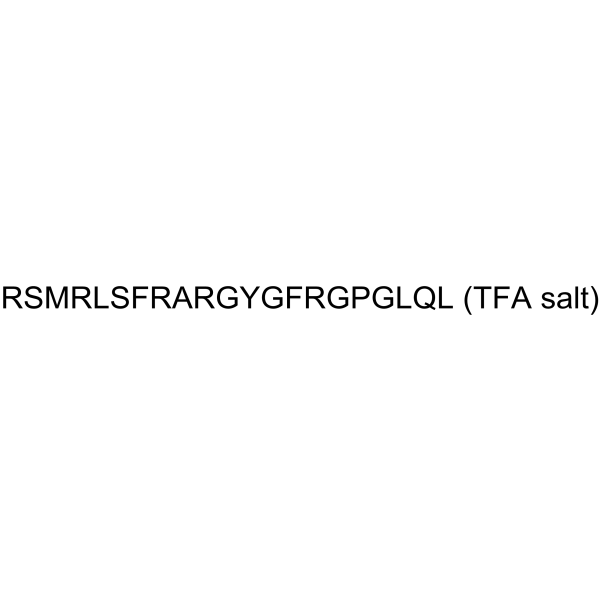
RSMRLSFRARGYGFRGPGLQL
-
Shipping
Room temperature in continental US; may vary elsewhere.
-
Storage
Sealed storage, away from moisture
Powder -80°C 2 years -20°C 1 year * In solvent : -80°C, 6 months; -20°C, 1 month (sealed storage, away from moisture)


Solvent & Solubility
In Vitro:
H2O : 20 mg/mL (7.87 mM; ultrasonic and warming and heat to 60°C)
Please refer to the solubility information to select the appropriate solvent. Once prepared, please aliquot and store the solution to prevent product inactivation from repeated freeze-thaw cycles.
Storage method and period of stock solution: -80°C, 6 months; -20°C, 1 month (sealed storage, away from moisture). When stored at -80°C, please use it within 6 months. When stored at -20°C, please use it within 1 month.
* Note: If you choose water as the stock solution, please dilute it to the working solution, then filter and sterilize it with a 0.22 μm filter before use.
Concentration (start) × Volume (start) = Concentration (final) × Volume (final)
In Vivo:
For the following dissolution methods, please prepare the working solution directly:
It is recommended to prepare fresh solutions and use them promptly within a short period of time.
The percentages shown for the solvents indicate their volumetric ratio in the final prepared solution. If precipitation or phase separation occurs during preparation, heat and/or sonication can be used to aid dissolution.
Add each solvent one by one: PBS
Solubility: 7.14 mg/mL (2.81 mM); Clear solution; Need ultrasonic
In Vivo Dissolution Calculator
Please enter the basic information of animal experiments:
-
-
-
-
Recommended: Prepare an additional quantity of animals to account for potential losses during experiments.
Working solution concentration: 0.22 mg/mL
This product has good water solubility, please refer to the measured solubility data in water/PBS/Saline for details.


Purity & Documentation


References

Complete Stock Solution Preparation Table
Please refer to the solubility information to select the appropriate solvent. Once prepared, please aliquot and store the solution to prevent product inactivation from repeated freeze-thaw cycles.
Storage method and period of stock solution: -80°C, 6 months; -20°C, 1 month (sealed storage, away from moisture). When stored at -80°C, please use it within 6 months. When stored at -20°C, please use it within 1 month.
| Optional Solvent | Concentration Solvent Mass | 1 mg | 5 mg | 10 mg | 25 mg |
|---|---|---|---|---|---|
| H2O | 1 mM | 0.3937 mL | 1.9686 mL | 3.9373 mL | 9.8431 mL |
| 5 mM | 0.0787 mL | 0.3937 mL | 0.7875 mL | 1.9686 mL |
* Note: If you choose water as the stock solution, please dilute it to the working solution, then filter and sterilize it with a 0.22 μm filter before use.


Catestatin TFA Related Classifications
HY-P1271A Related Classifications
 Powered by Bioz