



Agaric acid
Based on 1 publication(s) in Google Scholar
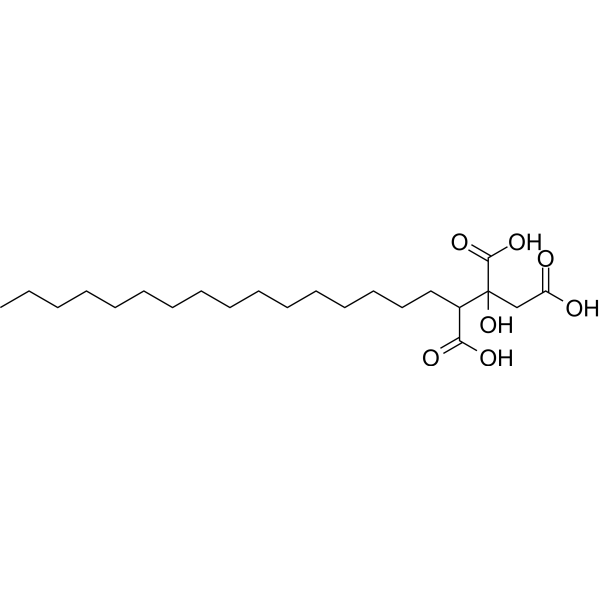
Agaric acid (Agaricinic Acid) is an orally active inhibitor of adenine nucleotide translocase found in specific fungi. Agaric acid can inhibit the biofilm formation of various bacteria such as Salmonella. Agaric acid can also induce mitochondrial permeability transition, prompting mitochondria to release Ca2+, disrupting the transmembrane potential, and causing mitochondrial swelling. In addition, Agaric acid can also inhibit citrate transport in liver mitochondria and participate in the inhibition of fatty acid synthesis, affecting multiple metabolic processes.
For research use only. We do not sell to patients.
- Purity : 99.45%
- CAS No.: 666-99-9
- Formula: C22H40O7
- Molecular Weight:416.55
-
Storage:
4°C, protect from light
* In solvent : -80°C, 6 months; -20°C, 1 month (protect from light)

To place orders, for customer services and technical support, please contact: MedChemExpress USA
Tel: 609-228-6898 E-mail: [email protected] [email protected]


-
 Biological Activity
-
Chemical Information
-
Solvent & Solubility
- Protocols
- Purity & Documentation
- References
-
 Help & FAQs




Publications Citing Use of MedChemExpress (MCE) Agaric acid
MoreAll Calcium Channel Isoforms
More

Biological Activity
Description
In Vitro
Agaric acid (2.5-20 μM; at 25°C) can accelerate the release rate of Ca2+, disrupt the transmembrane potential, and cause mitochondrial swelling in rat renal cortical mitochondria[1].
Agaric acid (100 μM; 24-48 h) can inhibit the biofilm formation of Salmonella typhimurium, suppress the transcription of flagellum-related genes, and inhibit the motility of bacteria[2].
MedChemExpress (MCE) has not independently confirmed the accuracy of these methods. They are for reference only.
In Vivo
MedChemExpress (MCE) has not independently confirmed the accuracy of these methods. They are for reference only.
-
Animal Model:Female Sprague-Dawley rats weighing 170-185 g[3]
-
Dosage:1% and 4% of the diet
-
Administration:3 weeks
-
Result:Significantly affected weight gain and food intake.
Decreased fatty acid synthesis and increased unsaponifiable lipid formation in the liver.
Caused a significant decrease in fatty acid synthesis and unsaponifiable lipid synthesis in adipose tissue at a dose of 4%.


Chemical Information
-
CAS No. 666-99-9
-
Appearance Solid
-
Molecular Weight 416.55
-
Formula C22H40O7
-
Color White to off-white
-
SMILES
CCCCCCCCCCCCCCCCC(C(O)=O)C(C(O)=O)(O)CC(O)=O
-
Synonyms
Agaricinic Acid
-
Structure Classification
-
Initial Source
-
Shipping
Room temperature in continental US; may vary elsewhere.
-
Storage
4°C, protect from light
* In solvent : -80°C, 6 months; -20°C, 1 month (protect from light)


Publications (1)
-
Journal Impact Factor
-
Most Recent


Solvent & Solubility
In Vitro:
DMSO : 125 mg/mL (300.08 mM; Need ultrasonic; Hygroscopic DMSO has a significant impact on the solubility of product, please use newly opened DMSO)
Please refer to the solubility information to select the appropriate solvent. Once prepared, please aliquot and store the solution to prevent product inactivation from repeated freeze-thaw cycles.
Storage method and period of stock solution: -80°C, 6 months; -20°C, 1 month (protect from light). When stored at -80°C, please use it within 6 months. When stored at -20°C, please use it within 1 month.
Please refer to the solubility information to select the appropriate solvent. Once prepared, please aliquot and store the solution to prevent product inactivation from repeated freeze-thaw cycles.
Storage method and period of stock solution: -80°C, 6 months; -20°C, 1 month (protect from light). When stored at -80°C, please use it within 6 months. When stored at -20°C, please use it within 1 month.
Concentration (start) × Volume (start) = Concentration (final) × Volume (final)
In Vivo:
Select the appropriate dissolution method based on your experimental animal and administration route.
- For the following dissolution methods, please ensure to first prepare a clear stock solution using an In Vitro approach and then sequentially add co-solvents:
- To ensure reliable experimental results, the clarified stock solution can be appropriately stored based on storage conditions. As for the working solution for In Vivo experiments, it is recommended to prepare freshly and use it on the same day.
- The percentages shown for the solvents indicate their volumetric ratio in the final prepared solution. If precipitation or phase separation occurs during preparation, heat and/or sonication can be used to aid dissolution.
Add each solvent one by one: 10% DMSO 90% (20% SBE-β-CD in Saline)
Solubility: 2.08 mg/mL (4.99 mM); Suspended solution; Need ultrasonic
This protocol yields a suspended solution of 2.08 mg/mL. Suspended solution can be used for oral and intraperitoneal injection.
Taking 1 mL working solution as an example, add 100 μL DMSO stock solution (20.8 mg/mL) to 900 μL 20% SBE-β-CD in Saline, and mix evenly.
Preparation of 20% SBE-β-CD in Saline (4°C, storage for one week): 2 g SBE-β-CD powder is dissolved in 10 mL Saline, completely dissolve until clear.
In Vivo Dissolution Calculator
Please enter the basic information of animal experiments:
-
-
-
-
Recommended: Prepare an additional quantity of animals to account for potential losses during experiments.
Please enter your animal formula composition:
-
%DMSO +
Recommended: Keep the proportion of DMSO in working solution below 2% if your animal is weak.
-
%+
-
+%Tween-80 + +
-
%Saline +
The co-solvents required include: DMSO, . All of co-solvents are available by MedChemExpress (MCE). , Tween 80. All of co-solvents are available by MedChemExpress (MCE).
Working solution concentration: 0.22 mg/mL
Method for preparing stock solution: mg drug dissolved in μL DMSO. Stock solution concentration: mg/mL. * In solvent : -80°C, 6 months; -20°C, 1 month (protect from light)
1. Take μL DMSO stock solution;
2. Add μL .
μL , mix evenly;
3. Then add μL Tween 80, mix evenly;
4. Then add μL
Please ensure that the stock solution in the first step is dissolved to a clear state, and add co-solvents in sequence. You can use ultrasonic heating (ultrasonic cleaner, recommended frequency 20-40 kHz), vortexing, etc. to assist dissolution.


Purity & Documentation
-
Data Sheet (270 KB)
-
SDS (252 KB)
- English - EN (252 KB)
- Français - FR (252 KB)
- Deutsch - DE (252 KB)
- Norwegian - NO (252 KB)
- Español - ES (252 KB)
- Swedish - SV (252 KB)
- Italian - IT (252 KB)
- Korean - KR (252 KB)
- Portuguese - PT (252 KB)
-
Handling Instructions (2659 KB)
References
[1]. García N, et al. Agaric acid induces mitochondrial permeability transition through its interaction with the adenine nucleotide translocase. Its dependence on membrane fluidity. Mitochondrion. 2005 Aug;5(4):272-81. [Content Brief]
[2]. Lories B, et al. Agaric acid reduces Salmonella biofilm formation by inhibiting flagellar motility. Biofilm. 2020 May 29;2:100022. [Content Brief]
[3]. Freedland RA, et al. Agaric acid. Methods Enzymol. 1981;72:497-506. [Content Brief]
[4]. Chávez E, et al. The effect of agaric acid on citrate transport in rat liver mitochondria. Life Sci. 1978 Oct 9;23(14):1423-9. [Content Brief]


Complete Stock Solution Preparation Table
Please refer to the solubility information to select the appropriate solvent. Once prepared, please aliquot and store the solution to prevent product inactivation from repeated freeze-thaw cycles.
Storage method and period of stock solution: -80°C, 6 months; -20°C, 1 month (protect from light). When stored at -80°C, please use it within 6 months. When stored at -20°C, please use it within 1 month.
| Optional Solvent | Concentration Solvent Mass | 1 mg | 5 mg | 10 mg | 25 mg |
|---|---|---|---|---|---|
| DMSO | 1 mM | 2.4007 mL | 12.0034 mL | 24.0067 mL | 60.0168 mL |
| 5 mM | 0.4801 mL | 2.4007 mL | 4.8013 mL | 12.0034 mL | |
| 10 mM | 0.2401 mL | 1.2003 mL | 2.4007 mL | 6.0017 mL | |
| 15 mM | 0.1600 mL | 0.8002 mL | 1.6004 mL | 4.0011 mL | |
| 20 mM | 0.1200 mL | 0.6002 mL | 1.2003 mL | 3.0008 mL | |
| 25 mM | 0.0960 mL | 0.4801 mL | 0.9603 mL | 2.4007 mL | |
| 30 mM | 0.0800 mL | 0.4001 mL | 0.8002 mL | 2.0006 mL | |
| 40 mM | 0.0600 mL | 0.3001 mL | 0.6002 mL | 1.5004 mL | |
| 50 mM | 0.0480 mL | 0.2401 mL | 0.4801 mL | 1.2003 mL | |
| 60 mM | 0.0400 mL | 0.2001 mL | 0.4001 mL | 1.0003 mL | |
| 80 mM | 0.0300 mL | 0.1500 mL | 0.3001 mL | 0.7502 mL | |
| 100 mM | 0.0240 mL | 0.1200 mL | 0.2401 mL | 0.6002 mL |


Agaric acid Related Classifications
HY-N4104 Related Classifications
 Powered by Bioz