



Cerebellin
Cerebellin is a neuromodulatory hexadecapeptide that serves as a marker for Purkinje cell maturation. Cerebellin stimulates norepinephrine release via the adenylate cyclase/PKA-dependent signaling pathway. Cerebellin reduces insulin secretion from pancreatic islets under high-glucose conditions. Cerebellin also regulates synaptic structure formation and controls catecholamine secretion in peripheral tissues. Cerebellin can be used in neurological research.
For research use only. We do not sell to patients.
- CAS No.: 94071-26-8
- Formula: C69H113N23O23
- Molecular Weight:1632.78
-
Storage:
Please store the product under the recommended conditions in the Certificate of Analysis.

To place orders, for customer services and technical support, please contact: MedChemExpress USA
Tel: 609-228-6898 E-mail: [email protected] [email protected]


-
 Biological Activity
-
Chemical Information
-
Solvent & Solubility
- Protocols
- Purity & Documentation
- References
-
 Help & FAQs




Biological Activity
Description
In Vitro
Cerebellin (1-100 nM; 10-30 min) potently stimulates the production of norepinephrine and cyclic adenosine monophosphate in rat adrenal medullary tissues via an adenylate cyclase/PKA-dependent pathway[1].
Cerebellin (1-100 nM; 90 min) inhibits glucose-stimulated insulin secretion from isolated rat islets[2].
Cerebellin (100 nM-1 μM; 1 hour) inhibits glucose/Exendin-4 (HY-13443)-stimulated insulin secretion in INS-1 cells[2].
Cerebellin (10 nM-1 μM; 5 min) reduces Forskolin (HY-15371)-induced cAMP accumulation in INS-1 cells in a concentration-dependent manner[2].
Cerebellin (100 nM) irreversibly reduces the intracellular free calcium concentration in INS-1 cells[2].
MedChemExpress (MCE) has not independently confirmed the accuracy of these methods. They are for reference only.
In Vivo
Cerebellin (0.5-1.5 nmol/100 g body weight; subcutaneous injection; single bolus) acts as an insulin inhibitor in healthy female Wistar rats[2].
MedChemExpress (MCE) has not independently confirmed the accuracy of these methods. They are for reference only.
-
Animal Model:Wistar (female, 8-12 weeks, 180-190 g)[2]
-
Dosage:0.5 nmol/100 g body weight; 1.5 nmol/100 g body weight
-
Administration:s.c.; single bolus
-
Result:Significantly reduced plasma insulin concentration at both 60 and 120 minutes post-injection at 0.5 nmol/100 g body weight.
Significantly reduced plasma insulin concentration at 120 minutes post-injection at 1.5 nmol/100 g body weight.
Caused a moderate significant increase in plasma glucagon at 60 minutes post-injection at 1.5 nmol/100 g body weight.
Caused a moderate significant decrease in blood glucose at 60 minutes post-injection at 1.5 nmol/100 g body weight.


Chemical Information
-
CAS No. 94071-26-8
-
Molecular Weight 1632.78
-
Formula C69H113N23O23
-
Sequence
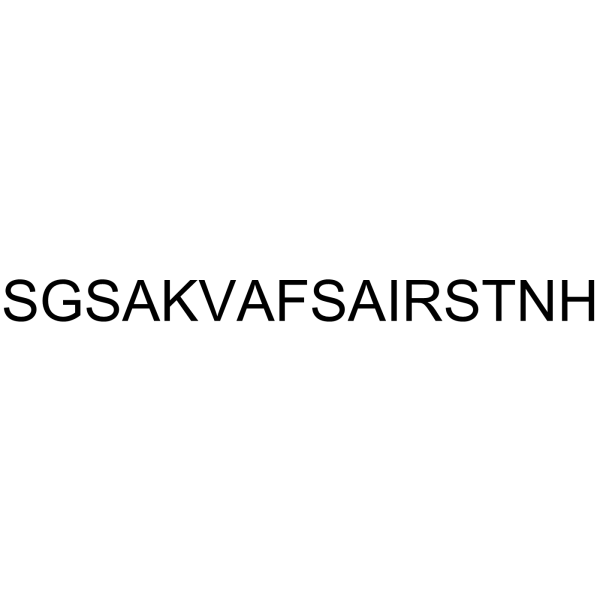
Ser-Gly-Ser-Ala-Lys-Val-Ala-Phe-Ser-Ala-Ile-Arg-Ser-Thr-Asn-His
-
Sequence Shortening
SGSAKVAFSAIRSTNH
-
Shipping
Room temperature in continental US; may vary elsewhere.
-
Storage
Please store the product under the recommended conditions in the Certificate of Analysis.


Solvent & Solubility
In Vitro
H2O
Peptide Solubility and Storage Guidelines:
1. Calculate the length of the peptide.
2. Calculate the overall charge of the entire peptide according to the following table:
| Contents | Assign value | |
|---|---|---|
| Acidic amino acid | Asp (D), Glu (E), and the C-terminal -COOH. | -1 |
| Basic amino acid | Arg (R), Lys (K), His (H), and the N-terminal -NH2 | +1 |
| Neutral amino acid | Gly (G), Ala (A), Leu (L), Ile (I), Val (V), Cys (C), Met (M), Thr (T), Ser (S), Phe (F), Tyr (Y), Trp (W), Pro (P), Asn (N), Gln (Q) | 0 |
3. Recommended solution:
| Overall charge of peptide | Details |
|---|---|
| Negative (<0) |
1. Try to dissolve the peptide in water first. 2. If water fails, add NH4OH (<50 μL). 3. If the peptide still does not dissolve, add DMSO (50-100 μL) to solubilize the peptide. |
| Positive (>0) |
1. Try to dissolve the peptide in water first. 2. If water fails, try dissolving the peptide in a 10%-30% acetic acid solution. 3. If the peptide still does not dissolve, try dissolving the peptide in a small amount of DMSO. |
| Zero (=0) |
1. Try to dissolve the peptide in organic solvent (acetonitrile, methanol, etc.) first. 2. For very hydrophobic peptides, try dissolving the peptide in a small amount of DMSO, and then dilute the solution with water to the desired concentration. |


Purity & Documentation
References
[1]. Albertin G, et al. Cerebellin stimulates the secretory activity of the rat adrenal gland: in vitro and in vivo studies. Neuropeptides. 2000;34(1):7-11. [Content Brief]
[2]. Strowski MZ, et al. Insulinostatic activity of cerebellin--evidence from in vivo and in vitro studies in rats. Regul Pept. 2009;157(1-3):19-24. [Content Brief]
[3]. Slemmon JR, et al. Cerebellin: a quantifiable marker for Purkinje cell maturation. Proc Natl Acad Sci U S A. 1985;82(20):7145-7148. [Content Brief]
[4]. Mugnaini E, et al. The neuropeptide cerebellin is a marker for two similar neuronal circuits in rat brain. Proc Natl Acad Sci U S A. 1987;84(23):8692-8696. [Content Brief]

Calculators
Concentration (start) × Volume (start) = Concentration (final) × Volume (final)


Cerebellin Related Classifications
HY-P1544 Related Classifications
 Powered by Bioz
Keywords
- Cerebellin
- 94071-26-8
- Endogenous Metabolite
- Adenylate Cyclase
- PKA
- Calcium Channel
- rat insulinoma cells
- rat adrenomedullary tissue
- precerebellin (Cbln1)
- cerebellar Purkinje cells
- corticosterone
- norepinephrine
- rat brain
- dorsal cochlear nucleus cartwheel cells
- adenylate cyclase/PKA-dependent signaling pathway
- aldosterone
- Inhibitor
- inhibitor
- inhibit