



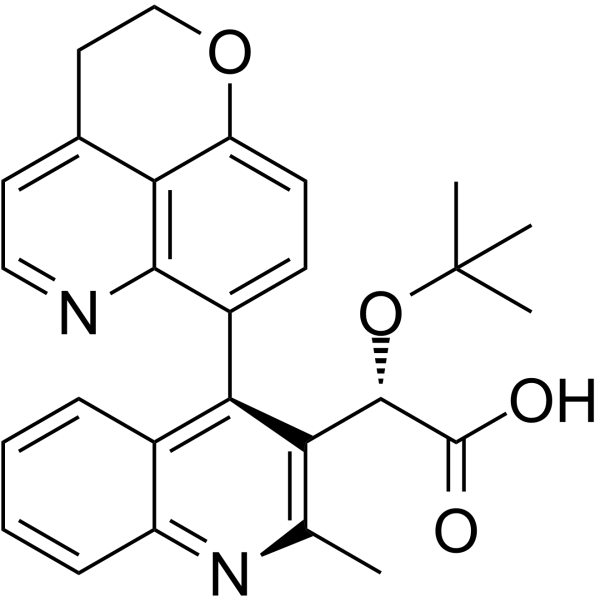
BI 224436
Based on 6 publication(s) in Google Scholar
BI 224436 is a novel HIV-1 noncatalytic site integrase inhibitor with EC50 values of less than 15 nM against different HIV-1 laboratory strains.
For research use only. We do not sell to patients.
The BI 224436 was designed by Boehringer Ingelheim and could be obtained free of charge through the Boehringer Ingelheim open innovation portal opnMe.com, associated with its negative control.
- Purity: 98.01%
- CAS No.: 1155419-89-8
- Formula: C27H26N2O4
- Molecular Weight:442.51
-
Storage:
-20°C, protect from light
* The compound is unstable in solutions, freshly prepared is recommended.


-
 Biological Activity
-
Chemical Information
-
Solvent & Solubility
- Protocol
- Purity & Documentation
- References
-
 Help & FAQs



Publications Citing Use of MedChemExpress (MCE) BI 224436
More

Biological Activity
EC50: 15 nM (HIV-1)[1]
|
Cell Line

|
Type | Value | Description | References |
|---|---|---|---|---|
| MT2 | CC50 |
>40 μM
Compound: 1; BI-224436
|
Cytotoxicity against human MT2 cells assessed as reduction in cell viability after 4 days by XTT assay
Cytotoxicity against human MT2 cells assessed as reduction in cell viability after 4 days by XTT assay
|
[PMID: 30609350] |
| MT2 | CC50 |
3339.15 μM
Compound: BI-224436
|
Cytotoxicity against human MT2 cells measured after 4 days by XTT assay
Cytotoxicity against human MT2 cells measured after 4 days by XTT assay
|
[PMID: 32081010] |
| MT4 | CC50 |
>50000 nM
Compound: BI-224436
|
Cytotoxicity against human MT4 cells assessed as reduction in cell viability measured after 4 days by MTT assay
Cytotoxicity against human MT4 cells assessed as reduction in cell viability measured after 4 days by MTT assay
|
[PMID: 32773094] |
| MT4 | CC50 |
>50000 nM
Compound: BI 224436
|
Cytotoxicity against human MT4 cells by MTT assay
Cytotoxicity against human MT4 cells by MTT assay
|
[PMID: 33316407] |
| MT4 | CC50 |
>50000 nM
Compound: BI-224436
|
Cytotoxicity against human MT4 cells assessed as reduction in cell viability by MTT assay
Cytotoxicity against human MT4 cells assessed as reduction in cell viability by MTT assay
|
[PMID: 35272008] |
BI 224436 has cellular cytotoxicity of more than 90 μM. BI 224436 has a low, 2.1-fold decrease in antiviral potency in the presence of 50% human serum. BI 224436 retains full antiviral activity against recombinant viruses encoding INSTI resistance substitutions N155S, Q148H, and E92Q. BI 224436 displays an additive effect in combination with most approved antiretrovirals, including INSTIs. BI 224436 has drug-like in vitro absorption, distribution, metabolism, and excretion (ADME) properties, including Caco-2 cell permeability, solubility, and low cytochrome P450 inhibition[1].
MedChemExpress (MCE) has not independently confirmed the accuracy of these methods. They are for reference only.
MedChemExpress (MCE) has not independently confirmed the accuracy of these methods. They are for reference only.
| NCT Number | Sponsor | Condition | Start Date |
Phase
|
|---|---|---|---|---|
| NCT01329991 | Plexxikon| | 2011-05 | PHASE1 |


Chemical Information
-
CAS No. 1155419-89-8
-
Appearance Solid
-
Molecular Weight 442.51
-
Formula C27H26N2O4
-
Color White to yellow
-
SMILES
CC1=C([C@@H](C(O)=O)OC(C)(C)C)[C@@]([C@@]2=CC=C3C4=C2N=CC=C4CCO3)=C5C(C=CC=C5)=N1
-
Shipping
Room temperature in continental US; may vary elsewhere.
-
Storage
-20°C, protect from light
* The compound is unstable in solutions, freshly prepared is recommended.


Publications (6)
-
Journal Impact Factor
-
Most Recent
-
Sci Adv
GRL-142 binds to and impairs HIV-1 integrase nuclear localization signal and potently suppresses highly INSTI-resistant HIV-1 variants. [Abstract]2023 Jul 14;9(28):eadg2955. PMID: 37436982 -
Elife
HIV-1 integrase tetramers are the antiviral target of pyridine-based allosteric integrase inhibitors. [Abstract]2019 May 23:8:e46344. PMID: 31120420 -
Retrovirology
2020 Aug 31;17(1):28. PMID: 32867805 -
J Biol Chem
Resistance to pyridine-based inhibitor KF116 reveals an unexpected role of integrase in HIV-1 Gag-Pol polyprotein proteolytic processing. [Abstract]2017 Dec 1;292(48):19814-19825. PMID: 28972144 -
J Virol
2020 Sep 15;94(19):e00486-20. PMID: 32611758 -
Ann Med Res
Evaluation of a flavonoid library for inhibition of interaction of HIV-1 integrase with human LEDGF/p75 towards a structure-activity relationship. [Abstract]2022 Dec;54(1):1590-1600. PMID: 35658757


Solvent & Solubility
DMSO : ≥ 50 mg/mL (112.99 mM; Hygroscopic DMSO has a significant impact on the solubility of product, please use newly opened DMSO)
* "≥" means soluble, but saturation unknown.
Please refer to the solubility information to select the appropriate solvent. The compound is unstable in solutions, freshly prepared is recommended.
Please refer to the solubility information to select the appropriate solvent. The compound is unstable in solutions, freshly prepared is recommended.
Concentration (start) × Volume (start) = Concentration (final) × Volume (final)
Select the appropriate dissolution method based on your experimental animal and administration route.
- For the following dissolution methods, please ensure to first prepare a clear stock solution using an In Vitro approach and then sequentially add co-solvents:
- To ensure reliable experimental results, the clarified stock solution can be appropriately stored based on storage conditions. As for the working solution for In Vivo experiments, it is recommended to prepare freshly and use it on the same day.
- The percentages shown for the solvents indicate their volumetric ratio in the final prepared solution. If precipitation or phase separation occurs during preparation, heat and/or sonication can be used to aid dissolution.
Add each solvent one by one: 10% DMSO 40% PEG300 5% Tween-80 45% Saline
Solubility: ≥ 2.5 mg/mL (5.65 mM); Clear solution
This protocol yields a clear solution of ≥ 2.5 mg/mL (saturation unknown).
Taking 1 mL working solution as an example, add 100 μL DMSO stock solution (25.0 mg/mL) to 400 μL PEG300, and mix evenly; then add 50 μL Tween-80 and mix evenly; then add 450 μL Saline to adjust the volume to 1 mL.
Preparation of Saline: Dissolve 0.9 g sodium chloride in ddH₂O and dilute to 100 mL to obtain a clear Saline solution.
Add each solvent one by one: 10% DMSO 90% (20% SBE-β-CD in Saline)
Solubility: ≥ 2.5 mg/mL (5.65 mM); Clear solution
This protocol yields a clear solution of ≥ 2.5 mg/mL (saturation unknown).
Taking 1 mL working solution as an example, add 100 μL DMSO stock solution (25.0 mg/mL) to 900 μL 20% SBE-β-CD in Saline, and mix evenly.
Preparation of 20% SBE-β-CD in Saline (4°C, storage for one week): 2 g SBE-β-CD powder is dissolved in 10 mL Saline, completely dissolve until clear.
Please enter the basic information of animal experiments:
-
-
-
-
Recommended: Prepare an additional quantity of animals to account for potential losses during experiments.
Please enter your animal formula composition:
-
%DMSO +
Recommended: Keep the proportion of DMSO in working solution below 2% if your animal is weak.
-
%+
-
+%Tween-80 + +
-
%Saline +
The co-solvents required include: DMSO, . All of co-solvents are available by MedChemExpress (MCE). , Tween 80. All of co-solvents are available by MedChemExpress (MCE).
Working solution concentration: 0.22 mg/mL
Method for preparing stock solution: mg drug dissolved in μL DMSO. Stock solution concentration: mg/mL. * The compound is unstable in solutions, freshly prepared is recommended.
1. Take μL DMSO stock solution;
2. Add μL .
μL , mix evenly;
3. Then add μL Tween 80, mix evenly;
4. Then add μL
Please ensure that the stock solution in the first step is dissolved to a clear state, and add co-solvents in sequence. You can use ultrasonic heating (ultrasonic cleaner, recommended frequency 20-40 kHz), vortexing, etc. to assist dissolution.

Protocol
BI 224436 is dissolved in acetonitrile-methanol (50:50, vol/vol) to achieve a concentration of 1.5 mM. Phosphate buffer (pH 7.4), cofactor, and test substance or isoform-selective inhibitors are added to 96-well plates and are prewarmed to 37°C for 10 min. Cofactor concentrations are 1.3 mM NADP, 3.3 mM glucose-6-phosphate, and 0.4 U/mL glucose-6-phosphate dehydrogenase. Reactions are initiated by the addition of prewarmed (37°C) enzyme and substrate. Reaction mixtures are incubated at 37°C and terminated by the addition of 0.038 ml of 40:40:20 (vol/vol) methanol–acetonitrile–0.5 M Tris buffer. Formation of the fluorescent metabolites is measured using a microplate spectrofluorometer at specific excitation and emission wavelengths. The IC50 is determined using the 96-well 32 procedure supplied with the SAS software[1].
MedChemExpress (MCE) has not independently confirmed the accuracy of these methods. They are for reference only.
Rats: For oral PK studies, BI 224436 is administered in a suspension of 0.5% (wt/vol) methyl cellulose (MC), 0.3% (vol/vol) Tween 80, and 1% (vol/vol) N-methyl-2-pyrrolidine (MP) in water. For i.v. dosing, BI 224436 is dissolved in 70% PEG 400–30% water (vol/vol). The appropriate amount of BI 224436 is dissolved in PEG 400 with sonication. The rats receive a single i.v. dose of 0.2 mg/kg of body weight (1 mL/kg) via the jugular vein as a bolus or received a single oral dose of 0.4 mg/kg (10 mL/kg) administered by gavage. Blood samples are obtained at 0, 0.25, 0.5, 1, 1.5, 2, 3, 4, 6, 8, 12, 24, and 32 h after dosing for analysis[1].
MedChemExpress (MCE) has not independently confirmed the accuracy of these methods. They are for reference only.


Purity & Documentation
-
Data Sheet (286 KB)
-
SDS (252 KB)
- English - EN (252 KB)
- Français - FR (252 KB)
- Deutsch - DE (252 KB)
- Norwegian - NO (252 KB)
- Español - ES (252 KB)
- Swedish - SV (252 KB)
- Italian - IT (252 KB)
- Korean - KR (252 KB)
- Portuguese - PT (252 KB)
-
Handling Instructions (2659 KB)
References


Complete Stock Solution Preparation Table
Please refer to the solubility information to select the appropriate solvent. The compound is unstable in solutions, freshly prepared is recommended.
| Optional Solvent | Concentration Solvent Mass | 1 mg | 5 mg | 10 mg | 25 mg |
|---|---|---|---|---|---|
| DMSO | 1 mM | 2.2598 mL | 11.2992 mL | 22.5984 mL | 56.4959 mL |
| 5 mM | 0.4520 mL | 2.2598 mL | 4.5197 mL | 11.2992 mL | |
| 10 mM | 0.2260 mL | 1.1299 mL | 2.2598 mL | 5.6496 mL | |
| 15 mM | 0.1507 mL | 0.7533 mL | 1.5066 mL | 3.7664 mL | |
| 20 mM | 0.1130 mL | 0.5650 mL | 1.1299 mL | 2.8248 mL | |
| 25 mM | 0.0904 mL | 0.4520 mL | 0.9039 mL | 2.2598 mL | |
| 30 mM | 0.0753 mL | 0.3766 mL | 0.7533 mL | 1.8832 mL | |
| 40 mM | 0.0565 mL | 0.2825 mL | 0.5650 mL | 1.4124 mL | |
| 50 mM | 0.0452 mL | 0.2260 mL | 0.4520 mL | 1.1299 mL | |
| 60 mM | 0.0377 mL | 0.1883 mL | 0.3766 mL | 0.9416 mL | |
| 80 mM | 0.0282 mL | 0.1412 mL | 0.2825 mL | 0.7062 mL | |
| 100 mM | 0.0226 mL | 0.1130 mL | 0.2260 mL | 0.5650 mL |


 Powered by Bioz