



Fibrinopeptide A, human
Fibrinopeptide A, human is a 16-residue short polypeptide cleaved from fibrinogen by thrombin. Fibrinopeptide A, human locates at the NH2-termini of the Aα chain.
연구목적의 판매만을 진행합니다. 환자를 대상으로 한 판매는 하지 않습니다.
- CAS No.: 25422-31-5
- 화학식: C63H97N19O26
- 분자량:1536.56
-
보관:
Please store the product under the recommended conditions in the Certificate of Analysis.

To place orders, for customer services and technical support, please contact: MedChemExpress USA
Tel: 609-228-6898 E-mail: [email protected] [email protected]


-
 Biological Activity
-
Chemical Information
-
용액&용해도
- 순도&문서
- References
-
 Help & FAQs




Biological Activity
The conversion of monomeric fibrinogen into polymeric fibrin is mediated by thrombin, which binds to the central region of fibrinogen and catalyzes cleavage of the 2 short peptides, the 16-residue fibrinopeptide A (FpA) and the 14-residue fibrinopeptide B (FpB), located at the NH2-termini of the Aα and Bβ chains, respectively[1].
MedChemExpress (MCE) has not independently confirmed the accuracy of these methods. They are for reference only.
MedChemExpress (MCE) has not independently confirmed the accuracy of these methods. They are for reference only.


Chemical Information
-
CAS No. 25422-31-5
-
분자량 1536.56
-
화학식 C63H97N19O26
-
Synonyms
Human fibrinopeptide A
-
Sequence
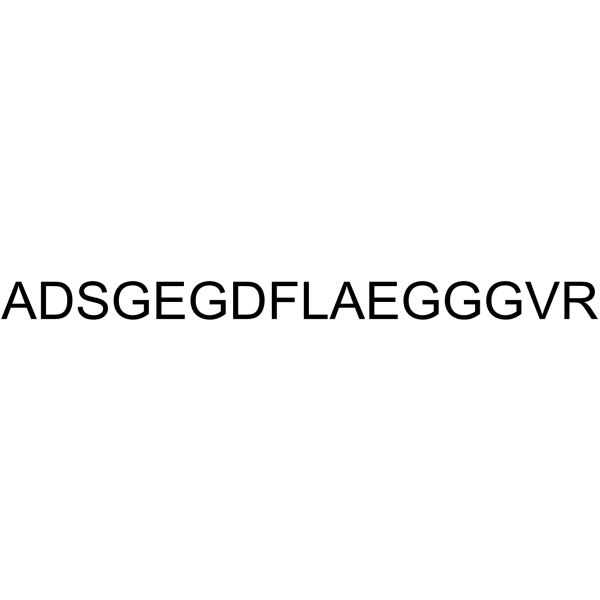
Ala-Asp-Ser-Gly-Glu-Gly-Asp-Phe-Leu-Ala-Glu-Gly-Gly-Gly-Val-Arg
-
Sequence Shortening
ADSGEGDFLAEGGGVR
-
선적
Room temperature in continental US; may vary elsewhere.
-
보관
Please store the product under the recommended conditions in the Certificate of Analysis.


용액&용해도
H2O
Peptide Solubility and Storage Guidelines:
1. Calculate the length of the peptide.
2. Calculate the overall charge of the entire peptide according to the following table:
| Contents | Assign value | |
| Acidic amino acid | Asp (D), Glu (E), and the C-terminal -COOH. | -1 |
| Basic amino acid | Arg (R), Lys (K), His (H), and the N-terminal -NH2 | +1 |
| Neutral amino acid | Gly (G), Ala (A), Leu (L), Ile (I), Val (V), Cys (C), Met (M), Thr (T), Ser (S), Phe (F), Tyr (Y), Trp (W), Pro (P), Asn (N), Gln (Q) | 0 |
3. Recommended solution:
| Overall charge of peptide | Details |
| Negative (<0) |
1. Try to dissolve the peptide in water first. 2. If water fails, add NH4OH (<50 μL). 3. If the peptide still does not dissolve, add DMSO (50-100 μL) to solubilize the peptide. |
| Positive (>0) |
1. Try to dissolve the peptide in water first. 2. If water fails, try dissolving the peptide in a 10%-30% acetic acid solution. 3. If the peptide still does not dissolve, try dissolving the peptide in a small amount of DMSO. |
| Zero (=0) |
1. Try to dissolve the peptide in organic solvent (acetonitrile, methanol, etc.) first. 2. For very hydrophobic peptides, try dissolving the peptide in a small amount of DMSO, and then dilute the solution with water to the desired concentration. |


순도&문서
References
[1]. Riedel T, et al. Fibrinopeptides A and B release in the process of surface fibrin formation. Blood. 2011 Feb 3;117(5):1700-6. [Content Brief]
[2]. Manolis AS, et al. Plasma level changes of fibrinopeptide A after uncomplicated coronary angioplasty. Clin Cardiol. 1993 Jul;16(7):548-52. [Content Brief]

Calculators
Concentration (start) × Volume (start) = Concentration (final) × Volume (final)


Fibrinopeptide A, human Related Classifications
HY-P1538 Related Classifications
 Powered by Bioz