



Licoisoflavanone

Based on 1 Customer Validation
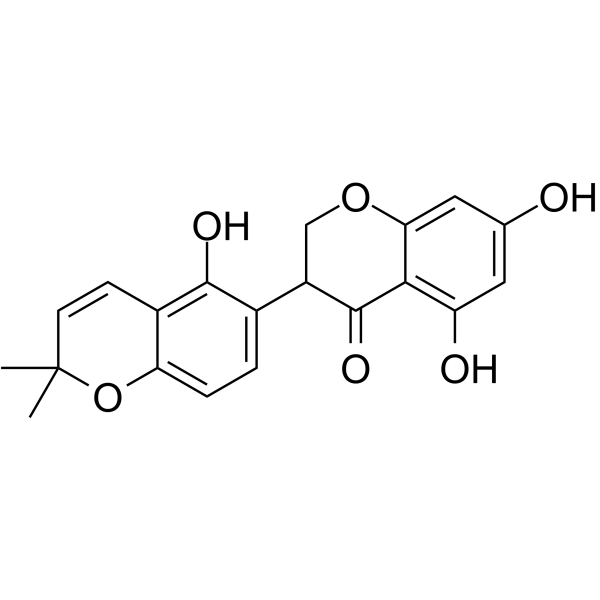
Licoisoflavanone is an orally active isoflavane-based immunomodulator with multiple activities including antiviral, anti-inflammatory, cytoprotective and cancer cell apoptosis-inducing effects. Licoisoflavanone can be isolated from the roots and rhizomes of Glycyrrhiza uralensis Fisch. Licoisoflavanone not only enhances the body's immunity, but also effectively prevents acute respiratory distress syndrome and multiple organ damage by alleviating cytokine storm, thereby reducing the degree of inflammation. In rats, Licoisoflavanone undergoes multiple metabolic transformation processes such as glucuronidation, hydroxylation, sulfation, methylation and dehydrogenation. Licoisoflavanone has become an important candidate molecule for research on COVID-19 and related inflammatory diseases.
연구목적의 판매만을 진행합니다. 환자를 대상으로 한 판매는 하지 않습니다.
- Purity: 96.74%
- CAS No.: 66067-26-3
- 화학식: C20H18O6
- 분자량:354.35
-
보관:
-20°C, sealed storage, away from moisture and light
* In solvent : -80°C, 6 months; -20°C, 1 month (sealed storage, away from moisture and light)

To place orders, for customer services and technical support, please contact: MedChemExpress USA
Tel: 609-228-6898 E-mail: [email protected] [email protected]


-
 Biological Activity
-
Chemical Information
- 순도&문서
- References
-
 Help & FAQs





Biological Activity
Licoisoflavanone (40 mg/kg; p.o.; single dose) shows no plasma detection but is present in high abundance in urine and feces, with glucuronidation and hydroxylation as its major in vivo metabolic reactions in male Sprague-Dawley rats[2].
MedChemExpress (MCE) has not independently confirmed the accuracy of these methods. They are for reference only.
-
Animal Model:Sprague-Dawley rats (male, 180-220 g)[2]
-
Dosage:40 mg/kg
-
Administration:p.o.; single dose
-
Result:Was not detected in plasma, but was detected in high abundance in urine and feces.
Identified ten metabolites, including dihydroxylated, hydroxylated glucuronide, monohydroxylated, glucuronide, sulfate, methylated, and dehydrogenated glucuronide conjugates.
Confirmed glucuronidation and hydroxylation as the major metabolic reactions via β-glucuronidase treatment, which eliminated glucuronide peaks.


Chemical Information
-
CAS No. 66067-26-3
-
Appearance Solid
-
분자량 354.35
-
화학식 C20H18O6
-
Color Light yellow to yellow
-
SMILES
O=C1C(C2=CC=C3C(C=CC(C)(C)O3)=C2O)COC4=CC(O)=CC(O)=C14
-
Structure Classification
-
Initial Source
-
선적
Room temperature in continental US; may vary elsewhere.
-
보관
-20°C, sealed storage, away from moisture and light
* In solvent : -80°C, 6 months; -20°C, 1 month (sealed storage, away from moisture and light)


순도&문서
-
Data Sheet (272 KB)
-
SDS (251 KB)
- English - EN (251 KB)
- Français - FR (251 KB)
- Deutsch - DE (251 KB)
- Norwegian - NO (251 KB)
- Español - ES (251 KB)
- Swedish - SV (251 KB)
- Italian - IT (251 KB)
- Korean - KR (251 KB)
- Portuguese - PT (251 KB)
-
Handling Instructions (2659 KB)
References
[1]. Li yanhua, et al. CN113262246A. 2021-04-19.
[2]. Wang Q, et al. Metabolites identification of bioactive licorice compounds in rats. J Pharm Biomed Anal. 2015;115:515-522. [Content Brief]
[3]. Li xin, et al. CN103989736A. 2014-06-16.
[4]. Fu Y, et al. Deep learning-based network pharmacology for exploring the mechanism of licorice for the treatment of COVID-19. Sci Rep. 2023;13(1):5844. Published 2023 Apr 10. [Content Brief]

Calculators
Concentration (start) × Volume (start) = Concentration (final) × Volume (final)


Licoisoflavanone Related Classifications
HY-N7372 Related Classifications
 Powered by Bioz