



HAUSP/USP7 Antibody (YA657)
(Synonyms: Deubiquitinating enzyme 7; HAUSP; herpes virus associated; Herpes virus associated ubiquitin specific protease; Herpesvirus-associated ubiquitin-specific protease; TEF 1; tef-1; TEF1; Ubiquitin carboxyl terminal hydrolase 7; Ubiquitin carboxyl-terminal hy)
Based on 1 Customer Validation
HAUSP/USP7 Antibody (YA657) is a Mouse-derived and non-conjugated IgG1 monoclonal antibody, targeting to HAUSP/USP7.
-
Host:
Mouse
-
Isotype:
IgG
-
Application:
WB
-
Reactivity :
Human
-
Formulation:
Supplied in 1*PBS (pH 7.3), 50% glycerol and 0.5% BSA. Preservative: 0.02% sodium azide.
-
Conjugation:
Non-conjugated


To place orders, for customer services and technical support, please contact: MedChemExpress USA
Tel: 609-228-6898 E-mail: [email protected] [email protected]





Applications
| Application |
WB

WB: Western Blot
|
|---|---|
| Dilution Ratio | 1:500-1:1000 |


Product Details
HAUSP/USP7 Antibody (YA657) is a Mouse-derived and non-conjugated IgG1 monoclonal antibody, targeting to HAUSP/USP7.
-
Host Mouse

-
Clonality Monoclonal

-
Species ReactivityHuman
-
Observed Molecular WeightObserved band size: 135 kDa
Note: Due to possible protein modifications or aggregation, the molecular weight should be confirmed by actual measurement, and the predicted value is for reference only.

-
Calculated Molecular Weight Predicted band size: 128 kDa

Synthetic peptide corresponding to Human HAUSP/USP7.The exact sequence is proprietary to MCE.
Endogenous
affinity purified
Non-conjugated
Unmodified
IgG


Product Properties
-
Appearance
Solution
-
Formulation
Supplied in 1*PBS (pH 7.3), 50% glycerol and 0.5% BSA. Preservative: 0.02% sodium azide.
-
Concentration
Batch-dependent, Please check the COA for the concentration of each lot. Check Lot Concentration
-
Storage & Stability
Stored at -20°C for 1 year. Avoid repeated freeze / thaw cycles.
-
Shipping
Shipping with blue ice.


Verification Images
-
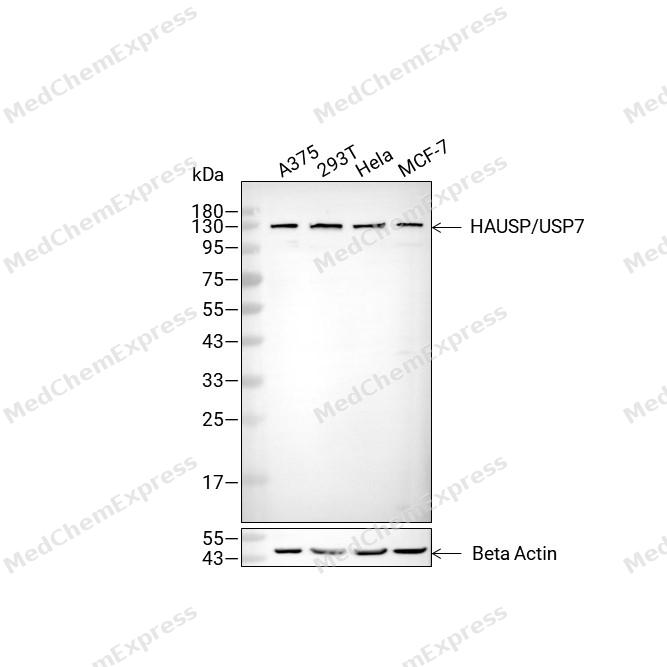 Western blot analysis of extracts from A375 (lane2(20μg), 293T (lane3(20μg), Hela (lane4(20μg) and MCF-7 (lane5(20μg) using HAUSP/USP7 Antibody (HY-P80926). Proteins were transferred to a PVDF membrane and blocked with 5% non-fat milk in TBST for 2 hour at room temperature. The primary antibody (1/1000) and Loading control antibody (Beta Actin, HY-P80993, 1/10,000) was used in 5% non-fat milk in TBST at 4°C overnight. Goat Anti-Mouse IgG-HRP Secondary Antibody (HY-P8004 ,1/10,000) was used for 1 hour at room temperature.


Background
-
Function
HAUSP/USP7 is a Hydrolase that deubiquitinates target proteins such as ARMC5, FOXO4, DEPTOR, KAT5, p53/TP53, MDM2, ERCC6, DNMT1, UHRF1, PTEN, KMT2E/MLL5 and DAXX. Together with DAXX, prevents MDM2 self-ubiquitination and enhances the E3 ligase activity of MDM2 towards p53/TP53, thereby promoting p53/TP53 ubiquitination and proteasomal degradation. Deubiquitinates p53/TP53, preventing degradation of p53/TP53, and enhances p53/TP53-dependent transcription regulation, cell growth repression and apoptosis. Deubiquitinates p53/TP53 and MDM2 and strongly stabilizes p53/TP53 even in the presence of excess MDM2, and also induces p53/TP53-dependent cell growth repression and apoptosis. Deubiquitination of FOXO4 in presence of hydrogen peroxide is not dependent on p53/TP53 and inhibits FOXO4-induced transcriptional activity. In association with DAXX, is involved in the deubiquitination and translocation of PTEN from the nucleus to the cytoplasm, both processes that are counteracted by PML. Deubiquitinates KMT2E/MLL5 preventing KMT2E/MLL5 proteasomal-mediated degradation. Involved in cell proliferation during early embryonic development. Involved in transcription-coupled nucleotide excision repair (TC-NER) in response to UV damage: recruited to DNA damage sites following interaction with KIAA1530/UVSSA and promotes deubiquitination of ERCC6, preventing UV-induced degradation of ERCC6. Involved in maintenance of DNA methylation via its interaction with UHRF1 and DNMT1: acts by mediating deubiquitination of UHRF1 and DNMT1, preventing their degradation and promoting DNA methylation by DNMT1. Deubiquitinates alkylation repair enzyme ALKBH3. OTUD4 recruits USP7 and USP9X to stabilize ALKBH3, thereby promoting the repair of alkylated DNA lesions. Acts as a chromatin regulator via its association with the Polycomb group (PcG) multiprotein PRC1-like complex; may act by deubiquitinating components of the PRC1-like complex. Able to mediate deubiquitination of histone H2B; it is however unsure whether this activity takes place in vivo. Exhibits a preference towards 'Lys-48'-linked ubiquitin chains. Increases regulatory T-cells (Treg) suppressive capacity by deubiquitinating and stabilizing the transcription factor FOXP3 which is crucial for Treg cell function. Plays a role in the maintenance of the circadian clock periodicity via deubiquitination and stabilization of the CRY1 and CRY2 proteins. Deubiquitinates REST, thereby stabilizing REST and promoting the maintenance of neural progenitor cells. Deubiquitinates SIRT7, inhibiting SIRT7 histone deacetylase activity and regulating gluconeogenesis. Involved in the regulation of WASH-dependent actin polymerization at the surface of endosomes and the regulation of endosomal protein recycling. It maintains optimal WASH complex activity and precise F-actin levels via deubiquitination of TRIM27 and WASHC1. Mediates the deubiquitination of phosphorylated DEPTOR, promoting its stability and leading to decreased mTORC1 signaling; (Microbial infection) Contributes to the overall stabilization and trans-activation capability of the herpesvirus 1 trans-acting transcriptional protein ICP0/VMW110 during HSV-1 infection; (Microbial infection) Upon infection with Epstein-Barr virus, the interaction with viral EBNA1 increases the association of USP7 with PML proteins, which is required for the polyubiquitylation and degradation of PML[1][2][3][4][5][6][7][8][9][10][11][12][13][14][15][16][17][18][19][20][21][22][23][24][25].
-
Subcellular Localization
Nucleus; Cytoplasm; Nucleus, PML body; Chromosome
-
Expression
Tissue_specificity:Expression (protein level) in neural progenitor cells (PubMed: 21258371) . Widely expressed. Overexpressed in prostate cancer.
Induction:Up-regulated in regulatory T-cells (Treg) . Down-regulated during neural progenitor cell differentiation (PubMed:21258371) -
Isoforms & Post-Translational Modification
Q93009 has 3 isomers: Q93009-1: 128302 Da (predicted); Q93009-2: Da (predicted); Q93009-3: 126269 Da (predicted).
Isoform 1: Phosphorylated. Isoform 1 is phosphorylated at positions Ser-18 and Ser-963. Isoform 2: Not phosphorylated;Isoform 1: Polyneddylated. Isoform 2: Not Polyneddylated;Isoform 1 and isoform 2: Not sumoylated;Isoform 1 and isoform 2: Polyubiquitinated by herpesvirus 1 trans-acting transcriptional protein ICP0/VMW110; leading to its subsequent proteasomal degradation. Isoform 1: Ubiquitinated at Lys-869 -
Subunit
Monomer. Homodimer. Part of a complex with DAXX, MDM2, RASSF1 and USP7 (PubMed:18566590). Part of a complex with DAXX, MDM2 and USP7 (PubMed:16845383).
-
SwissProt ID
-
Synonyms
Deubiquitinating enzyme 7; HAUSP; herpes virus associated; Herpes virus associated ubiquitin specific protease; Herpesvirus-associated ubiquitin-specific protease; TEF 1; tef-1; TEF1; Ubiquitin carboxyl terminal hydrolase 7; Ubiquitin carboxyl-terminal hy
-
Research Field
Cell Biology


Documentation
-
Data Sheet (264 KB)
-
SDS (252 KB)
- English - EN (252 KB)
- Français - FR (252 KB)
- Deutsch - DE (252 KB)
- Norwegian - NO (252 KB)
- Español - ES (252 KB)
- Swedish - SV (252 KB)
- Italian - IT (252 KB)
- Korean - KR (252 KB)
- Portuguese - PT (252 KB)
-
User Guide for Antibodies (1077 KB)
[1]. Li M, et al. Deubiquitination of p53 by HAUSP is an important pathway for p53 stabilization. Nature. 2002 Apr 11;416(6881):648-53. [Content Brief]
[2]. Li M, et al. A dynamic role of HAUSP in the p53-Mdm2 pathway. Mol Cell. 2004 Mar 26;13(6):879-86. [Content Brief]
[3]. van der Horst A, et al. FOXO4 transcriptional activity is regulated by monoubiquitination and USP7/HAUSP. Nat Cell Biol. 2006 Oct;8(10):1064-73. [Content Brief]
[4]. Song MS, et al. The deubiquitinylation and localization of PTEN are regulated by a HAUSP-PML network. Nature. 2008 Oct 9;455(7214):813-7. [Content Brief]
[5]. Zhang J, et al. ABRO1 suppresses tumourigenesis and regulates the DNA damage response by stabilizing p53. Nat Commun. 2014 Oct 6;5:5059. [Content Brief]
[6]. Cui H, et al. The stress-responsive gene ATF3 regulates the histone acetyltransferase Tip60. Nat Commun. 2015 Apr 13;6:6752. [Content Brief]
[7]. Ding X, et al. Mixed Lineage Leukemia 5 (MLL5) Protein Stability Is Cooperatively Regulated by O-GlcNac Transferase (OGT) and Ubiquitin Specific Protease 7 (USP7). PLoS One. 2015;10(12):e0145023. [Content Brief]
[8]. Jiang L, et al. Ubiquitin-specific peptidase 7 (USP7)-mediated deubiquitination of the histone deacetylase SIRT7 regulates gluconeogenesis. J Biol Chem. 2017 Aug 11;292(32):13296-13311. [Content Brief]
[9]. Yan G, et al. Deubiquitylation and stabilization of ARMC5 by ubiquitin-specific processing protease 7 (USP7) are critical for RCC proliferation. J Cell Mol Med. 2021 Mar;25(6):3149-3159. [Content Brief]
[10]. Vega M, et al. Turnover of the mTOR inhibitor, DEPTOR, and downstream AKT phosphorylation in multiple myeloma cells, is dependent on ERK1-mediated phosphorylation. J Biol Chem. 2022 Apr;298(4):101750. [Content Brief]
[11]. Tang J, et al. Critical role for Daxx in regulating Mdm2. Nat Cell Biol. 2006 Aug;8(8):855-62. [Content Brief]
[12]. Song MS, et al. The tumour suppressor RASSF1A promotes MDM2 self-ubiquitination by disrupting the MDM2-DAXX-HAUSP complex. EMBO J. 2008 Jul 9;27(13):1863-74. [Content Brief]
[13]. Tang J, et al. Daxx is reciprocally regulated by Mdm2 and Hausp. Biochem Biophys Res Commun. 2010 Mar 12;393(3):542-5. [Content Brief]
[14]. Chavoshi S, et al. Identification of Kaposi Sarcoma Herpesvirus (KSHV) vIRF1 Protein as a Novel Interaction Partner of Human Deubiquitinase USP7. J Biol Chem. 2016 Mar 18;291(12):6281-91. [Content Brief]
[15]. Schwertman P, et al. UV-sensitive syndrome protein UVSSA recruits USP7 to regulate transcription-coupled repair. Nat Genet. 2012 May;44(5):598-602. [Content Brief]
[16]. Zhang X, et al. Mutations in UVSSA cause UV-sensitive syndrome and destabilize ERCC6 in transcription-coupled DNA repair. Nat Genet. 2012 May;44(5):593-7. [Content Brief]
[17]. Felle M, et al. The USP7/Dnmt1 complex stimulates the DNA methylation activity of Dnmt1 and regulates the stability of UHRF1. Nucleic Acids Res. 2011 Oct;39(19):8355-65. [Content Brief]
[18]. Ma H, et al. M phase phosphorylation of the epigenetic regulator UHRF1 regulates its physical association with the deubiquitylase USP7 and stability. Proc Natl Acad Sci U S A. 2012 Mar 27;109(13):4828-33. [Content Brief]
[19]. Zhao Y, et al. Noncanonical regulation of alkylation damage resistance by the OTUD4 deubiquitinase. EMBO J. 2015 Jun 12;34(12):1687-703. [Content Brief]
[20]. Maertens GN, et al. Ubiquitin-specific proteases 7 and 11 modulate Polycomb regulation of the INK4a tumour suppressor. EMBO J. 2010 Aug 4;29(15):2553-65. [Content Brief]
[21]. Iphöfer A, et al. Profiling ubiquitin linkage specificities of deubiquitinating enzymes with branched ubiquitin isopeptide probes. Chembiochem. 2012 Jul 9;13(10):1416-20. [Content Brief]
[22]. van Loosdregt J, et al. Stabilization of the transcription factor Foxp3 by the deubiquitinase USP7 increases Treg-cell-suppressive capacity. Immunity. 2013 Aug 22;39(2):259-71. [Content Brief]
[23]. Hirano A, et al. USP7 and TDP-43: Pleiotropic Regulation of Cryptochrome Protein Stability Paces the Oscillation of the Mammalian Circadian Clock. PLoS One. 2016;11(4):e0154263. [Content Brief]
[24]. Huang Z, et al. Deubiquitylase HAUSP stabilizes REST and promotes maintenance of neural progenitor cells. Nat Cell Biol. 2011 Feb;13(2):142-52. [Content Brief]
[25]. Hao YH, et al. USP7 Acts as a Molecular Rheostat to Promote WASH-Dependent Endosomal Protein Recycling and Is Mutated in a Human Neurodevelopmental Disorder. Mol Cell. 2015 Sep 17;59(6):956-69. [Content Brief]

 Powered by Bioz
