4 Results for "

ATF4-CHOP axis

" in MedChemExpress (MCE) Product Catalog:
Products (4)

4 Results for "ATF4-CHOP axis" in MCE Product Catalog:

Cat. No.: HY-13559
CAS No.: 123018-47-3
Synonyms: Azaspirane ; SKF 106615-12; SKF 106615A12
Atiprimod (Azaspirane) is a STAT3 inhibitor with antitumor, anti-inflammatory, and anti-angiogenic activities. Atiprimod blocks the signaling pathways of IL-6 and VEGF by inhibiting the phosphorylation of signal transducer and activator of STAT3. Atiprimod blocks the JAK-STAT signaling pathway by inhibiting the phosphorylation of JAK2 and JAK3. Atiprimod also inhibits cell proliferation, induces cell cycle arrest, and induces autophagy and apoptosis. Atiprimod triggers persistent ER stress-mediated apoptosis in breast cancer cells by activating the PERK/eIF2α/ATF4/CHOP axis and inhibiting the nuclear translocation of STAT3/NF-κB. Atiprimod shows great anti-tumor activities in tumor xenograft mouse models. Atiprimod can be used for the study of pituitary adenoma, breast cancer, multiple myeloma and acute myeloid leukemia (AML) .
loading...
    loading...
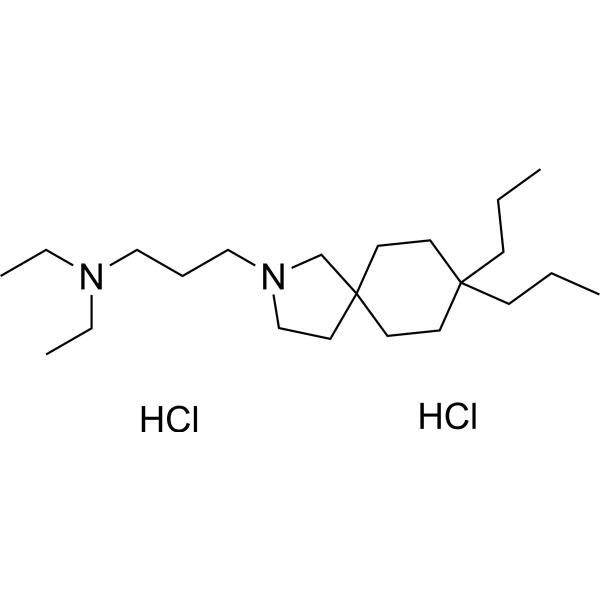
Cat. No.: HY-110102
CAS No.: 130065-61-1
Synonyms: Azaspirane hydrochloride; SKF 106615-12 hydrochloride; SKF 106615
Atiprimod (Azaspirane) hydrochloride is a STAT3 inhibitor with antitumor, anti-inflammatory, and anti-angiogenic activities. Atiprimod blocks the signaling pathways of IL-6 and VEGF by inhibiting the phosphorylation of signal transducer and activator of STAT3. Atiprimod blocks the JAK-STAT signaling pathway by inhibiting the phosphorylation of JAK2 and JAK3. Atiprimod also inhibits cell proliferation, induces cell cycle arrest, and induces autophagy and apoptosis. Atiprimod triggers persistent ER stress-mediated apoptosis in breast cancer cells by activating the PERK/eIF2α/ATF4/CHOP axis and inhibiting the nuclear translocation of STAT3/NF-κB. Atiprimod shows great anti-tumor activities in tumor xenograft mouse models. Atiprimod can be used for the study of pituitary adenoma, breast cancer, multiple myeloma and acute myeloid leukemia (AML) .
loading...
    loading...
Cat. No.: HY-13559A
CAS No.: 183063-72-1
Synonyms: Azaspirane dimaleate; SKF 106615-12 dimaleate; SKF 106615A12 dimaleate
Atiprimod (Azaspirane) (dimaleate) is a STAT3 inhibitor with antitumor, anti-inflammatory, and anti-angiogenic activities. Atiprimod blocks the signaling pathways of IL-6 and VEGF by inhibiting the phosphorylation of signal transducer and activator of STAT3. Atiprimod blocks the JAK-STAT signaling pathway by inhibiting the phosphorylation of JAK2 and JAK3. Atiprimod also inhibits cell proliferation, induces cell cycle arrest, and induces autophagy and apoptosis. Atiprimod triggers persistent ER stress-mediated apoptosis in breast cancer cells by activating the PERK/eIF2α/ATF4/CHOP axis and inhibiting the nuclear translocation of STAT3/NF-κB. Atiprimod shows great anti-tumor activities in tumor xenograft mouse models. Atiprimod can be used for the study of pituitary adenoma, breast cancer, multiple myeloma and acute myeloid leukemia (AML) .
loading...
    loading...
Cat. No.: HY-187096
Research Areas:  

Cancer

ERα/RAD51 degrader 1 is a ERα and RAD51 HyT degrader as well as an apoptosis (Apoptosis) inducer. ERα/RAD51 degrader 1 induces conformational changes in helices 11-12 of ERα, promotes the recruitment of Hsp70, and drives the degradation of ERα and RAD51 via the ubiquitin-proteasome pathway. ERα/RAD51 degrader 1 downregulates the expression of BRCA1/2. ERα/RAD51 degrader 1 acts on tamoxifen (HY-13757A)-sensitive and tamoxifen-resistant breast cancer in both in vitro and in vivo models. ERα/RAD51 degrader 1 is applicable to breast cancer-related research (hydrophobic tag: (HY-B0402)) .
loading...
    loading...

