15 Results for "

CDK2/4

" in MedChemExpress (MCE) Product Catalog:
Products (15)

15 Results for "CDK2/4" in MCE Product Catalog:

  • Targets Recommended:
Art. -Nr.: HY-148214
CAS. Nr.: 2531748-80-6
Reinheit:  98.20%
Target:  

CDK

Forschungsgebiete:  

Cancer

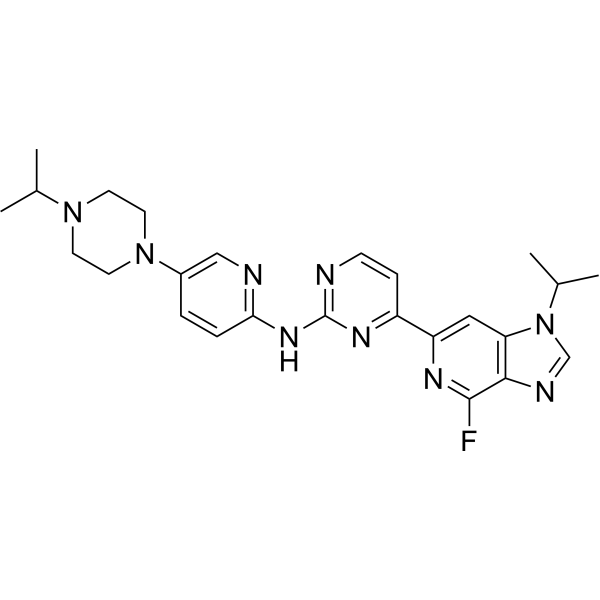
CDK2/4/6-IN-2 is a selective CDK2/4/6 inhibitor with IC50 values <1 μM. CDK2/4/6-IN-2 inhibits cells proliferation and phosphorylation of retinoblastoma protein at Ser807/811 in breast cancer cells. CDK2/4/6-IN-2 can be used for the research of cancer, such as breast cancer .
Art. -Nr.: HY-148213
CAS. Nr.: 2803837-13-8
Target:  

CDK

Forschungsgebiete:  

Cancer

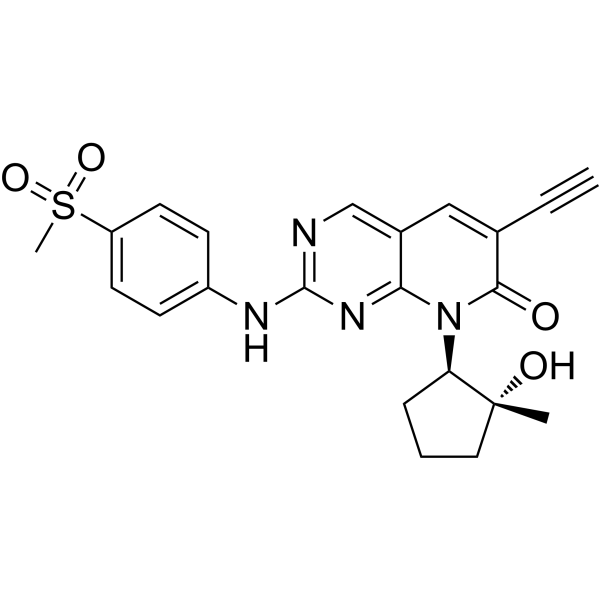
CDK2/4/6-IN-1(example 29) is a CDK2/4/6 inhibitor with IC50 values of 2.5, 23.7 and 44.3 nM for CDK2, CDK4 and CDK6, respectively. CDK2/4/6-IN-1 can be used in cancer research . CDK2/4/6-IN-1 is a click chemistry reagent, it contains an Alkyne group and can undergo copper-catalyzed azide-alkyne cycloaddition (CuAAc) with molecules containing Azide groups.
Art. -Nr.: HY-N8146
CAS. Nr.: 53729-52-5
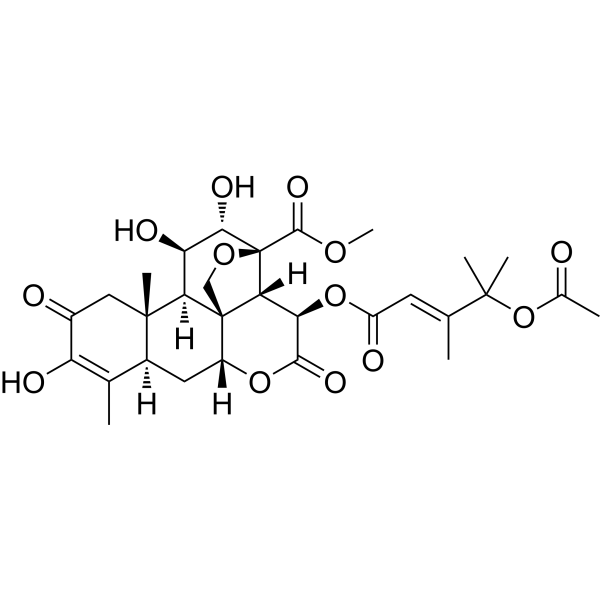
Bruceantinol is a quassinoid that can be isolated from Brucea javanica, inhibits pepper mottle virus (PepMoV) in pepper. Bruceantinol is a STAT3 inhibitor demonstrating potent antitumor activity in in vitro and in vivo human colorectal cancer (CRC) models. Bruceantinol has potent anti-leukemic activity. Bruceantinol strongly inhibits STAT3 DNA-binding ability (IC50 = 2.4 pM), blocks the constitutive and IL-6-induced STAT3 activation, and suppresses transcription of MCL-1, PTTG1, survivin and c-Myc. Bruceantinol binds with CDK2/4/6 to facilitate protein degradation through proteasome pathway. Bruceantinol can dose- and time-dependently reduces the cell growth, impede cell proliferation, disrupts the cell cycle, and induces necrosis in MCF-7 cells and apoptosis in MDA-MB-231 cells [2] .
Art. -Nr.: HY-169048
CAS. Nr.: 3034898-59-1
Target:  

CDK

Forschungsgebiete:  

Cancer

CDK2/4-IN-2 (compound 56) is a CDK2 and CDK4 dual inhibitor with IC50s less than 100 nM. CDK2/4-IN-2 can be used in the study of cancer .
Art. -Nr.: HY-159155
Target:  

CDK Microtubule/Tubulin

Forschungsgebiete:  

Cancer

CDK2/4-IN-1 (compound B-4a) is a CDK2/4 inhibitor and a tubulin polymerization inhibitor. CDK2/4-IN-1 can be used in cancer research .
Art. -Nr.: HY-W1047040
CAS. Nr.: 1211585-07-7
Forschungsgebiete:  

Cancer

CDK2/4 ligand 1 is a ligand for target protein for PROTACs, which targets CDK2/4. CDK2/4 ligand 1 can be used for synthesis of PROTAC CDK2/4 Degrader-1 (HY-179688) .
Art. -Nr.: HY-179688
Target:  

PROTACs CDK

Forschungsgebiete:  

Cancer

PROTAC CDK2/4 Degrader-1 (Compound 5) is a CDK2/4 PROTAC degrader, with its DC50 values for CDK2 and CDK4 both ≤ 10 nM. PROTAC CDK2/4 Degrader-1 exhibits excellent inhibitory activity against cell proliferation in OVCAR3 and T47D cells. PROTAC CDK2/4 Degrader-1 can be used for research on breast cancer and ovarian cancer .
Art. -Nr.: HY-185121
CAS. Nr.: 2541626-49-5
Target:  

PROTACs CDK Caspase

Forschungsgebiete:  

Cancer

PROTAC CDK2/4/6 Degrader-2 is a CDK2/4/6 PROTAC degrader. PROTAC CDK2/4/6 Degrader-2. PROTAC CDK2/4/6 Degrader-2 can be converted into the prodrug PROTAC CDK2/4/6 Degrader-1 (HY-171826) through a one-step reaction with chloromethyl pivalate. PROTAC CDK2/4/6 Degrader-2 degrades CDK2/4/6 and their complex in malignant melanomas cells. PROTAC CDK2/4/6 Degrader-2 induces cell cycle arrest and cell apoptosis in various cancer cells, in particular for melanomas. PROTAC CDK2/4/6 Degrader-2 can be used for malignant melanomas research .
Art. -Nr.: HY-181501
Forschungsgebiete:  

Cancer

CDK2/4/6-IN-3 (compound 32a) is a CDK2/4/6 inhibitor. CDK2/4/6-IN-3 can be used as a target protein ligand for the synthesis of PROTAC WWZ-11-098 (HY-181490) .
Art. -Nr.: HY-171826
CAS. Nr.: 2541626-55-3
Target:  

CDK PROTACs

Forschungsgebiete:  

Cancer

PROTAC CDK2/4/6 Degrader-1 is an orally active CDK2/CDK4/CDK6 PROTAC degrader. PROTAC CDK2/4/6 Degrader-1 is a prodrug derived from PROTAC CDK2/4/6 Degrader-2 via one-step reaction with chloromethyl pivalate. PROTAC CDK2/4/6 Degrader-1 can be used for malignant melanoma research .
Art. -Nr.: HY-132914
CAS. Nr.: 2762181-73-5
Target:  

CDK

Forschungsgebiete:  

Cancer

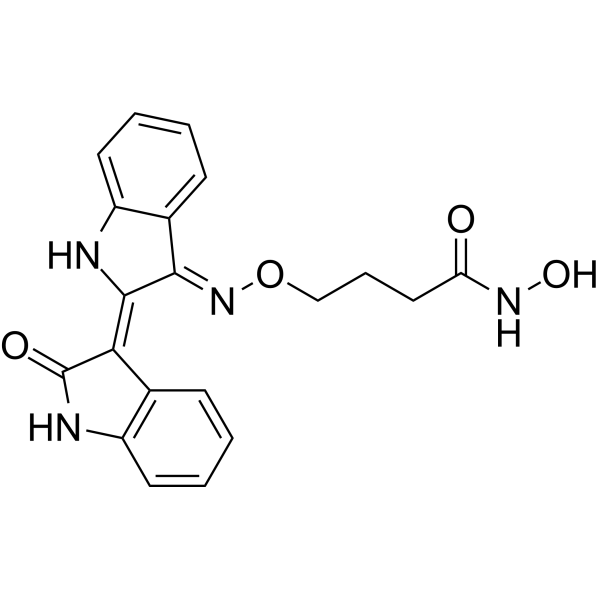
CDK/HDAC-IN-1 shows remarkable CDK2/4/6 and HDAC6 inhibitory activity of IC50 = 60.9 ± 2.9, 276 ± 22.3, 27.2 ± 4.2, and 128.6 ± 0.4 nM, respectively.
Art. -Nr.: HY-172128
Target:  

AMPK CDK

Forschungsgebiete:  

Neurological Disease Cancer

NUAK1-IN-2 (Compound 24) is a NUAK1 (IC50 of 3.162 nM) and CDK2/4/6 inhibitor. NUAK1-IN-2 can be used in cancer, neurodevelopmental disorders and Alzheimer's disease research .
Art. -Nr.: HY-W883326
CAS. Nr.: 2913408-82-7
Target:  

Ligands for E3 Ligase

Forschungsgebiete:  

Others

CRBN ligand-902 is a CRBN E3 ligase ligand that can be used for synthesis of PROTAC CDK2/4 Degrader-1 (HY-179688) .
Art. -Nr.: HY-181906
Forschungsgebiete:  

Cancer

ZnPc-PEG2-VH032 is a VHL-pathway-dependent photodegradation targeting chimera (PDTAC) and cytotoxic agent. ZnPc-PEG2-VH032 (HY-120217) binds to the VHL ligand domain, and then specifically degrades VHL under light irradiation, a process independent of non-specific ROS-mediated protein damage. ZnPc-PEG2-VH032 uses Zinc phthalocyanine (HY-19204) as a photosensitizer, and generates ROS via type I and type II photodynamic pathways under 680 nm LED irradiation. On one hand, it targets and degrades the bound VHL protein through ROS; on the other hand, it exerts direct photodynamic cytotoxicity. Meanwhile, the degradation of VHL downregulates the phosphorylation level of CDK2/4, induces cell cycle arrest in tumor cells, further enhances the sensitivity of tumor cells to oxidative damage caused by ROS, and achieves a synergistic anti-tumor effect. ZnPc-PEG2-VH032 exerts significant in vivo efficacy in an orthotopic mouse model of non-muscle invasive bladder cancer (NMIBC) .
Art. -Nr.: HY-181134
CAS. Nr.: 2715104-46-2
Target:  

PROTACs

Forschungsgebiete:  

Cancer

PROTAC HMGCR Degrader-2 is a HMGCR PROTAC degrader with an IC50 value of 0.25 μM. PROTAC degrades HMGCR-2 in Insig-silenced HepG2 cells with a DC50 of 0.12 μM. PROTAC HMGCR Degrader-2 takes PROTAC HMGCR Degrader-1 (HY-171823) as the oral prodrug. PROTAC HMGCR Degrader-2 degrades HMGCR by the VHL-dependent ubiquitin-proteasome system and reduces cellular cholesterol in HepG2 cells. PROTAC CDK2/4/6 Degrader-2 can be used for hyperlipidemia research .
  • 1

